
"A filmmaker must be like a missionary. He should concentrate on what he believes in and hunt for the truth. "
Filmography (*=screenwriter)
Features
Small Town / Kasaba (1998)
Clouds of May / Mayıs Sıkıntısı (2000)
Distant / Uzak (2002)
Climates / İklimler (2006)
Three Monkeys / Üç Maymun (2008)
Once Upon a Time in Anatolia / Bir Zamanlar Anadolu'da (2011)
Winter Sleep / Kış Uykusu (2014)
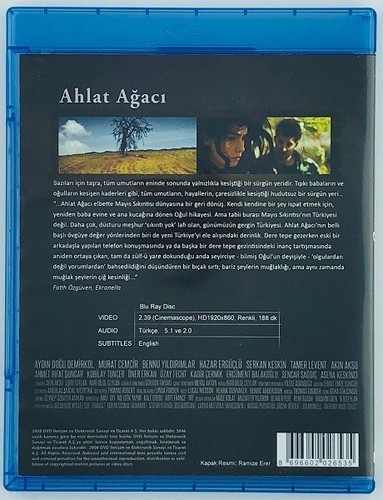
The Wild Pear Tree / Ahlat Ağacı (2018)
Shorts
"Cocoon" / "Koza" (1995)
Books
Nuri Bilge Ceylan: Essays and Interviews by Robert Cardullo, ed. (2015)
Six Turkish Filmmakers by Laurence Raw (2017)
The Cinema of Nuri Bilge Ceylan: The Global Vision of a Turkish Filmmaker by Bulent Diken, Graeme Gilloch, and Craig Hammond (2018)
Web Resources
2009 interview with Emanuel Levy
2009 interview with Geoff Andrew, The Guardian
"An Investigation in Anatolia" by Maria Garcia, Film Journal International (2011)
2011 video interview with Scott Foundas at the New York Film Festival
"A Director Holds Up a Mirror to Turkey" by Rachel Donadio, The New York Times (2014)
2014 interview with David Barker, Filmmaker Magazine
2014 interview with Eric Kohn, Indiewire
2018 review of The Wild Pear Tree by Bilge Ebiri, The Village Voice
"On Making The Wild Pear Tree" by Nuri Bilge Ceylan, Film Comment (2018)
Forum Resources
Iklimler / Climates (Nuri Bilge Ceylan, 2006)
Three Monkeys (Nuri Bilge Ceylan, 2008)
Once Upon a Time in Anatolia (Nuri Bilge Ceylan, 2011)
Winter Sleep (Nuri Bilge Ceylan, 2014)
The Wild Pear Tree (Nuri Bilge Ceylan, 2018)