
I was at this same exact screening (the dogs outside sounded like ravenous wolves) and this was my first time seeing the film as well. Dad1153 covered a lot of ground, so I'll just add a few scattered insights.
I saw this with two native Italian speakers. Both told me the translation on the print was exceedingly simple, losing much of the eloquence of the speech. My friend also explained how throughout the first section on the island, the characters used the "formal" way of speaking to each other to an extent that one would not realize they knew each other all that well. This is then much more jarring once we realize how intimate the characters actually are. At that point the speech changes to the "informal" style. I'm not sure this is something that could come through easily even with a strong English translation and it truly enhances the mysterious aura of the film, somehow making Antonioni's specific and overwhelming control seem that much more impressive.
This film is said to be the real genesis of Antonioni's style, and I think that rings true not just narratively, but also technically. It hit me with the shot of the two lovers driving off in their car as the camera pushes in ever so slowly, methodically revealing the church in the distance with eerie tension. I saw this and thought "He just figured out what he loves! Its that shot right there!" I could be totally off base, but it seemed right to me.
Finally, am I the only one who felt the final shot is terrifying? The sadness of the moment mixed with the frightening score building up seemed to say Claudia accepting the faults of Sandro, therefore accepting the imperfections of the human male, is her accepting the scariest truth of all.
By the way, was that you Dad who let out a sarcastic groan at the loud snoring man? It certainly made me laugh.
98 L'avventura
-
dad1153

- Joined: Thu Apr 16, 2009 2:32 pm
- Location: New York, NY
Re: 98 L'avventura
No, that was a dude in the front row (three rows ahead) that had enough; I was sitting right next to the snorer on the third row. I would have probably complained but I was munching on a McDonalds burger & fries. The stench of this fast food was enough to make me forgive the snorer next to me the same way Claudia forgave Sandro in the end (and just like the other attendees around me forgave me for bringing smelly food into the theater). :)
-
Drucker

- Your Future our Drucker
- Joined: Wed May 18, 2011 1:37 pm
Re: 98 L'avventura
I finally watched this film a few weeks ago and wanted to add some thoughts about it. This is the third Antonioni film I've seen, as I watched The Blow-Up a few years ago as I was getting into films and watched the Passenger last year on my laptop. While there were parts of both of these movies I enjoyed (more of the latter than the former), I was ultimately left a bit confused about what to make of a lot of the films. As I learned a little more about the director, I came to realize this wasn't exactly unheard of when getting into his work. L'avventura seemed to be his most well-reputed film, so I wanted to take my time watching it, watch it on a good set-up and certainly while in the right mood.
I was absolutely blown away by the film. The scenery, the dialogue...and especially the pacing I found to be absolutely remarkable. And for such a seemingly bizarre tale, the movie really unfolds very naturally, especially when compared to my memory of The Passenger and Blow-Up (I don't remember really it making a lot of sense as to why Nicholson, for example, felt compelled to steal the guy's identity).
The part of the movie spent searching for Anna took what felt like a surprisingly long amount of time, or at least more than I expected it to, but it seemed to make sense.
Another thing I love, and it's alluded to on the early part of the commentary (the part I listened to), is how the characters seem to be one with the scenery. They are not outside of it or occupying it, but seemingly one with it. The parts of the film as they are searching for Anna, and the camera hangs above the actors as they seem to be at a loss for where she could be, reminded me a lot of High and Low, and the way Kurosawa's characters sort of stood stationary and thus acting more as scenery than actors.
Perhaps because I'm more familiar and comfortable with film, and had more of an idea what to "expect" from Antonioni, I certainly never felt like I was waiting for an ending and for everything to be solved. If there's one word I would use to describe how I felt watching this film, it would be engrossing. I felt totally absorbed with the film, as if I was experiencing it with the characters, and I was right along with them.
Hopefully it will get the blu ray treatment, but I must say, I didn't think the film looked that bad for a relatively older criterion, and there really weren't that many instances of lines down the screen and not that much damage in the print. (perhaps L'Eclisse is worse?) A really wonderful film that continues to occupy my thoughts!
I was absolutely blown away by the film. The scenery, the dialogue...and especially the pacing I found to be absolutely remarkable. And for such a seemingly bizarre tale, the movie really unfolds very naturally, especially when compared to my memory of The Passenger and Blow-Up (I don't remember really it making a lot of sense as to why Nicholson, for example, felt compelled to steal the guy's identity).
The part of the movie spent searching for Anna took what felt like a surprisingly long amount of time, or at least more than I expected it to, but it seemed to make sense.
Another thing I love, and it's alluded to on the early part of the commentary (the part I listened to), is how the characters seem to be one with the scenery. They are not outside of it or occupying it, but seemingly one with it. The parts of the film as they are searching for Anna, and the camera hangs above the actors as they seem to be at a loss for where she could be, reminded me a lot of High and Low, and the way Kurosawa's characters sort of stood stationary and thus acting more as scenery than actors.
Perhaps because I'm more familiar and comfortable with film, and had more of an idea what to "expect" from Antonioni, I certainly never felt like I was waiting for an ending and for everything to be solved. If there's one word I would use to describe how I felt watching this film, it would be engrossing. I felt totally absorbed with the film, as if I was experiencing it with the characters, and I was right along with them.
Hopefully it will get the blu ray treatment, but I must say, I didn't think the film looked that bad for a relatively older criterion, and there really weren't that many instances of lines down the screen and not that much damage in the print. (perhaps L'Eclisse is worse?) A really wonderful film that continues to occupy my thoughts!
-
Foam

- Joined: Sat Apr 04, 2009 4:47 am
Re: 98 L'avventura
Does anyone know what it is that Anna says around 5:45 between "But it's easy too" and "Understand?" Doesn't seem to be translated.
-
puxzkkx

- Joined: Fri Jul 17, 2009 4:33 am
Re: 98 L'avventura
I watched this again the other day. I have the Umbrella DVD and it doesn't translate it either - would like to know the answer to this question, too.Foam wrote:Does anyone know what it is that Anna says around 5:45 between "But it's easy too" and "Understand?" Doesn't seem to be translated.
I think this is one of the tense-est endings ever, but for a different reason.Grand Wazoo wrote:Finally, am I the only one who felt the final shot is terrifying? The sadness of the moment mixed with the frightening score building up seemed to say Claudia accepting the faults of Sandro, therefore accepting the imperfections of the human male, is her accepting the scariest truth of all.
If we take the view that Anna's disappearance represents a transcendence of the ruined emotional landscape that Antonioni depicts - she was becoming disillusioned with her vaguely-defined relationship with the chauvinist Sandro and was beginning to form an identity outside of the group of 'friends'. She performs perhaps the only truly kind gesture of the film - giving Claudia her shirt without telling her - and the books she leaves behind show that she has respect for pure emotional expression (Tender Is the Night) and the religion that Antonioni appears to believe bound the community experience together (the Bible). She wants more than is being offered and, although I don't believe it is the point of the film that we know exactly where she went to, by disappearing she is attaining personhood. However, the fact that, in doing so, she vanishes, shows that the strength of will to define an identity is not accepted as a realistic part of this 'new world'.
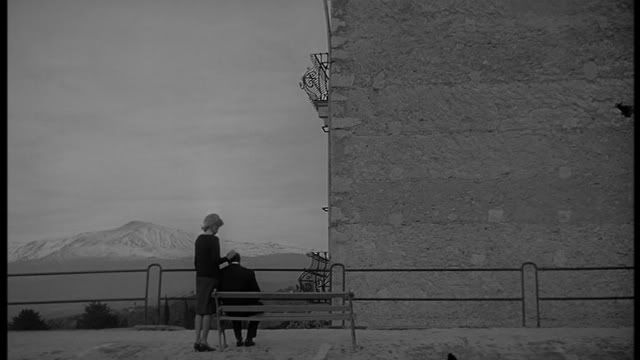
Claudia's trajectory as a character in the film stands in contrast to Anna's: she starts off quite autonomous, the only character with a lower-middle-class background (which counts for something in Antonioni's character gallery), she appears to be the only one truly moved by Anna's disappearance, but becomes more and more a puppet of Sandro's self-pitying emotional need as the film wears on. By the end I think that by placing her hand on his head and accepting his betrayal of her, she is sacrificing her self to a feeble idea of intimacy that carries no weight whatsoever in the film's empty postwar emotional and societal milieu. You can see the dilemma in the movement of her hand and in her eyes - should she cave to Sandro's (crocodile, IMO) tears and console him, submitting to his emotional abuse, infantilisation and objectification of her, or should she show a strength of will that only Anna showed and, like her, 'disappear' from his life? That she chooses the former shows a rather bleak outlook for human relations. People have interpreted the active volcano as a symbol of dormant life or passion - I think it is foreboding of further emotional disaster. And the impassive wall speaks for itself. To be honest, it kind of annoys me when people see this ending as optimistic, because I see the construction of the final sequence, the ominous music that reaches that piercing height, and that hesitant twitch of Vitti's hand, as all functioning to fill out a darker interpretation.
One of the best final shots in all cinema, imo - this is also my favourite film.
Last edited by puxzkkx on Sun Mar 18, 2012 3:35 am, edited 1 time in total.

-
colinr0380

- Joined: Mon Nov 08, 2004 8:30 pm
- Location: Chapel-en-le-Frith, Derbyshire, UK
Re: 98 L'avventura
Wonderful photograph! It is so strange to see it in colour! (And someone has moved the drainpipe!)
For comparison purposes:
For comparison purposes:
-
dad1153
- Joined: Thu Apr 16, 2009 2:32 pm
- Location: New York, NY
Re: 98 L'avventura
B&W for the win!
-
ellipsis7
- Joined: Tue Nov 02, 2004 5:56 pm
- Location: Dublin
Re: 98 L'avventura
It's remarkable to be able inhabit the spaces of the final scenes of L'AVVENTURA, in the hotel, and here on a raised car parking area outside, my photos are personal aide memoires, but also clues to the geography of the shoot... Of course completely bowing to the mastery of the original conception (after all I'm writing a book on the guy)... I've now been to several MA locations, and his decoupage of the space is fascinating, none more than here in Taormina...
-
vertovfan

- Joined: Tue Nov 02, 2004 11:46 pm
Re: 98 L'avventura
In answer to the dialogue question, I think she says "Sì, perche pensi quello che vuoi, come vuoi" - "Yes, because you think what you want, how you want".
-
HerrSchreck

- Joined: Sun Sep 04, 2005 3:46 pm
Re: 98 L'avventura
It's amazing how two films can be so similar and yet so different.They certainly find MA at the pinnacle of his craft.
If the greatest of filmmakers manage to fill their films with richnesses that are never rendered visually onscreen nor articulated by anyone in the cast, meanings and subtexts that the director never hamhandedly specifically has to mention, then Antonini is in the front ranks of greats (which is of course old news).
Really tough call between L'A and L'E. . . I dont think I could choose. Depends on where I'm at at any given moment in terms of mood& inclination.
If the greatest of filmmakers manage to fill their films with richnesses that are never rendered visually onscreen nor articulated by anyone in the cast, meanings and subtexts that the director never hamhandedly specifically has to mention, then Antonini is in the front ranks of greats (which is of course old news).
Really tough call between L'A and L'E. . . I dont think I could choose. Depends on where I'm at at any given moment in terms of mood& inclination.
-
Michael

- Joined: Wed Nov 03, 2004 4:09 pm
Re: 98 L'avventura
I will be in Sicily for two weeks next month. Taomina is on my itinerary. Is the San Domenico Palace where L'avventuras final frame was shot free to people to walk around? How do I get to that spot where Claudia laid her hand on the back of Sandro's head? Any other Antonioni sites worth checking out while in Sicily?
-
ellipsis7
- Joined: Tue Nov 02, 2004 5:56 pm
- Location: Dublin
Re: 98 L'avventura
The final shot is from the easily accessible public carpark outside the San Domenico Palace, access to the hotel itself, where all the interior final scenes were shot, is problematical if you're not a guest - it's basically private... You could also visit the Baroque town of Noto, where Sandro & Claudia ring the bells...
-
hearthesilence

- Joined: Fri Mar 04, 2005 8:22 am
- Location: NYC
Re: 98 L'avventura
Marvelous! Just for kicks, I googled this spot, and there's actually a "street view" of this area. Funny to see so many cars cluttering that spot now, I never realized it was (or rather now is) a parking lot.

-
ellipsis7
- Joined: Tue Nov 02, 2004 5:56 pm
- Location: Dublin
Re: 98 L'avventura
This shows better the overall geography...


-
kinjitsu

- Joined: Sat Feb 12, 2005 5:39 pm
- Location: Uffa!
Re: 98 L'avventura
What's mind-blowing is that I've walked past there dozens of times and even sat and chatted on a short wall next to that building without realizing...
-
captveg

- Joined: Wed Sep 02, 2009 11:28 pm
Re: 98 L'avventura
Reminds me of the film location essays on Kino's Keaton releases.

-
colinr0380
- Joined: Mon Nov 08, 2004 8:30 pm
- Location: Chapel-en-le-Frith, Derbyshire, UK
Re: 98 L'avventura
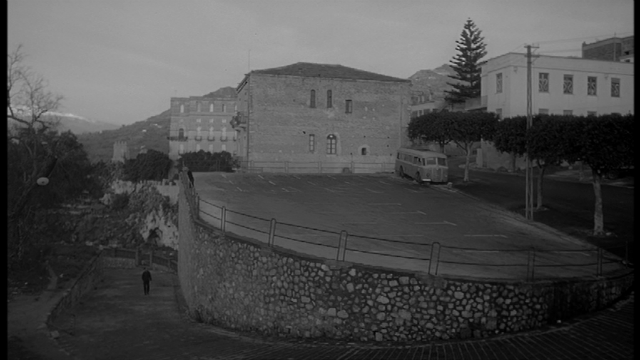
And here is another grab from the film for comparison purposes:
-
Jack Phillips
- Joined: Mon Jun 25, 2007 6:33 am
Re: 98 L'avventura
Antonioni added the bench for the scene, perhaps?
-
puxzkkx
- Joined: Fri Jul 17, 2009 4:33 am
Re: 98 L'avventura
Perhaps the true mystery of L'avventura is: where did that bench go? And now that it is gone, do we continue?
-
Roger Ryan

- Joined: Wed Apr 28, 2010 4:04 pm
- Location: A Midland town spread and darkened into a city
Re: 98 L'avventura
Looking at the screen-grab again, it does seem kind of ridiculous that the bench is placed over two parking spaces in a parking lot. Oh well, it makes for a spectacular closing shot even if the bench itself is impractical.Jack Phillips wrote:Antonioni added the bench for the scene, perhaps?
-
Drucker
- Your Future our Drucker
- Joined: Wed May 18, 2011 1:37 pm
Re: 98 L'avventura
Just got back from a screening of the new 35MM print at Film Forum and it looked beautiful.
One point I wanted to raise, which I haven't seen raised explicitly in this thread, is the feeling of the characters of the film being outsiders/tourists, and adding to their alienation. I'm married to a Sicilian woman, and one thing her family has taught me about is the strong differences in southern/northern Italy. The southern island can be seen as a different country, in a lot of ways, and there is in ways a big divide between Sicily and the north.
An example of this, for example, in Rosi's Salvatore Giuliano, when reporters from the north are covering the death of Salvatore, and a merchant asks "What do you know about Sicily?!" In L'Avventura, Sandro asks about tourists and a local mentions that they were told to get lost. One of the most wonderful scenes is when Claudia is surrounded by dozens of men, one of whom mentions "she must be French."
I'm not 100% positive that the whole movie is set in Sicily (though I'm fairly certain most of it is?) but I was wondering if anyone else had seen this element of the film mattering at all? To me, a bunch of northern Italians showing up in Sicily is a great backdrop to the tale, and just another example of how well-executed it is.
One point I wanted to raise, which I haven't seen raised explicitly in this thread, is the feeling of the characters of the film being outsiders/tourists, and adding to their alienation. I'm married to a Sicilian woman, and one thing her family has taught me about is the strong differences in southern/northern Italy. The southern island can be seen as a different country, in a lot of ways, and there is in ways a big divide between Sicily and the north.
An example of this, for example, in Rosi's Salvatore Giuliano, when reporters from the north are covering the death of Salvatore, and a merchant asks "What do you know about Sicily?!" In L'Avventura, Sandro asks about tourists and a local mentions that they were told to get lost. One of the most wonderful scenes is when Claudia is surrounded by dozens of men, one of whom mentions "she must be French."
I'm not 100% positive that the whole movie is set in Sicily (though I'm fairly certain most of it is?) but I was wondering if anyone else had seen this element of the film mattering at all? To me, a bunch of northern Italians showing up in Sicily is a great backdrop to the tale, and just another example of how well-executed it is.
-
rrenault
- Joined: Wed Nov 17, 2010 7:49 pm
Re: 98 L'avventura
Well the beginning is set in Rome I think, but everything else takes place in Sicily if you include the whole island sequence which is right off the coast of Sicily. Yes, Sicily's an island, but you all know what I mean by island sequence. I forgot the name of that group of islands they were exploring on the boat.Drucker wrote:I'm not 100% positive that the whole movie is set in Sicily (though I'm fairly certain most of it is?) but I was wondering if anyone else had seen this element of the film mattering at all? To me, a bunch of northern Italians showing up in Sicily is a great backdrop to the tale, and just another example of how well-executed it is.
-
ellipsis7
- Joined: Tue Nov 02, 2004 5:56 pm
- Location: Dublin
Re: 98 L'avventura
Yes, they start in Rome, Anna's apartment is in Trastevere, they then leave for Naples, and the group of rich and privileged Romans (Claudia being less so) depart on a cruise yacht for the Aeolian Islands in the Tyrrhenian Sea, landing on Lisca Bianca... (Stromboli is another of these islands).. Following Anna's disappearance they dock at the northern Sicilian port of Milazzo, and Sandro & Claudia crisscross the island together and separately, variously visiting Messina, Santa Panagia, the baroque town of Noto and finally the coastal resort of Taormina... In the original treatment they sailed from the Port of Ischia to the island of Palmarola (part of the Pontine group) where the action played out...
Antonioni describes why the film is set in Sicily...
Antonioni describes why the film is set in Sicily...
The film is set in Sicily because I wanted the characters moving freely in a landscape that was alien to them, that they ‘did not see'.