Ahem...
Depictions of Christ
The Birth, the Life and the Death of Christ (Alice Guy, 1906)
Stately scenes from the New Testament acted out plainly, punctuated by early special effects that recreate Christ's miracles. Simple but powerful.
Intolerance (D.W. Griffith, 1916)
One of the four stories here is of course the trial and crucifixion of Christ, which ties thematically to the other stories, and which provides the film with its majestic climax, where the film momentarily breaks free from its projector to be emitted from the skies.
Il Vangelo secondo Matteo (Pier Paolo Pasolini, 1964)
Made with fascination and respect if not necessarily reverence, but most importantly, made with the craft of a great artist. The extras on the MoC release provide great insight into Pasolini's motivations for making the film.
Godspell (David Greene, 1973)
The musical version of the above gospel, starring hippies in clown make-up in modern-day New York. Not for everyone, although a song like
"Day by Day" certainly should be.
By Their Fruits You Shall Know Them
Ordet (Carl Theodor Dreyer, 1955)
Of course, not all depictions of Christ are of Jesus of Nazareth. Some are also of delusional farm boys who preach to empty fields. But what difference does a mistaken identity make if the faith behind it is real?
Whistle Down the Wind (Bryan Forbes, 1961)
...But don't trust every guy on a farm who tells you he's the second coming of Christ. Some of them are completely sane and should know better! Here, a fugitive wanted for murder convinces some schoolchildren of his divinity, which buys him some time when they promise to protect him from further persecution.
God Told Me To (Larry Cohen, 1976)
Perhaps the hardest part about God commanding you to go on a killing spree is, like, who do you go to for a second opinion? What does it mean when many around you are getting similar promptings? How do you reconcile this knowledge with a lifetime of peaceful devotion? And what good could God have planned that would be worth all of this horror? Cohen entertains these questions for a few minutes before doing away with the mystery and just diving whole hog into some sci-fi silliness.
Breaking the Waves (Lars von Trier, 1996)
Who God chooses to speak to and why he sometimes commands them to do horrible things is a mystery for the ages, as explored in this arthouse breakthrough starring Lars von Trier as God.
Meek's Cutoff (Kelly Reichardt, 2010)
This film covers a lot of interesting (and scenic) ground. Both the settlers and the Indian that eventually joins them on their journey across the plains are religious, though coming from different traditions, they are deeply suspicious of one another. And the whole idea of blindly following someone who says they know the way has parallels both political and religious. How much of a chance do you give a leader to prove their mettle, and if they fail you, who do you follow next? If you never even see their fruits, how then shall you know them?
Satan Is Real
L'inferno (Giuseppe de Liguoro, Francesco Bertolini & Adolfo Padovan, 1911)
Come tour the many circles of hell in this cautionary "road movie," filled to the brim with all the practical effects that were known at the time (and maybe some that weren't).
Faust
By IMDb's count, the number of film adaptations of this story of a man granted a second chance at youth by the devil goes well into triple digits. (And that's not even counting loose adaptations like the wonderful
Phantom of the Paradise.) I've only bothered to see the ones made by directors I like. Murnau of course made one of the most dazzling special effects showcases of the silent era with his version. Sokurov made an equally dazzling, but also confounding and perverse, version. Švankmajer, um, made one with puppets. And then there's the Brian Yuzna version (actually an adaptation of a graphic novel) which is proof positive that Satan is real, because how else could this movie exist?
The Student of Prague (Arthur Robison, 1935)
This is basically the same deal as described above, only switch out youth for the love of a girl who would otherwise never give you the time of day. I've droned on and on about this one before, but am legally obligated to mention it again here by the dapper gentleman in the corner over th—oh no, not again...
The Devil and Daniel Webster (William Dieterle, 1941)
OK, we get it Satan, you like to make things contractual. A lot of these stories might seem to run together at some point, but what sets this film apart is that it managed to land the actual devil for the titular role. (He would later go on to moderate acclaim as the actor Walter Huston.)
Cabin in the Sky (Vincente Minnelli, 1943)
Now finally, to weigh the scales a little more fairly, God gets into the game as well in a bet with the devil over the odds of a degenerate gambler reforming his soul. Only, guess what God, that's gambling too. (That's how they getcha.)
To Sleep with Anger (Charles Burnett, 1990)
For a nice change of pace, the devil here doesn't feel the need to get anything in writing, but is content merely to hang around the house and watch as his influence slowly widens the cracks that tear at a typical unsuspecting family. Despite the sometimes surreal or mythical elements, this is above all a remarkable depiction of everyday life for a black community in America (not merely focusing on those in sensational circumstances), of which there are regrettably few.
The Convent (Manoel de Oliveira, 1995) -- SPOTLIGHT
What better way to honor this great director's recent passing than by watching one of his most magical films? The story begins with John Malkovich touring monasteries with wife Catherine Deneuve in tow in search of evidence of Shakespeare's true identity, perhaps ensuring his own immortality in a sense at the expense of someone else's. Things get sidetracked though when their journeys lead them to some peculiar caretakers who seem at the very least to be in league with the devil (and who give the perfect response when called out on this). Much of the film ends up taking place in a variant of the Garden of Eden, with the seduction/temptation scenes taking the form of lengthy discussions on religious philosophy, all very germane to this project. A few somber orchestral pieces provide a constant companion to the proceedings, not unlike the music that they might play in the waiting room on your way to hell.
Hors Satan (Bruno Dumont, 2011)
Satan is real and living in France. Or maybe he is an angel? Or maybe just magic? Seriously, if any of you know, please do enlighten the rest of us.
Life as Purgatory
Prison (Ingmar Bergman, 1949)
One of Bergman's earliest films imagines the world as the exclusive domain of the devil, where any pleas for God's intervention are met only by silence—a topic that Bergman felt he had pretty well exhausted his first go-around and so never felt the need to address again.
Palms (Artur Aristakisyan, 1994)
A uniquely harrowing experience,
Palms focuses its attention on those that society has cast aside—the crippled, indigent, and lame—plainly presenting them in harsh black and white images. But the film is most severe in its narration, framed as a desperate letter from a father to his unborn (and soon-to-be aborted?) son, ascetically pleading for emulation of the subjects on screen, urging his son to turn to God and not get mixed up in "the system" (i.e. the political and economic apparatus of the world), and gradually revealing a rather unsettling backstory.
Magnolia (Paul Thomas Anderson, 1999)
Life is hell because we don't forgive each other or ourselves. But maybe singing about it will make things better?
A Serious Man (Joel & Ethan Coen, 2009)
Life is hell because you are alive. For now.
Inherent Vice
Dr. Jekyll and Mr. Hyde (Rouben Mamoulian, 1931)
Jekyll's attempt to compartmentalize his sinful nature apart from his nobler self works at first, but he doesn't count on the id being stronger than the superego.
My Night at Maud's (Éric Rohmer, 1969)
Typical guy from a Rohmer film spends all night with a woman, talking about not sleeping with her, Pascal's wager, etc.
Mujo (Akio Jissoji, 1970)
People do bad things and it looks pretty. Apparently this is about Buddhism?
Edvard Munch (Peter Watkins, 1974)
Watkins painstakingly evokes the social and political climate, as well as the personal demons, that shaped the great Norwegian painter's art, vividly depicting both Puritan family members and an anarchist bohemian group that tugged at him in either direction.
Tender Mercies (Bruce Beresford, 1983)
A country singer whose alcoholism had torn his first marriage apart tries to put his life back on track.
The Decalogue (Krzysztof Kieślowski, 1989)
Ten stories generally taking the breaking of one of the Ten Commandments as a starting point, but then proceeding to go off in intriguing directions. Not mere morality tales.
Battle in Heaven/Silent Light/Post Tenebras Lux (Carlos Reygadas, 2005/2007/2013)
Though they take very different approaches, each of these films essentially boils down to a husband tempted by another woman's flesh, and how heavily this weighs on the soul. If thy head offend thee, cut it off.
Hope for Us Yet
Nostalghia (Andrei Tarkovsky, 1983)
A poet traveling abroad in Italy finds a much more cost-effective way to save the world than all that stuff Michael Bay had happen in
Armageddon. If that's not films of faith enough for you, please note that the film also seems to portray the afterlife as a sort of nostalgic return to a childhood home.
The Annunciation (András Jeles, 1984)
In the Garden of Eden, Satan shows Adam the future of childrenkind after partaking of the forbidden fruit, and then leaves him to decide if we're worth existing or not. No pressure or anything.
The Heart of the World (Guy Maddin, 2000)
A scientist searches for a cure for the heart failure of the world while also vying for the affections of a man who for no doubt symbolic reasons is portraying Christ in a passion play.
Noah (Darren Aronofsky, 2014)
Aronofsky somehow managed to morph this spare skeleton of a biblical story into an only occasionally preposterous CGI epic that asks the very pressing and universally relatable question: "Is mankind worth saving?" Predictably, just about no one related to it.
Miracle Workers
The Miracle Woman (Frank Capra, 1931)
Barbara Stanwyck takes revenge on disengaged churchgoers by giving them empty spectacle instead.
Anna und Elisabeth (Frank Wisbar, 1933) -- SPOTLIGHT
Two women share a passionate, faith-based bond after one of them discovers that she has miraculous healing powers...some of the time.
The Goddess (Satyajit Ray, 1960)
An old man has a dream one night that his daughter-in-law is an avatar of the goddess Kali. As she begins to manifest the ability to heal, people gradually start to believe him. This doesn't turn out so well.
Near Death (Frederick Wiseman, 1989)
The doctors at a Boston hospital for the terminally ill occasionally get to take part in seeming miracles, but there's a lot of death, drudgery, and downtime in between. They spend much of this time discussing the value of life and their place in the grand scheme of things, as well as trying to give solace to their patients' family members.
Religious Ritual
Les Maîtres fous (Jean Rouch, 1955)
A group of colonized African workers fulfill their tasks merrily by day, but by night they "cleanse" themselves through religious rituals that channel the spirits of their oppressors (and not in the good way)—stomping about in caricature, frothing at the mouth, exposing themselves to fire, sacrificing animals—all to prepare for another day of willing servitude in the morning. A clear inspiration for Ben Russell's
Trypps #6.
The House Is Black (Forough Farrokhzād, 1963)
A poetically brutal tour through a leper colony with the majority of the audio track devoted to the lepers' fervent prayers. Those most afflicted often draw closest to God, but is this done out of humility or resentment?
The Color of Pomegranates (Sergei Parajanov, 1968)
A feature film of nothing but depictions of religious rituals, presumably those practiced on and just below the surface of the moon. Particularly for this list project, make sure to watch the unedited version, as most of the cuts to the shorter version relate to expressly identifiable religious material.
The Eve of Ivan Kupalo (Yuri Ilyenko, 1968)
Lots of crazy stuff goes down during the festivities on St. John's Eve. (See also the Disney or Alexeïeff versions of
Night on Bald Mountain.)
Incantation (Peter Rose, 1972)
Experimental film pairing nicely edited images of nature with an Islamic chant.
Fire Festival (Mitsuo Yanagimachi, 1985)
The residents of a fishing village seem to have a knowing symbiotic relationship with the gods, a bond which they honor by ritually destroying things and generally being terrible to each other. A nice companion piece to
Profound Desires of the Gods.
Horse Thief (Tian Zhuangzhuang, 1986)
A faithful Buddhist attends numerous ceremonies while contemplating whether he's desperate enough to have to steal a bicycle—er, you know what I mean.
Iconography
Fuego en Castilla (José Val del Omar, 1961)
Val del Omar brings religious sculptures magically to life through psychedelic lighting effects. Rejoice at your power to be God!
Andrei Rublyov (Andrei Tarkovsky, 1966)
Tarkovsky avoids the missteps of so many biopics by depicting a time instead of a person (the eponymous Russian icon painter).
The Ossuary (Jan Švankmajer, 1970)
A kinetic tour of a religious shrine (assuming that you worship bones, like zedz).
A Life Devoted
The Bells of St. Mary's (Leo McCarey, 1945)
Hey everybody, let's help save the local Catholic school.
Black Narcissus (Michael Powell & Emeric Pressburger, 1947)
Apparently you can isolate a group of nuns in a foreign land, set up lodging for them at the edge of a steep cliffside, taunt them with superstitious local tales, and tempt them with men wearing painfully short shorts, and they'll still largely keep it together. But introduce the pollen from an exotic flower into their air supply and they will gradually all go nuts.
The Flowers of St. Francis (Roberto Rossellini, 1950)
Have you ever met a more agreeable bunch of monks?
Diary of a Country Priest (Robert Bresson, 1951)
Like a reed bending for every slight whim of the wind, this delicate, sickly man of the cloth feels intensely for all of the problems of his parishioners, including the ones who mean him harm.
I Confess (Alfred Hitchcock, 1953)
A priest seems willing to take a murder rap over breaking the seal of the confessional.
The Nun's Story (Fred Zinnemann, 1959)
The true story of a woman's decision to take on the habit gets the epic Hollywood treatment.
Léon Morin, Priest (Jean-Pierre Melville, 1961)
What happens when the development of faith is inextricably tangled up with intense attraction toward the person helping you develop it? How much of faith is love, and how much of love is faith? Will this faith weather the storm when the messenger is long gone? If not, how cruel was it to engage in the relationship in the first place? And is any other outcome possible when the church lets people who look like Jean-Paul Belmondo become priests? My favorite Melville.
Mother Joan of the Angels (Jerzy Kawalerowicz, 1961)
More nuns going nuts.
Winter Light (Ingmar Bergman, 1963)
A perfect exercise in ambiguity, the film seems mostly pessimistic on the surface as it follows a priest who, feeling abandoned by God, starts to take it out on his flock. But consider that Bergman claims in the informative making-of doc to have made the film to glorify God and a new meaning emerges—that it is precisely because of the emptiness in the world that we need to have faith and show kindness toward one another.
Simon of the Desert (Luis Buñuel, 1965)
Not to encourage the ridicule of others' religious beliefs, but this movie is hilarious.
Marketa Lazarová (František Vláčil, 1967)
Paganism and Christianity clash while God looks on (and occasionally chimes in) from above. Meanwhile, a young girl plans to join a convent but she still lives in medieval times so things don't turn out so well.
Thérèse (Alain Cavalier, 1986)
A young girl joins a convent and she lives in the 19th Century so everything goes smoothly until she gets tuberculosis. Her real-life counterpart is a popular saint within the Catholic church.
Syndromes and a Century (Apichatpong Weerasethakul, 2006)
Buddhist monks feature prominently in this film that unfolds somewhat like a dream. The repetitious structure echoes the film's themes of karma and reincarnation, and its city/country duality allows for an exploration of the place of religion in different strata of society.
The Overnighters (Jesse Moss, 2014)
Eye-opening documentary about a Lutheran pastor placed in an extraordinary situation (in the middle of an oil fracking boom that brought a huge influx of migrant workers to his small town in North Dakota) who decides to take Christ's teachings to heart and take many of these people in at his church and even into his own home. He treads a line of compassion and recklessness here, and many have been quick to either praise or condemn him in simplistic terms. But the truth is that putting your beliefs into practice (especially on such a grand scale as this) is a complicated process, and this is a complicated man. A couple of noteworthy developments after the camera stopped rolling:
The film ends with Pastor Reinke apparently becoming one of the destitute that he has been serving. He confesses to his wife that he is being blackmailed by a man with whom he had a sexual relationship in the past (before the events of the film). As a result of this and the fallout of the overnighters program, he is presumably about to lose both his parish and his family. This brings the film full circle but is perhaps a little misleading. (I actually read a review somewhere that inferred that the various migrant workers movingly shown over the film's end credits are actually the faces of all the men that Reinke had taken sexual advantage of over the course of filming. Um, what?) While Reinke has recently been working odd jobs in the oil industry, and has even had to resort to sleeping on the floor of one of his former overnighters, a little extracurricular reading reveals that his homosexuality was not news to his wife, and that after a brief separation immediately following filming, he is back with his family and is committed to making that work. Sorry if that is a less dramatically satisfying ending. In more disturbing news, Keith Graves, the man who was only "technically" a sex offender that Reinke took in to his home to live amongst his children, has since been arrested on sex trafficking and other very serious charges.
Hypocrisy is an interesting topic. No one is perfect, so can no one take a moral position without being at least a little bit of a hypocrite? To some extent, can't those most experienced with a certain vice take the most authoritative stance against it? Though of course there are some whose devotion is mere lip service, who make no effort to practice what they preach. It is to these that Weber directs her wagging finger, calling them out through the intriguing device of a nude female statue of truth—itself something of a litmus test for the audience's hypocrisy—that comes to life to show a better way.
The Passion of Joan of Arc (Carl Theodor Dreyer, 1928)
People are still claiming more than ever these days to receive direct revelation from God, and yet we don't really seem to burn any of them at the stake anymore. I suppose this is progress?
Tabu (F.W. Murnau, 1931)
Tribe elders play the "reserved for the gods" card to break up a young couple.
Él (Luis Buñuel, 1953)
Man plays the "I met you at church so we are meant to be" card to first possess a woman and then eventually drive her mad.
The Cremator (Juraj Herz, 1969)
Are you racially pure? Do you long to see your loved ones on the other side? My ovens can help with that.
The Believer (Henry Bean, 2001)
 Leviathan (Andrei Zvyagintsev, 2014)
Say what you will about organized religion, those bastards know how to construct an edifice.
Religious Allegory
Our Daily Bread (King Vidor, 1934)
A community's attempt to survive the Depression through collective farming has parallels with the struggles of the soul to escape the enticements of the world, to cast off vice and self-doubt, and to recognize miracles for what they are.
A Man Escaped (Robert Bresson, 1956)
A prison escape brings spiritual deliverance.
Au hasard Balthazar (Robert Bresson, 1966)
Or
The Passion of the Donkey.
Teorema (Pier Paolo Pasolini, 1968)
It's relatively easy to feel happy when immersed in the glow of whatever provides you with inspiration—a special someone, artistic or philosophical epiphany, the love of God—but how do you respond when the light source is removed? Do you have faith that it will one day return or do you abandon all hope? Do you spiral into self-destruction? Do you cling to past joys and shun the present? Or do you rise up and give something back to the world?
Days of Heaven (Terrence Malick, 1978)
I like
this interpretation of the film as a religious noir, filled with allusions to the Old Testament.
Stalker (Andrei Tarkovsky, 1979)
Some things can never be fully known, and this is part of what makes them beautiful. Besides, it may just be that the thirst for this knowledge, or better yet, the sharing of this thirst with others, is more important than attainment of the knowledge itself.
Where Is the Friend's Home? (Abbas Kiarostami, 1987)
The film’s title and themes are steeped in Sufism,
as well discussed in the most recent 1980s thread, though they also happen to provide a beautiful illustration of the Christian concept of grace—that after all of our efforts, an intermediary is necessary to make up for our shortcomings.
Landscape in the Mist (Theodoros Angelopoulos, 1988)
A brother and sister wander across a bleak European countryside in search of their fabled father. All the while, the ominous, stone hand of God swings about, delicately suspended in the air above them, watching over and guiding them. But what happens when the strings break?
The Son (Jean-Pierre & Luc Dardenne, 2002)
A carpenter's dilemma about whether or not to forgive someone who has greatly wronged his family begs comparisons to another carpenter in practice a couple thousand years ago.
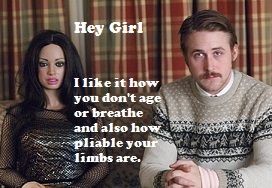
Lars and the Real Girl (Craig Gillespie, 2007)
Churchgoing community bands together to lovingly rehabilitate this guy back into society:
 Beyond the Veil
After Death (Yevgeni Bauer, 1915)
Beyond the Veil
After Death (Yevgeni Bauer, 1915)
A man is too shy to requite the affections of a beautiful stage performer until she subsequently kills herself and haunts him as a ghost.
Where Are My Children? (Lois Weber & Phillips Smalley, 1916)
Bonkers yet powerful anti-abortion tract moves between heaven and earth in speculation of the fate of both aborted children and their would-be parents.
The Seventh Seal (Ingmar Bergman, 1957)
The Black Plague is that much harder to get through when the dead can be seen dancing in plain sight.
Vertigo (Alfred Hitchcock, 1958)
A bit too quick to take things on faith, a private detective becomes obsessed with his deceased charge almost enough to will her back into existence. Also, nuns make some people jumpy.
Don't Look Now (Nicolas Roeg, 1973)
I like the interpretation someone here gave that Christie's character embodies the peace that faith can bring after a difficult loss, whereas Sutherland's shows certainty to be an uneasy, dangerous, and perhaps even unachievable ideal.
Ponette (Jacques Doillon, 1996)
A little girl learns about resurrection and then puts this knowledge to use when her mother dies. A scene of impassioned prayer late in the film is particularly devastating.
Waking Life (Richard Linklater, 2001)
Man isn't sure if he is alive anymore, relives the movie
Slacker.
One with the Infinite
Dog Star Man (Stan Brakhage, 1962-64)
Innately both animal and celestial, a man cycles through the seasons of the earth and of his own life. By the end, what has he become?
2001: A Space Odyssey (Stanley Kubrick, 1968)
The evolution from ape to god.
Le quattro volte (Michelangelo Frammartino, 2011)
How coal is made.
Uncle Boonmee Who Can Recall His Past Lives (Apichatpong Weerasethakul, 2011)
How Wookies are made.
Meet the Mormons
Brigham Young (Henry Hathaway, 1940)
It's a bit of a wonder that this seeming puff piece was made in Hollywood at all, but it's even more surprising to learn that the LDS church was not directly involved with its making! Dean Jagger apparently took the title role seriously enough that he eventually joined the faith years later. Also starring Vincent Price as Vincent Price playing Joseph Smith.
My Turn on Earth (Craig Call, 1986)
Filmed performance of a musical stage show dating back a decade earlier that had come about in the wake of
Godspell, aiming to teach children the Mormon (but still pretty universally relatable) take on the purpose of life (e.g. learning from your mistakes, being charitable, the importance of family). There are not really any singing or dancing skills of note on display here, and the production does veer at times into
Barney & Friends territory, but at least a few of the songs are legitimately fantastic (studio versions of a couple of examples here:
1 2).
Deseret (James Benning, 1995)
This is more about Utah history than Mormonism per se, though the two are so intertwined that you can hardly tell the difference. Historical snippets from the New York Times concerning the affairs of Utah are read over scenic images of all the many wonders that the state has to offer. Both the actions described in the paper and the manner in which they are written are at times quite violent, though given the latter it's not always clear how much credence to give the former. (Some later readings even seem overly apologetic about what had been written in the past.) There's some nice structural stuff going on here as well, but above all, this is a remarkable film about divides informed by prejudice, as well as the incongruity between the beauty of the earth and the ugliness that we inflict upon both it and each other, with or without religion.
Brigham City (Richard Dutcher, 2001)
In the early oughts in Utah, Dutcher ignited a local craze for films aimed squarely at LDS audiences that no one else would ever want to watch. Within this movement, he fancied himself as something of a Mormon Dreyer. While this is nowhere near the case, this film of his comes closest I think to moving in interesting ways in that direction. It's about the clash between faithful folk in a small town and the evil lurking on the outside, personified by the sudden invasion of a serial killer. That last part (i.e. half of the movie) doesn't really work, but the film hits some strong notes when it focuses on the simple, heartfelt rituals that the townsfolk turn to in times of crisis. Dutcher later left the church and now makes "edgy" films that don't appear to have had much luck in receiving any kind of distribution. Though on that front I personally prefer Neil LaBute, who actually made his earliest films while still a practicing Mormon!
New York Doll (Greg Whiteley, 2005)
One thing the church does internally is called the home teaching program, where you are sort of assigned to be friends with other members in your area. So one day Whiteley (not a film director at the time) finds that he has been assigned to none other than legendary New York Dolls bassist Arthur Kane (who converted to the church post-stardom) and Whiteley soon begins to realize that this guy's story is just starting to get too good to keep to himself. What Whiteley might lack in filmmaking skills is more than made up for by the events that he captures over the course of the film—if you made a story like this up people would call it mawkish, but the ring of truth to it all lends the film a certain sincere sweetness. Whiteley went on to direct the Netflix documentary
Mitt.
Spreading the Word
Elmer Gantry (Richard Brooks, 1960)
A preacher agrees to hand her ministry over to a smooth-talking salesman to help drum up more followers.
Salesman (Albert & David Maysles & Charlotte Zwerin, 1968)
The Bible includes no instructions as to how it is to be sold.
Aguirre, the Wrath of God (Werner Herzog, 1972)
It takes a certain kind of man to lead the charge in spreading Christianity to the natives of the jungle (in exchange for all of their gold of course). Unfortunately, some of those men are stark raving mad.
The Sacrifice (Andrei Tarkovsky, 1986)
If you want to ensure that what's most important to you survives to the next generation, plant a tree.
Shooting the Messenger
The Virgin Spring (Ingmar Bergman, 1960)
The extremes of good and evil clash when an innocent young girl on her way to church crosses paths with a couple of monsters.
Blaise Pascal (Roberto Rossellini, 1972)
The famed mathematician fought for an enlightened reconciliation of religion and science, but the superstitions and persecutions of men, as well as the frailty of the human body, left him drowning instead in a world devoid of knowledge.
The Wicker Man (Robin Hardy, 1973)
To a certain extent, when you intrude on someone else's property and start insisting that they're living the wrong religion, you've arguably brought upon yourself however they decide to respond. Which is why you should never even set foot on the pagan isle run by Christopher Lee.
There Will Be Blood/The Master (Paul Thomas Anderson, 2007/2012)
Both mental wrestling matches between two incredibly strong-willed men, one of whom represents some kind of organized religion.