Page 5 of 15
Re: Auteur List: Howard Hawks - Discussion and Defenses
Posted: Fri Jun 05, 2020 9:53 pm
by therewillbeblus
therewillbeblus wrote: Tue Jun 02, 2020 2:57 am
Red Screamer wrote: Mon Jun 01, 2020 11:05 pm
Never Cursed wrote: Mon Jun 01, 2020 9:01 pm
I've never seen
The Big Sleep before, so to those who have, which version should I seek out?
You can probably find a precise list of differences between the versions somewhere
This is a pretty thorough comparison of the two versions
I grew up watching the theatrical as a kid, but I've latched onto the original pre-release since. I think we get the perfect amount of Bogart/Bacall in the pre-release version, and their strange hostile flirtation and curious chance encounters makes the relationship a lot more interesting and mysterious as we focus on that as its own social-emotional mystery along with the others in the narrative.
The Warner Archives blu has a nice feature comparison the versions and showing the different scenes in each, mostly in full. I’m realizing on a revisit that I’ve actually continued to watch the re-release mostly, and so I’ll go back on my previous post and say the relationship is more enigmatic in the shorter ‘46 version. I also prefer the rerelease in the way that it eliminates the police grilling that explains the plot to catch everyone up, because I think it’s focusing on the wrong details of interest. The strengths in the first one are really the extra attention to Bogart collecting clues in the apt, but the action scenes missing like the catching of Carol shouldn’t be missed.
In comparing the two, I reverse my opinion: the ‘46 version is superior. The sharp dialogue scenes with Bacall are all necessary and form a complex relationship integral to the hazy tonal tension and forward momentum. Bogart and Bacall’s ‘relaxed’ familiarity in certain later re-shot scenes only makes their relationship stranger, while the original dynamic (which had been called more mysterious, including incorrectly by me) is actually following a simpler logic in detachment. It’s the nebulous interplay of comfortability/attraction/trust, and abrasive challenging/disbarring/mistrust that is unpredictably fluid as its own form of collective flirtation
and self-preserving individualism, that makes the film so great. I’d highly recommend that anyone who has only seen the ‘45 version seek out the 114-minute ‘46 one, which is an entirely different movie in tone. I didn’t remember having such a strong opinion but I actually believe this version plays to Hawks’ strengths and fits his thematic interests better, even if this was the product of studio interference!
Re: Auteur List: Howard Hawks - Discussion and Defenses
Posted: Fri Jun 05, 2020 10:11 pm
by Rayon Vert
I'm re-reading the Robin Wood book and his reading of Scarface, especially along those very lines of where Hawks's sympathy lies, or how he presents the violence or criminal lifestyle as fun/good or not, jibes with my memory of it (but it's one of the films I'll nevertheless revisit), and it definitely tends more towards your evaluation, blus. One of Wood's overarching frameworks in regards to Hawks's oeuvre is that his adventure films value responsibility and celebrate a civilizing force, and in a mirror image his comedies express "the lure of irresponsibility" and an anarchic force, and he groups Scarface among the comedies in that framework, whom he sees as having nothing in common with the adventure films and everything in common with the comedies. Nevertheless with Scarface specifically he does a good job of pointing out how the film conveys "strongly" a sense of exhilaration and encourages the viewer to enjoy the gangsters' acts of violence, but at the same time the film makes those acts disturbing. At the same time that the violence is exhilarating, the results provoke frequently, and more and more as they go on, a sense of horror and terrible waste. He also sees the crosses symbolism as "disturbing our response to the film's humour". (He also notes how Tony is a figure of sympathy for the viewer, in a pitiable way, but isn't glorified.) To me this is very much like the gangster figures in Scorsese's films (think of Pesci in Goodfellas for example), where we are made to feel both initial excitement and ultimately horror/revulsion.
Re: Auteur List: Howard Hawks - Discussion and Defenses
Posted: Fri Jun 05, 2020 10:25 pm
by therewillbeblus
Thanks for sharing that, RV, very interesting and I mostly agree. I do think that, in an inverse kind of way (which makes sense given that Wood’s viewings of his comedy vs drama inverts one another) Scarface served as the best precursor to Red River in that film’s deep exploration of how the ‘lure of irresponsibility’ (both as pure individualism or actually manifested by Wayne repressing his feelings of responsibility in his romantic interest’s death at the start) needs responsibility and collectivism to function best in the long term. I have more on that film later but it’s more complex in how Hawks allows pure individualism to exist as an invaluable strength, lifesaving even, up to a point without drawing a clear line in the sand for specific didacticism, beyond a call to be inclusive of others to achieve harmony. Yet his refusal to damn the characters for not doing this sooner (and even including lines in the film suggesting that this flawed mentality has been integral to survival) allows an ambiguity to fight moral judgment until it can’t be helped and threatens to destroy both men.
Re: Auteur List: Howard Hawks - Discussion and Defenses
Posted: Sat Jun 06, 2020 2:31 am
by Rayon Vert
So I did indeed revisit Land of the Pharaohs. Knives and twbb, you did a pretty deep analysis of this one. I find both your readings interesting (I especially like the geometrical society gone mad one!) even though I don’t necessarily go along with everything you wrote, but you both thought this one out more so than I. One thing I like about your analyses is that they bring out how this film isn’t so entirely removed from Hawks’ usual themes, even though it's definitely less obvious on the surface. In that sense I'd add that, as knives mentioned, Hawks studied engineering, and in the same way that his interests (car racing, air piloting, etc.) inform his film choices, so much of this film is about the engineering that goes into building the tomb. Those very long sections about the planning and then the work that goes into building it obviously seem to fascinate the director, and they parallel how often in his films he is interested in work itself and documenting it – e.g. animal catching and herding in Red River and Hatari!, all the aviation films, the documentary-like scenes about fishing (Tiger Shark) or the lumber mill (Come and Get It).
As much as I like the film well enough, though, both as entertainment and for its visuals - and it may even have a chance of making the bottom of my (15-film) list on that basis -, I understand Altair’s near-dismissal of it too because it doesn’t showcase Hawks’ usual strengths. Going beyond the initial fact that these characters speak a most uncharacteristically stilted British English, the acting doesn’t have any of the incredibly rich naturalness that his much better films do. Collins is really the only one that stands out here, although her performance (and yes partially it’s the role) is nowhere near the level of a Bacall, Arthur or Dickinson (and Russell and... and...). And I agree with Altair also that many of the characters are incredibly banal. It’s also hard to think of the slaves’ “community” as a typically Hawksian one because just a few characters are sketched out, and not interestingly, and they are fairly sidelined through most of it.
Re: Auteur List: Howard Hawks - Discussion and Defenses
Posted: Sat Jun 06, 2020 3:31 am
by therewillbeblus
Yeah, it's definitely one of those films I enjoy analyzing more than I like watching, and while it could sneak onto the tail end of the 10-15 range, if it does that would be the reason. I finally finished off my revisits with Rio Lobo tonight, and although I'll be tampering with the last five, it's amazing the range of esteem across it. Hawks has about 7-8 films that are masterpieces in my eyes, at least five of which could wind up on my All-Time list when that time comes, and then the drop in quality between spot 8 and 9 is drastic. The rest are mostly great but it feels like two different lists.
Anyways, you bring up female perfs so let's talk about one of Hawks' most charitable: Russell in His Girl Friday, which in the context of this project, I've come to view as arguably his most empowered woman.
By making Hildy a woman in the first place, Hawks continues to smash gender and offers the same gesture of opportunity that he does for men in his own vision of progressive American values. Hildy is respected and welcomed by her fellow reporters and it’s notable how confident she walks, and how they appear to look up to her as one of the best with enthusiasm. Not for the first time in his filmography (I’d argue that both Twentieth Century and Bringing Up Baby toy with briefly nullifying gender norms at times*), but perhaps most obviously, gender is nearly destroyed in favor of a bootstraps theoretical strive for personal excellence.
Grant’s chasing of Russell makes this existential idealism contingent on unity for the achievement to be of maximum value. Similar to the non-exclusive co-occurring states of independence and loving bonds in Hawks’ other films, Grant wants Russell, needs her even, but also requires personal space as an innate rule. This confusion drives Russell away, given social norms and biological drives, yet the power of supremacy can abolish these domineering influences, which shape most everyone’s lives! Her prowess may be indicative of masculine temperament, but being the best and receiving a self, and externally-infused, respect for identity over beauty provides the sexual charge here, a kind of sapiosexual attraction between Grant and Russell. At the beginning, Bellamy’s neediness and doe-eyed admiration of her unique personality flatters her, but Grant’s appreciation for her specific skills and history is what wins. Bellamy accuses Russell of never loving him as he exits the film, but he only sees the surface of Russell as one who has an original self- not what that original self is. You could argue that he loves the idea of her, without taking the time to get to know her deeply and truly, which Grant does in a manner that refuses to preach sonnets and kiss her feet. Through this angle, this is a pretty progressive film!
Grant may be manipulating her, but as opposed to Twentieth Century the spirit isn’t so mean- and in fact, Hildy has been on board all along, and the best reveal is that Grant’s influence was superficially responsible. She actualizes her identity, and if it’s not ‘all by herself’ that’s because synergy breeds glory.
His Girl Friday lives and dies by its script and the actors’ capabilities to inject themselves with Hecht’s words as adrenaline shots. The shifting power between players transfers so seamlessly and frequently that your head will spin trying to keep up. There is always a new line or gag to discover (I didn’t even register the meta-joke that Soderbergh reveals on the Ocean’s Twelve commentary, and I’ve seen this one a lot!) but, like The Big Sleep, this is one where I try to turn my brain off, sit back and just enjoy the ride. Still, the gender dynamics are especially fun to unpack here. Even if at the end Russell exits the film vulnerably, which kinda crushes these ideas, I'd say this is her biological/social normative drives kicking back in, and indicative that she'll be doing the same dance Arthur will in Only Angels Have Wings between different parts of her, accepting and not accepting, til the end of time - just as we all will. The difference here is that she's signing on with agency, and has evidence of rebounding with confidence.
*I know Hawks draws a lot of his humor and drama from gender distinctions, as well as the inevitable struggles for opposite sexes to coexist or understand one another, so I'm not suggesting that he is altogether ignoring gender. But- even though eventually we will return to those sex-specific defaults, or confusion between sexes, in Hawks' films- through a universal opportunity of self-actualization can gender become a non-issue for a while. This also helps explain why the 'success' in forming 'strong' relationships between men and women in Hawks' world contains a co-occurrence of mutually exclusive relationship bases, in reciprocity (love, camaraderie) and personal space (self-discovery, freedom)- which is used to thrive and to work on oneself without bothering/imposing the self on the other.
Re: Auteur List: Howard Hawks - Discussion and Defenses
Posted: Sat Jun 06, 2020 12:44 pm
by Mr Sheldrake
I opened my Hoopla app to see what Hawks movies were available and discovered that they offered McCarthy’s biography as a free Ebook. The movies were Ball of Fire, A Song is Born and His Girl Friday.
Re: Auteur List: Howard Hawks - Discussion and Defenses
Posted: Sun Jun 07, 2020 3:28 am
by Rayon Vert
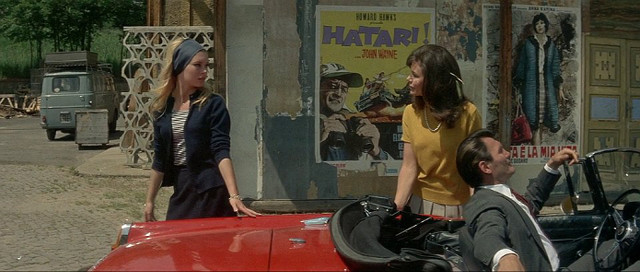
Hatari! I think this is such a delightful film – tremendous fun, as knives says, but more than that also. The animal-catching scenes are visually exciting and impressive, as well as beautiful. (Spielberg used the film’s scenes as template for
The Lost World.) The more so since the actors are actually doing the daring actions themselves. That really is Wayne strapped to the front of that vehicle, and it’s him and the other actors at the end tangling up that dangerous rhino.
But it’s immensely likeable and engaging because of everything else here. This is really a film about relationships, between the human animals, between the human and non-human animals, and to some degree even between the different human cultures. It’s up there among the director’s best films in terms of showcasing a community of non-blood-related adults, all very individualized, forming a new, self-chosen family of sorts, united through their work, but where the collaborative spirit spills out everywhere – think of how Dallas and Pockets help each other with their love lives, for example. It’s also another example at how gifted the director could be in creating and staging such enjoyable, natural acting. It’s precisely because there’s not much of an overarching “plot” (although all the episodes have their own logic and they’re thematically related) that the focus is a lot more purely on the human behavior and exchanges. It’s a process Hawks started with
Rio Bravo and it’s furthered here. I think it’s important to go in the post-
Pharaohs work knowing Hawks deliberately and consciously set about fairly radically changing his approach – the themes are the same, as well as the visual style, but the pace greatly contrasts with the speed and manic energy of his early films, and the plot takes a backseat to the actors’ relating. In the case of this film, it’s helpful to also expect an adventure
comedy film, rather than drama – there’s less at stake tension-wise precisely because of this (e.g. the difference between this and
Only Angels Have Wings, otherwise two have films that have several things in common). Personally I laugh a lot throughout this.
Robin Wood’s writing on this film helps appreciate its thematic importance. In relation to the contrary, opposed forces in the director’s work between the adventure films (adventure in the larger sense, which includes the war films,
Red River, etc.) that showcase a group of humans mastering their environment, and the comedies that express “primitive”, irrational and uncivilized energies breaking out (and which can also feature animals, e.g. the leopard in
Bringing Up Baby, chimpanzee in
Monkey Business), he sees
Hatari! reconciling these two, and creating a unified “instinctive consciousness”.
In Hatari! one finds serenity and harmony. In the perfect Hawksian society that the hunters’ world embodies, all the tensions between the attraction to the primitive-instinctive and the need for conscious control and mastery that we have found so often in Hawks’ work are resolved.
On the one hand, you have the “hunters”’ mastery and advanced technology used to do their work (think of Pockets’ rocket invention!) – on the other hand, you have the way the humans and animals cozy up to each other – especially evident in Dallas’ mothering of the elephant calves. You can also see parallels between the animal-catching storylines and the romantic mate-catching ones.
Maybe it’s because of all this harmony that some people are turned off by the lack of tension in the film – which is a fair point, but then that's the very nature of the film. Personally I’m always won over by that aspect, and by the good-natured spirit of this film, where even potential conflict and rivalry ends up giving way to friendship and collaboration. (The evolution of Kurt and Chips’ relationship being the prime example.) The length (2h38) just adds to the enjoyment in this sense (and also fits the pace and slow breathing of this film), being able to just sit and live in this near-Eden like world for that amount of time, and
hang out with these people and animals. This may not be everyone’s cup of tea, but in no way is it a minor film in the corpus. It’s easily in the top 5 for me and one of my favorite 60s films in general. (I'm not alone in my appreciation - Godard picked it as the best of that year!)
Re: Auteur List: Howard Hawks - Discussion and Defenses
Posted: Sun Jun 07, 2020 4:01 am
by therewillbeblus
Great defense, RV - I just wish I could see the film you did, as my revisit was pretty painful. I generally really enjoy films with a lack of tension, and think your- and Woods'- points about fusing these work better in Ed Dorado, which furthers the foundation of Rio Bravo into a great film where characters are more in harmony with each other. I had remembered liking this, but I'll be joining Altair on its merits and post my writeup out of sequence to get it over with.
Hatari!: I’m embarrassed for recalling liking this one, as it may be my least favorite Hawks film, right next to Red Line 7000. I could just copy and paste Altair’s post here, because they described my thoughts exactly. This is an environment that should just naturally be more interesting than it is, and I finished my screening feeling like it was largely unexplored. Hawks slows his ‘hangout’ style down to let his actors chalk it up freely, which is fine - the problem is, as Altair noted, it’s about nothing- or nothing worth caring about. In his longest film, I didn't feel like I got to know any of the characters or their dynamics well enough because they were so thin to begin with that whatever interpersonal relations occurred seemed like a C-sitcom's greatest hits. I can see how, in this world, we don't need to be let in on their personalities because they're just so comfortable and in rhythm with each other, but I'm sorry-that's just not an excuse for drawing monotonous characters and providing knee-slapping punchlines that are unearned, because there's no stake in anyone to warrant that response. What the fuck is with the iodine/butter/fingers goofy-analogy at the end? Rio Bravo’s scenes with Wayne and Dickinson didn’t work for me either, but they’re Shakespeare next to this. Godard has some questionable tastes, but this is up (down?) there with the worst of them. I'm down with Hawks' breezy collectivistic family sessions, but I need to know the family members to care about the system.
The action scenes don’t work for me either, and I felt zero exhilaration watching them, so that probably sums up how immune I am to whatever this film’s charms are.
Re: Auteur List: Howard Hawks - Discussion and Defenses
Posted: Sun Jun 07, 2020 4:11 am
by Rayon Vert
Rio Bravo is also in my top five, so we've probably got a fundamental difference there. But honestly I didn't feel these characters were that much less individualized than the ones in Angels Have Wings for example, or definitely something like Air Force. Viewing this after Pharaohs, I found myself feeling like I was completely in another world in terms of quality of characters and acting, i.e. back to Hawks' usual skill in these areas. I definitely didn't experience them as monotonous either - definitely not Sean, Dallas, Pockets, even Kurt and the Frenchman even though their parts are smaller. But then my being enamored with the whole spirit of the thing probably makes me more generous in my assessment in many others would be.
Re: Auteur List: Howard Hawks - Discussion and Defenses
Posted: Sun Jun 07, 2020 4:16 am
by knives
Glad I'm not alone in seeing the Only Angels Have Wings connection. In some ways it feels like a very subtle updating of that film to be reflect the comfortably old lounger Hawks had become. There's still the intruding woman and damaged 'pilot' among other things, but as you say it plays here without stakes I think in part because of genre (it's a delightfully silly movie where rocket launchers capturing monkeys is mundane), but also fitting that idea of just hanging out with your friends and coworkers. It makes professionalism seem very humane and I almost wonder if the film's small revival is in part because America is a much more workaholic culture now. It's cut from the same cloth as a lot of these workplace comedies that have supplemented the domestic sitcoms of the '50s, '60s, and '70s.
Re: Auteur List: Howard Hawks - Discussion and Defenses
Posted: Sun Jun 07, 2020 4:27 am
by Rayon Vert
Thanks knives for making me feel not completely insane! (I know
Hatari! is known as a film that is very divisive.) Yes the genre aspect is important - you're not going to get traumatic backstories behind these individuals (although Sean did have a traumatic marriage/relationship) like you do in
Angels because it is a light comedy-adventure romp to begin with.
By the way, it was no 3 for that year by the entire
Cahiers du Cinéma staff, so not just Godard. Here's also
an interesting article that I had just started reading that analyzes the film's formal originality and success as a safari film. It mentions Ford's
Mogambo, which I also like a lot, but I even prefer
Hatari!.
Likewise, this same degree of organic integrity can be witnessed in the picture’s narrative structure: that is in moments of narrative repose, of waiting between the visceral animal-catching sequences. In these many passages of down time, Hawks’ characters sing, drink, etc., with the languid pace of said activities matched by the slow cutting between shots, and the warm air circulating through the interior and exterior spaces of the compound doubled in the sounds of off-camera voices wafting through the night air. Hence, Hawks has constructed a form to match the experience of the film shoot itself: where the animal-catching sequences are documented on the one hand, and the moments of waiting are reconstructed on the other. As François Truffaut argued during the film’s French release, Hatari! provides a “disguised account of the process of [his] filmmaking” (52). If Truffaut’s point goes more to Hawks’ collaborative efforts with stand-in Wayne at the centre, the form itself matches the director’s stated goal of creating a film “like it was vacation”.
Re: Auteur List: Howard Hawks - Discussion and Defenses
Posted: Sun Jun 07, 2020 4:35 am
by therewillbeblus
Rayon Vert wrote: Sun Jun 07, 2020 4:11 am
Rio Bravo is also in my top five, so we've probably got a fundamental difference there. But honestly I didn't feel these characters were that
much less individualized than the ones in
Angels Have Wings for example, or definitely something like
Air Force. Viewing this after
Pharaohs, I found myself feeling like I was completely in another world in terms of quality of characters and acting, i.e. back to Hawks' usual skill in these areas. I definitely didn't experience them as monotonous either - definitely not Sean, Dallas, Pockets, even Kurt and the Frenchman even though their parts are smaller. But then my being enamored with the whole spirit of the thing probably makes me more generous in my assessment in many others would be.
Yeah, and I'm sure I'm being less generous. I think the characters in
Only Angels Have Wings and
Air Force develop distinct personalities through how they respond to other people with different wants, needs, and actions layered on top of similar overarching ones (i.e. Thomas Mitchell wanting to selfishly fly, Grant wanting to protect his friend from relived trauma with his brother's 'killer' coming to town, but operating under a banner of ethos as well as shared enthusiasm, history, etc.) -
Air Force is more action oriented and characters develop themselves through shared experience (i.e. Garfield's reaction to saving the dog).
In the later 'hangout' films, I find that there is development through either power differentials in role modeling and earning trust (i.e. Wayne and Martin in
Rio Bravo) or power-games (
Man's Favorite Sport?- which yes, I think fits the 'hangout' vibe a bit) vs. a lack of power differential and more unified harmony- which would be
Hatari! and
Ed Dorado (which I'll get into later, but it's painfully obvious to me that Mitchum and Wayne are equals here and their camaraderie is much more powerful than Martin and Wayne's differentiated relationship). In order for that equal-playing-field hangout vibe to work, there needs to be detailing of why it's even (I'm of course being simplistic, it's not completely "even" in
Hatari!, nor the western, but close enough). There just wasn't enough to make me feel like the characters had depth worth caring about, like those earlier aviation films accomplished with brief exchanges, or like the later hangout films did with.. well, also brief exchanges.
To knives' point, yes it's a film about hanging out with your friends, conflict free - and many of my all-time favorite films fit this paradigm - but the exchanges in
Hatari! felt empty because I didn't believe that they were actually three-dimensional people, which is a requirement for me to buy into friendship. It's definitely a problem with how I'm accessing it, but Wayne telling Mitchum "I know the feeling" in
Ed Dorado regarding the hangover is more powerful in one line, and defines their equality and worthiness in friendship in that validation and alleviation of shame, in my eyes than however many hundreds of lines are spoken in
Hatari! between even-handed relationships.
Oh well, as is always the case when I cannot see the glory- it's my loss and your gain.
Re: Auteur List: Howard Hawks - Discussion and Defenses
Posted: Sun Jun 07, 2020 4:48 am
by Rayon Vert
To your point, blus, I guess the setting, the spirit of the whole thing, so many of the film's immediate (to me obviously!) "charms" make me get into it and like all these people from the get-go, so that whether they have more or less "depth" I don't even think about or care to look for. (Though they were characterized or individualized enough, unlike say the slaves in Pharaohs). But again depth is maybe something that wouldn't make too much sense to look for in a film that as knives says flaunts its silliness.
Re: Auteur List: Howard Hawks - Discussion and Defenses
Posted: Sun Jun 07, 2020 4:54 am
by domino harvey
I went through and looked to see who at
Cahiers had also voted for
Hatari! as one of the best films of the year, and what was really interesting is that I'd always heard the defenses of their defenses of the film being that the
Cahiers contributors saw the movie as a metaphor for filmmaking, but the only non-
Cahiers contributing director to list the film was Jacques Demy, so (in Richard Karn voice) "I don't think so, Tim". Fun fact though: do you know what movie (1961 American release, but 1962 for France)
does appear on most of the non-
Cahiers director's (including Melville, Demy, and Rozier) best of lists?
West Side Story
Re: Auteur List: Howard Hawks - Discussion and Defenses
Posted: Sun Jun 07, 2020 4:58 am
by therewillbeblus
Rayon Vert wrote: Sun Jun 07, 2020 4:48 am
To your point, blus, I guess the setting, the spirit of the whole thing, so many of the film's immediate (to me obviously!) "charms" make me get into it and like all these people from the get-go, so that whether they have more or less "depth" I don't even think about or care to look for. (Though they were characterized or individualized enough, unlike say the slaves in
Pharaohs). But again depth is maybe something that wouldn't make too much sense to look for in a film that as knives says flaunts its silliness.
Fair point, but to counter- I do think Hawks has a knack, practically in his blood, for creating 'depth' effortlessly between men with subtle gestures, glances, a few plain words, etc. I'm not exactly asking him to flesh out self-serious relationships (I'll get to these later, but I think he does this just fine in
Ed Dorado and
Man's Favorite Sport? in passive ways while flaunting silliness). To me it's not a high bar, or a 'task' to break from silly to get to, but a brand that is in his DNA and I just found it missing here, that's all.
Re: Auteur List: Howard Hawks - Discussion and Defenses
Posted: Sun Jun 07, 2020 5:03 am
by Rayon Vert
domino harvey wrote: Sun Jun 07, 2020 4:54 am I'd always heard the defenses of their defenses of the film being that the
Cahiers contributors saw the movie as a metaphor for filmmaking, but the only non-
Cahiers contributing director to list the film was Jacques Demy, so (in Richard Karn voice) "I don't think so, Tim"
The senses of cinema article I quoted above (actually in the quote itself) mentions Truffaut making that claim. (The source is page 580 in the McCarthy bio, but looking through the book it doesn't give the source for Truffaut's comment - possibly he made it elsewhere.)
Re: Auteur List: Howard Hawks - Discussion and Defenses
Posted: Sun Jun 07, 2020 6:04 am
by therewillbeblus
If we're going down the road of revisits with wildly different returns this project, to end the night on a positive note, here's The Film for me:
 Sergeant York
As I said before, I was pretty surprised when domino placed this so high on his 40s list, and in our discussion I realized it was time to revisit the film, as I remembered very little- short of the terrific ending.
therewillbeblus wrote: Mon Nov 04, 2019 8:50 pm
I'll be revisiting the film for the Hawks list project next summer, so for all I know I'll eat these words then.
Word eaten. This film is a masterpiece. Tracing back my viewing history, I saw this too many years ago to care about its spirituality and ethical engagement between principles and duty. Well, seeing it again, I was moved beyond words by Cooper’s transformation from active alcoholic to actualizing his dreams through a combination of self-discipline and reliance on a connection with a higher power. Hawks is in top form at showcasing his ability to craft an engaging narrative, and between this and
Red River it’s a wonder he didn’t direct more time-spanning epics.
Brennan’s guidance to Cooper is his greatest tool, which is perhaps the most sensitive portrayal of the power of friendship in Hawks’ oeuvre. More than a nebulous God or exhausting self-will, it is Brennan who helps Cooper shape his own actions to access a tangible sense of moral compass, and a support that plants the seeds that cause his initial changes. He acts as a mentor, a sponsor, a father, a priest, and a friend all at once, eliminating a power differential by respecting Cooper’s humanity and always moving to a place of considerate support when Cooper’s executive functioning skills are failing him. This unconditional love and compassion has never been portrayed in such a sensitive way, even in the works of an auteur who makes it his ethos, and the friendship is a perfect example of the notion that God works through people. The army leaders even move from a possibly manipulative stance to slowing down their agendas to meet Cooper where he’s at with empathy. They use the Bible as an analytical tool to weigh rigid religious doctrines with compromised duty for the same principles of freedom and excellence.
The process of identifying idealism and realism as mutually exclusive under certain circumstances, and whittling them down to the same core ingredients, is powerful and detailed attention very unlike Hawks to meditate on for so long. It’s no wonder this film got so many people to sign up for the army- it directly validates the inner conflict between individualism in the ego while motivating those people to see the same ethics in the collective they are being asked to join. If you told me that I’m not actually giving anything up, but joining a cause aligned with my values and assets, I might sign up too!
The final action scenes were even more thrilling than I remember, and earn their cumulative effect after acclimating to this man and his movement through moral crises. His reasoning simplifies this process to Hawks’ own worldview with a sweet touch, and the story’s spaciousness in carrying on to show the man slipping right back into his wonderful life with ease is necessary and generous in colorful significance rather than tacked on. This has skyrocketed up my list, and stands a chance at piercing the (previously thought to be) impenetrable top five.
Re: Auteur List: Howard Hawks - Discussion and Defenses
Posted: Sun Jun 07, 2020 6:52 pm
by Altair
After my largely frustrating exploration of Hawks' late career, I return to the beginning with four of his early films I hadn't seen before (thanks to Rayon Vert to pointing to where they could be found):
The Dawn Patrol (1930)
For an early talkie, this is amazingly dynamic with some wonderful location shooting by Ernest Haller (in California, of course), especially around the airfield, with the biplanes taking off in the dawn light. The dogfights are astonishing - it really is the shock of 'the real' at work here. The acting can be a little stiff, not helped by histrionic dialogue, but it's easily forgivable. The basic dynamics of the officers and the enlisted men (including James Finlayson, familiar to anyone who has seen Hal Roach comedies) would be repeated time and again in Hawks' subsequent films. I don't think it's an exaggeration to say this is both genre and
oeuvre-defining film.
The Criminal Code (1931)
One of the marvellous penal expose films from the 'thirties, which at this remove and with current debates on prison reform look remarkably progressive for major studios to have committed to. This one has a gnarly Boris Karloff as a hardened con stealing the whole thing (we are saddled with the bland Phillips Holmes as a protagonist) and Hawks gets a lot of mileage out of the prison setting. The plot, with Holmes being redeemed by his love for the prison warden's daughter, must have been hokey even in 1931, yet it is the cruel rhythms of prison life (solitary confinement, corrupt and abusive guards, the masculine sociability of the prisoners) which Hawks lingers on and elevates the film.
Barbary Coast (1935)
The film begins with a bang, with a wonderfully atmospheric introduction to Miriam Hopkins as her ship drifts through the fog into San Francisco. Indeed the whole film is wrapped in murky wisps of cloud and smoke - this is a San Francisco where anything can and will happen. Edward G. Robinson shows what star power means, by turning his reprehensible villain into the heart of the film, completely overshadowing the callow Joel McCrea. Robinson's always moving, trying to maintain his grip on the city through murder, intimidation, and oily charm. Walter Brennan has a lot of fun as one of the denizens of the underworld and Hawks really goes all out with the climax, a chase of rowing boats through the fog-enshrouded harbour. It's a shame this isn't currently on blu-ray, because the film would surely look spectacular. The final word must go to Robinson, because in the climactic moment when
he is lead away by the lynching committee, disappearing into the night, there is a sudden thrill of pathos, even for someone this wicked, leaving the audience feeling ambivalent about mob 'justice'.
(1936)
One of the most powerful First World War films I've seen - I'm surprised it doesn't have the reputation it deserves. The scene with the French solider caught on the barbed wire is hard to watch even today. The friendship and rivalry between Fredric March and Warner Baxter is affecting and creates a strong dynamic in the centre of the film - you even have the Hawksian woman (nurse June Lang) entering into this otherwise masculine space and disrupting it, although she isn't the powerful figure we'll see in later Hawks films. The trench scenes are riven with dirt and mud and are intensely claustrophobic - in this vision of the Western Front, the war seems to take place entirely at night, emphasising how hellish it is. Even the sentimental elderly solider played by Lionel Barrymore has his jingoism undercut by the end. Ultimately the film shows the cyclical nature of war, the agonising stalemate of trench warfare, and the contingency of life and death in such circumstances. Essential viewing.
Re: Auteur List: Howard Hawks - Discussion and Defenses
Posted: Sun Jun 07, 2020 7:28 pm
by Rayon Vert
Altair, have you seen Raymond Bernard's Wooden Crosses? I'm asking not to take away from The Road to Glory, but since this is a kind of remake (in fact it's pretty much an English-version of it and if I remember well "borrows" some footage) so it was hard for me to feel this was as groundbreaking or "essential" given the already-existing Bernard (and may in part explain the absence of the reputation you bemoan). I also really love both The Criminal Code and The Dawn Patrol - it's been a while I've seen Barbary Coast. Hawks is really underrepresented in blu-ray releases.
Re: Auteur List: Howard Hawks - Discussion and Defenses
Posted: Sun Jun 07, 2020 7:48 pm
by Altair
I haven't - it's now on my radar, thanks. Still I think in the realm of American cinema, my point stands (and of course it's also a remake of Hawks' own silent version of the story).
Re: Auteur List: Howard Hawks - Discussion and Defenses
Posted: Sun Jun 07, 2020 7:50 pm
by knives
It's actually not. The name duplication is just a coincidence and that lost silent film seems to have had a more domestic plot.
Re: Auteur List: Howard Hawks - Discussion and Defenses
Posted: Sun Jun 07, 2020 8:09 pm
by Altair
I clearly should've checked more carefully The Road to Glory's provenance...
Re: Auteur List: Howard Hawks - Discussion and Defenses
Posted: Sun Jun 07, 2020 8:59 pm
by Rayon Vert
Here's the plot of the 1926
Road to Glory according to Wiki:
May McAvoy is a young woman, gradually going blind. She tries to spare her boyfriend Rockliffe Fellowes and her father Ford Sterling from the burden of her illness. She agrees to live with Leslie Fenton, a greedy rich man, in order to get away from her father and lover.
Allmovie says:
Judith (May McCoy) and David (Leslie Fenton) are a pair of jazz-age libertines who care about nothing but satisfying their own desires. After suffering an injury in a car accident brought about by David's reckless driving, Judith discovers that she is slowly but surely going blind. This tragedy convinces Judith that God does not exist, while a penitent David desperately tries to convince her otherwise. In an excessively melodramatic climax, David is seriously injured by a falling tree, whereupon Judith abandons her agnosticism and prays for her sweetheart's recovery. Not only does David survive, but all the excitement has completely restored Judith's eyesight!
Re: Auteur List: Howard Hawks - Discussion and Defenses
Posted: Sun Jun 07, 2020 9:26 pm
by therewillbeblus
The rest of the uncredited jobs:
The Outlaw wasn’t as bad as I was expecting given that it’s yet another western depicting historical characters in mythical fashion, their paths crossing, etc. There wasn’t a whole lot to admire either though, other than the dramatic weight granted to the acts of ‘caring for’ rather than forward-pushing action in some early scenes before these depths were abandoned. Huston and Mitchell do their best with what they’re given, but ultimately this was a forgettable western, and spent too much time exerting effort with a self-serious weight that didn’t warrant audience investment. Maybe Hughes was too focused on Russell’s cleavage to care about the quality of the film around it?
Corvette K-225 sets off to a promising start with Ella Raines and Randolph Scott engaging in some pretty well-orchestrated interplay, and the shipmates’ camaraderie is reminiscent of Hawks strengths, but it’s all a bit watered down. Characters get fleshed out enough to make this a C-version of Air Force, but it's so far removed from that masterpiece that I feel guilty mentioning them in the same breath.
The Thing From Another World stirs me in the opposite way as its superior remake, in that the initial half-hour is the best part, followed by a huge letdown. The set up appears to be leading us in the direction of a light, fun B-horror, which I admit I have a soft spot for, but once the characters are introduced and the mystery is underway, any budding zeal peters out. The staging of the ‘action’ is the main problem, with Hawks using medium shots populating stale spaces with too many uninteresting characters, suffocating with banalities. Contrary to Hawks’ typical prioritization, the characterizations and their dynamics are underdeveloped and even apathetically portrayed. I don’t have a very high bar for falling in love with cheesy 50s sci-fi horror, but this one pulls back and takes itself too seriously with too many cooks in the kitchen, and winds up shining a spotlight on how little there is of interest in the process.
Re: Auteur List: Howard Hawks - Discussion and Defenses
Posted: Sun Jun 07, 2020 9:49 pm
by Rayon Vert
I'll give
The Thing a rewatch, when the blu ray I ordered arrives, but one typically Hawksian thing it has, among many, is the sense of an enclosed space, where the community/working group, operates, but - and this is maybe the aspect that has been less mentioned in this thread so far - as a haven from the dangerous or chaotic world outside, surrounding it. I've been listening to a lot of John Carpenter interviews, he being such a huge Hawks fan, and I'm just listening to one
where he talks about this very aspect (talking about the relationship of
Rio Bravo to
Assault on Precinct 13) and the many films in which it features.