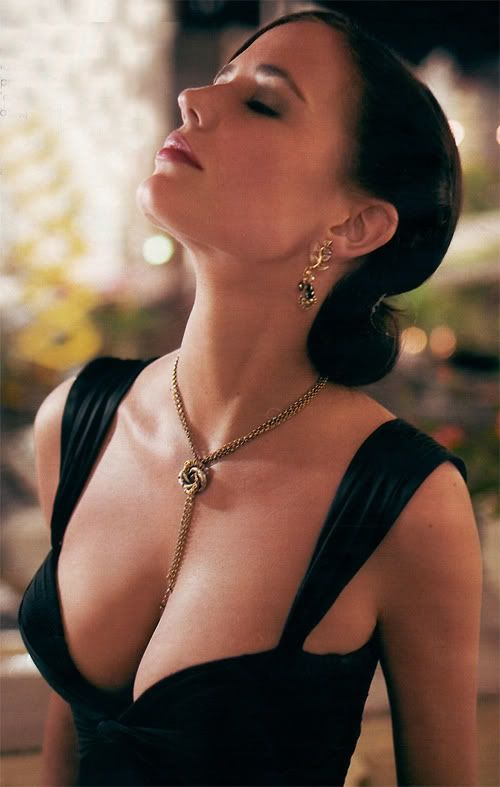
Antoine Doinel wrote:Matt wrote:I'll be able to tolerate it a lot better if they bring back the naked lady silhouettes in the credits instead of sticking with, uh, playing cards like in the last film.
Naked lady silhouettes aren't really necessary when you have Eva Green spending a good portion of
Casino Royale looking like this:
Naked ladies are always necessary.
Always.
Or perhaps I should say artistic nudes. The appreciation of female beauty in the nude is one of the great pleasures of life -- even for women. The last several Bond films are downright chaste, if not prudish. I say, let's allow female sexuality to bloom again in the Bond films as in the original novels, and let's be more adult about it, too, as in the novels. The novels achieved an eroticism that was never condescending or pornographic; compared to what best-selling authors are publishing today, Fleming's eroticism was mild. Let the films grow up in their depiction of sexual relationships between Bond and women. What we've seen in the last few films, and especially in
Casino Royale, is a kind of regression, and a hypocritical regression at that.
karmajuice wrote:The Bond movies can be rather silly. And not just in the campy way everyone associates with Bond, but some of the movies are downright surreal. In fact the success of the series often baffles me, because the movies are so frequently bizarre and absurd. Diamonds Are Forever stands out as particularly odd, but nearly all of the movies have at least some inexplicable quality (a dead woman painted gold, a dragon machine on the beach, a hall of mirrors climax, a dude with metal teeth who can BITE POLES IN HALF). The exception being the most recent ones with Daniel Craig, which are about as realistic and gritty as one can expect a fanciful spy thriller to be (making some assumptions about this upcoming one, of course).
I'm not sure which style I prefer. I like both for entirely different reasons. Would there be pre-existing thread to discuss the more bizarre elements in Bond films, and does the topic mystify or provoke anyone enough to discuss it besides me?
It provokes me, and I know which style I prefer.
Ian Fleming didn't write juvenile, silly sci-fi fantasies about cars with ejector seats, underwater jet packs, sports cars that turn into submarines and jet planes, space shuttles engaging in laser battles, gondolas that turn into secret weapons, and subterranean ocean lairs for mad scientists. Nor did he write about giants with superhuman strength and steel teeth, nasty midgets who fit into suitcases, or caricatures of southern sheriffs for comedy relief. The producers imposed these elements on the script writers and directors. The Bond films are producer's films. Their creative control is inflexible, and putting across their agendas is a pre-requisite to employment. This is why directors like Steven Spielberg and Ridley Scott are turned down. They won't be controlled.
Ian Fleming wrote internalized thrillers. Noirs. Feverish noirs. His James Bond may be a blunt instrument, but he is a thinking, reasoning blunt instrument even during his first mission in which he allows the
femme fatale to get under his skin. Bond is also a moral compass; he operates on honorable motives and does the right thing for the right reasons. The most engaging parts of the novels are when Bond
thinks, and Fleming puts the character's voice into our heads as he reasons through a problem or a challenge and steels himself to face an ordeal. Fleming's writing was very pungent, an appeal to our senses. The relationships are sophisticated, the sexuality is adult, and there is no shying away from giving the female characters equal measure and equal exposure.
There is an element of surrealism in the novels, but not in the campy, farcical, sci-fi way of the films. Let's not misconstrue the chapter-serial structure of
Diamonds Are Forever or the fun-house shooting gallery of
The Man With Golden Gun with Ian Fleming's novels. What you describe as surrealism in the films is more of an attempt at farce. Bad comedy. Tongue-in-cheek turned pedantic. Fleming's surrealism was dark, deep, and dangerous; like the nude girl who suffocates from being covered in gold paint. Often, the surrealism is connected to the eroticism. I believe Ben MacIntyre and James Chapman deal very well with the issue of Fleming's surrealism in their respective books.
I would like to see the austere minimalism and emotional intelligence of the novels brought to the cinematic James Bond.
Dr. No,
From Russia With Love, and
On Her Majesty's Secret Service struck just the right balance between the size of the production and the tone of the story without resorting to farce or caricature. The latter film develops the character of Bond and gives him an arc, as did the novel, which audiences appreciated at the time, and which approach was promptly discarded along with Peter Hunt. There are bits and pieces in the latter films that do something interesting or something in the spirit of Fleming, particularly
Licence to Kill, but Bond deteriorated mainly into a one-dimensional work horse in expensive clothes in most of the films.
Casino Royale and, judging from the first reviews,
Quantum of Solace is much closer to what Fleming intended, but there are significant problems with the former that noone seems willing to confront.
Casino Royale is a barely literate adaptation and a profoundly bad film. What was needed here was a skilled dramatist who knows how to convert character into action without writing reams of expository and redundant cell-phone chit-chat that add up to over an hour of screen time. Worse, the militant feminism of
Casino Royale repudiates both the morality and the internal workings of Fleming's character in subtle ways, and threatens to turn into a new kind of camp. I don't think anyone has really analyzed what's up there on screen.
Richard