Re: The Soviet Influence: From Turksib to Night Mail
Posted: Wed Aug 03, 2011 12:57 pm
https://criterionforum.org/forum/
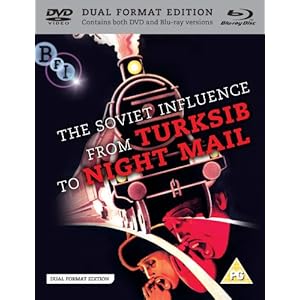
The Soviet Influence: From Turksib to Night Mail
In the early 1930s, a small number of Soviet propaganda films were shown in Britain, and excited filmmakers such as John Grierson, Paul Rotha and Basil Wright – luminaries of the British documentary film movement – who were then developing their ideas of film as an art form.
The Soviet Influence, a new BFI Dual Format Edition strand, explores the impact that these films had on British directors by presenting key Soviet works, along with the British films which they inspired, in specially curated editions.
The first release in this occasional series, entitled From Turksib to Night Mail, explores the profound effect that the classic, yet little-seen silent Soviet documentary Turksib (Viktor Turin, 1929) had on British documentary films, including the celebrated Night Mail.
Turksib is a bold and exhilarating film which brilliantly illustrates the problems faced by regional farmers and trades people, and highlights the need for the Turkestan-Siberian railway. Dazzling, arresting, and yet curiously overlooked, this fine example of Soviet montage cinema was presented to British audiences in 1930 in a version prepared by documentary pioneer John Grierson. That same version is included here with a newly commissioned score by Guy Bartell (from celebrated electronic outfit Bronnt Industries Kapital), and is accompanied by a collection of archival British documentary shorts, all of which were made in the wake of Turksib by filmmakers whose debt to the film is very much in evidence.
The British films are as follows:
• The Workers’ Topical News No 1 (1930): the newsreel shown at Turksib’s British premiere;
• Australian Wine (Paul Rotha, 1931): charming and lively promotional film employing Soviet-style montage techniques;
• The Country Comes to Town (Basil Wright, 1931): a celebration of the importance of the British countryside;
• Shadow on the Mountains (Arthur Elton, 1932): expressive titles and cinematography are deployed in this lyrical film about farming;
• The Face of Britain (Paul Rotha, 1935): a passionate and ambitious appeal for socialist planning;
• Night Mail (Harry Watt, Basil Wright, 1936): justly celebrated, this seminal film applies the aesthetic lessons of Soviet cinema to a very British tale.
Special features
• Presented in High Definition & Standard Definition with new HD transfer of Turksib;
• Newly commissioned score for Turksib by Guy Bartell (Bronnt Industries Kapital);
• New musical scores for The Workers’ Topical News No 1, Australian Wine and Shadow on the Mountains by Neil Thomas;
• Extensive, 36-page illustrated booklet which draws on the writings of John Grierson, Basil Wright, Paul Rotha and others to chart the Soviet influence in the development of British documentary filmmaking
Release date: 19 September 2011
RRP: £19.99 / cat. no. BFIB1130 / Cert U
UK and USSR / 1929-1936 / black and white / English, and silent with music / 163 mins / Original aspect ratios 1.33:1 / Region 0 / Disc 1: BD50 / 1080p / 24fps / PCM mono audio (48k/24bit) / Disc 2: DVD9 / PAL / Dolby Digital (320kbps)
Oh ...NABOB OF NOWHERE wrote:Should we read anything in the dropping of Volume 1 in favour of an "occasional series"? Is it now more of a toe in the water to gauge sales than a definite series?
 ... It would be a pity, if there were no further instalments!
Phew..ThanksMichaelB wrote:The press release makes it pretty clear that they intend to produce more than one. As far as I'm aware, a second volume is definitely on the cards.
...I have to question whether this guy actually bothered to watch the film before "reviewing" it. Aside from the glaring factual error about the positioning of the Auden poem (which famously, and memorably, appears for the first time in the final montage), he tells you absolutely nothing that couldn't be gleaned from the credits and a quick skim of the booklet.Finally, the much heralded Night Mail (Harry Watt, Basil Wright, 1936) closes out the collection. It is the culmination of the Soviet influence over British documentarians with all the techniques garnered through the years focused to pinpoint precision on a thoroughly British film. The documentary features music composed by the great Benjamin Britten and a poem by the equally great W.H. Auden and tells of a mail train traveling from London to Scotland, “This is the Night Mail crossing the border / Bringing the cheque and the postal order,” begins the film with Auden’s famous lines as the wheels of the train clickety-clack off on its journey.
“Don’t disturb me,” I found myself snapping at a variety of distractions the other night. “I am watching a black-and-white documentary on the building of the Turkestan-Siberian railway.” Unlikely as it may seem, Turksib, Viktor Turin’s 1929 epic, is a richly engrossing exposition on, well, the urgent need to increase cotton production and the efficient use of surplus grain. I know that’s not the kind of line that lures punters into the Multiplexes these days. But it’s our loss.
The DVD department has gone from strength to strength, with the splendid Flipside strand being complemented by numerous relishable collections from the documentary archive. The latest, The Soviet Influence: From Turksib to Night Mail, is one of the best yet and suggests a new direction in film studies aids designed to prompt viewers into reassessing cine-truisms in much the same manner as Mark Cousins's muddled, egotistical, but nonetheless laudably original and ambitious 15-part series, The Story of Film: An Odyssey.
While the visual techniques and editing may not be as dazzling or intricate as other Soviet films, and with the picture quality inevitably having damage from time to time, the BFI’s restoration has managed to allow Turksib’s aesthetically beautiful depiction of Soviet life to be realised. As a whole, From Turksib To Night Mail manages to superbly exemplify just how important the work of Soviet cinema was to British documentary.