Page 11 of 21
Re: Documentaries List Discussion & Suggestions (Genre Proje
Posted: Sun Dec 29, 2013 6:06 pm
by domino harvey
Frank Lloyd Wright (Ken Burns 1998) / Not For Ourselves Alone: Elizabeth Cady Stanton and Susan B Anthony (Ken Burns 1999) / Mark Twain (Ken Burns 2001) / Horatio's Drive: America's First Road Trip (Ken Burns 2003) So the question has arisen in this thread and elsewhere before, do we grade documentaries on a scale of filmic art or educational value? It would be hard to argue for Ken Burns' work on the filmic art side of the argument, as his style has become so well-regarded, lampooned, and ripped-off that its now the standard bearer for most non-ADD-edited docs. I like Burns films because I like learning something new, but I'm not sure how much of that will carry-over to my final list. The best shot of this round of viewings (I was clearly house-cleaning my unwatched pile by finishing one of the Ken Burns boxed sets) was Horatio's Drive, which tells a compelling story previously unknown to me of the first cross-country automobile drive, and while that may not sound so interesting, the story itself is so fascinating and told with wry humor (and there's even a dog mascot that gets picked up early) that it's a wonder Hollywood hasn't turned it into a big budget narrative feature. Tom Hanks' vocal perf as the titular driver Horatio goes a long way towards helping the folksiness of the source material. Folksiness also drives Mark Twain, a four hour walking tour of Twain's life that imparts a lot of safe, easy to digest biographical material without ever really engaging its fascinating central figure or, more damningly, his work-- when we only got a series of cliched hagiographic talking head responses to Huck Finn, I knew the film was in trouble. The worst of this lot was Not For Ourselves Alone, which presented a tale too far removed from current insight and Burns showed little interest in engaging in the fight for suffrage beyond more safe biographical anecdotes. This film was long (over three hours, I think) and a total chore to sit through. Frank Lloyd Wright surprisingly shows Burns at his most playful, with the architect treated not with simple deification like many of Burns subjects but more a begrudging admission of the brilliance of an asshole-- in anecdote after anecdote, Burns and his commentators makes the case that Wright was a demanding, selfish, curt jerk who was lucky he was so talented, and the doc is frequently laugh-out-loud funny as Burns finds several architecture experts to gingerly dance around the elephant in the room while praising Wright out of the side of their mouth. If only every Burns doc could be this lively!
Re: Documentaries List Discussion & Suggestions (Genre Proje
Posted: Sun Dec 29, 2013 8:46 pm
by Lemmy Caution
Re-watched Brother's Keeper, which reminded me why it will place very high on my list. The pace and storytelling really mesh. It's such a good tale of a possible murder, or maybe a mercy killing, or an accidental death or even some kind of sex crime. Then the town rallies around a bunch of outcasts. A very interesting glimpse into rural poverty and small town values.
It's almost painful to watch nervous brother Lyman on the witness stand. Not the most persuasive witness, as he's literally shaking when he disavows his deposition testimony. It is painful to watch the pig killing scene -- fortunately my blanket blocked my view of the screen until that ended.
I had forgotten that the old yellow school bus was being used as a chicken (& turkey) coop. I really liked the two main friends of the Ward Bros, who stand by them and comment intelligently on the events and the brothers. I enjoyed the music throughout, with its Appalachian feel.
It's funny but I assumed all of the brothers were close to 70, but at the time of the film/trial the accused Delbert was just 59, though looking much older. The brother who died was 64. Seemed like a throwback to when medical care was limited, as it undoubtedly was for the Ward Brothers, and life expectancy was around 66.
One thing I noticed this time was how the medical examiner sounds exactly like Woody Allen. Which is pretty amusing when he tries to show off a little and gives extended banal examples which really have nothing to do with the case. It's a little less evident when he tries to evade giving the answer the defense attorney is trying to elicit.
This documentary blew me away on first viewing and still is powerful even when you've met these characters before and know how it turns out. Really a must-see doc.
Re: Documentaries List Discussion & Suggestions (Genre Proje
Posted: Sun Dec 29, 2013 9:58 pm
by swo17
matrixschmatrix wrote:FORUM MEMBER SPOTLIGHTS
Queen of Trees (Victoria Stone & Mark Deeble), Matt. Available on DVD
here and on YouTube
here.
That YouTube link is dead, but it looks like there is another one
here.
Re: Documentaries List Discussion & Suggestions (Genre Proje
Posted: Mon Dec 30, 2013 4:05 am
by matrixschmatrix
Updated, thanks.
Re: Documentaries List Discussion & Suggestions (Genre Proje
Posted: Mon Dec 30, 2013 4:08 am
by domino harvey
Matrix, can you make
Surviving Edged Weapons my second spotlighted title? I wrote it up
in-depth here and maybe if we're lucky swo will up a copy somewhere again (I, uh, lost mine, but others would like it too I'm sure)
Re: Documentaries List Discussion & Suggestions (Genre Proje
Posted: Mon Dec 30, 2013 4:25 am
by matrixschmatrix
It's up. Let me know if the youtube link is wrong.
Re: Documentaries List Discussion & Suggestions (Genre Proje
Posted: Mon Dec 30, 2013 4:39 am
by domino harvey
No, that's awesome, I didn't know someone upped it to YouTube in whole and in the right aspect ratio. Now everyone can enjoy it! Apologies in advance to everyone who watches this for ruining your life \:D/
Re: Documentaries List Discussion & Suggestions (Genre Proje
Posted: Mon Dec 30, 2013 4:42 am
by swo17
domino harvey wrote:I, uh, lost mine
HOW HAVE YOU BEEN SURVIVING EDGED WEAPONS ALL THIS TIME???
Re: Documentaries List Discussion & Suggestions (Genre Proje
Posted: Mon Dec 30, 2013 4:48 am
by domino harvey
I can't wait to rewatch this so I can once more safely reenter the outer doors
Commie Infighting & Nazis ...
Posted: Fri Jan 03, 2014 10:22 am
by Lemmy Caution
Caught up to
Ordinary Fascism (1965).
It's actually a more interesting film for when and why it was made rather than the content itself. Clearly the intent of criticizing Hitler and his dictatorial powers, his personality cult and attendant sycophants is to condemn the similar path that was trod by the USSR under Stalin. Kind of a tricky business, and the film goes so far as to praise the German people and German workers, arguing that Hitler and the Nazis fomented instability and bullied its way to power at the expense of noble German socialists. The interesting thing is that such an analysis could be applied to Lenin and the Russian Revolution, though I'm almost certain that is not the intent.
There's some interesting footage, some taken from captured German high command footage. But it's really not that well put together. The narrator sounds like he is supposed to represent your favorite uncle telling it to you straight with common sense and folksiness. There are plenty of cheap shots, such as when they show some large assembly and a grand dais, and Hitler enters. The folksy Russian narrator intones that
there is just one chair and it's for Hitler. And he's taking in the assembled masses. And, oh there, now he sits! As though this is Nero in Rome or somesuch. What's amusing is that there are actually 5 chairs clearly visible. One is center and grander, but there are 4 other chairs right there just slightly behind. Yeah, Hitler strides in and sits first, but to ridicule him for, in an exaggerated manner, that is kind of shoddy. The film also takes glee in freeze-framing the faces of Nazi leaders in ugly unflattering poses, much as Drudge does with Hillary and Obama. Early on, the film bludgeons us with some images of kids in cute poses followed by dead bodies, Nazi victims, in similar poses. Subtlety (and fairness) are not exactly the film's calling cards, except with reference to the Soviet Union itself which is rarely mentioned except as a Nazi victim.
The film is overlong, but worth seeing. Some good glimpses of ordinary German life in the 30's, and some mass rallies which I hadn't seen before. But most interesting for its implicit criticism of Stalin, and attendant praise for ordinary Germans who were oppressed and misled by a dictator. Unexpected to hear a Soviet political film from 1965 telling people they need to think for themselves and not just blindly follow their leaders.
Btw, I have a Russian edition, but the writing on the dvd is all either Cyrillic or Chinese. It has good English subtitles. If anyone is interested I can try to track down which edition is actually is.
Here's the cover:

And the film poster which is on my inside disc sleeve insert:
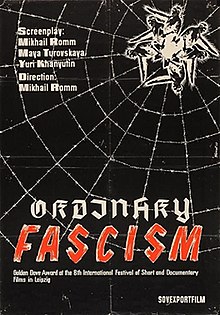
Edit:
the wiki page says that director Romm did the narration himself.
Initially, the filmmaker had sought a speaker for this job, but when his comrades heard working versions of the comments written by himself, he was advised to record his own voice-over. Finally, the comments by his peculiar vocabulary and intonation, became one of the main identifying features of the film.
Oddly the wiki page doesn't mention at all the implicit criticism of Stalinism, which seems to me the most interesting aspect of the film, and the main reason the film is constructed as it is. Odd.
According to one source I found, the film was made in 1961, which would put it squarely into Khrushchev's reform era, but wasn't released until 1965, when Brezhnev was busy drunk driving the Soviet state. It'd be interesting to know more about that history -- at what level this project got the green light, who supported it, and any changes made before the Brezhnev regime allowed it to be released.
I was also wondering if the film also contained a dig at Mao's China. Khrushchev had spent a lot of energy and resources throughout the 50's courting China, transferring a lot of technology, sending teams of engineers, educating a generation of Chinese leaders and engineers, etc. But by 1959, the close cooperation had fallen apart as Mao insisted on being his own dictator*, and trying to be a leader of world communism opposed to Khruschev's relative liberalism. Mao was also strongly opposed to Khrushchev's repudiation of Stalin, which this film is all about. I think politics were such a frontburner issue in the Soviet Union of that day, that audiences couldn't help miss the anti-Stalin critique, and probably could easily extend it to renegade China, where Mao's personality cult was plainly evident and gearing up for the overdrive of The Cultural Revolution launched in 1966.
* part of the rift was due to Khrushchev trying to undertake rapprochement with Tito's independent brand of socialism, and Mao wanting to maintain a hardline against reform-minded communism and lead a more active communist struggle v. Western Capitalism. Tito had been such a thorn in the USSR's side that Stalin repeatedly tried to assassinate him. Prompting Tito to send a message to Stalin that if he didn't stop sending assassins to Belgrade, Tito would send assassins to Moscow, and he would only need to send them once. Ballsy little commie was he.
Re: Documentaries List Discussion & Suggestions (Genre Proje
Posted: Sat Jan 04, 2014 6:13 pm
by swo17
domino harvey wrote:Should I Marry Outside My Faith?
This was actually a bit more well done than I might have expected for an educational film of this nature. I can see how an outsider could see this as an unintentional indictment of religion, and of Catholicism in particular, but I dunno, if you take religion out of the equation, isn't the central tenet of the film (i.e. if you feel very strongly about a certain tradition, belief, political ideology, etc. or are adamant about raising your children a certain way, you should talk about this with a potential spouse in advance, and if you aren't on the same page about something this important to you, it could add friction to your marriage) actually pretty sound advice? The couple in the film seem like genuine people who have the best intentions for their courtship, but they also seem a little clueless--perhaps blinded by love to some extent--about things that you really should be discussing with each other before deciding to start a family together (again, even taking religion out of the equation, there are still the potentially contentious issues of how many children to have, how you might use birth control, who will work, where you'll live, what kind of relationship you'll have with your respective families, how you'll manage finances, how and when to teach your children certain things about the world, etc., etc.). If religion isn't that important to both you and the person you are dating, then presumably the consequences of interfaith marriages that this film warns against won't be worth much consideration to you either. But that doesn't rule out the possibility of there emerging an "impenetrable wall" between the two of you.
Re: Documentaries List Discussion & Suggestions (Genre Proje
Posted: Fri Jan 10, 2014 11:22 pm
by bamwc2
Viewing Log:
The Battle of Chile (Patricio Guzmán, 1975-9): I've had this one on my radar ever since its DVD debut a few years ago, and now I can finally see what the fuss was all about. This three part epic examines the the tumultuous election of President Salvador Allende, the US backed coup that claimed his life, and the early aftermath that would eventually lead to the country's leftists (and thousands of others) being "disappeared". Using whatever footage he could get his hands on, Guzmán brilliantly reconstructs a tale of a country whose counterrevolution stands as one of the greatest tragedies of the latter half of the 20th century. It's essential viewing for the project.
The Cove (Louie Psihoyos, 2009): This Oscar winning documentary chronicles the activities of former dolphin trainer turned animal rights activist, Ric O'Barry, as he and his Western cohorts attempt to expose the horrors of Japan's annual dolphin harvest. The practice depicted here (and there is plenty of a serendipitously shot footage of the slaughter as well as numerous eyewitness testimonies) is undeniably horrific, but it would have been nice to have heard a bit more on the Japanese justification for the practice. Speculation about duplicitous meat labeling and overfishing is made, but the most that we get in terms of an official word is the brief mention from a governmental representative that Japan holds that is that there is nothing special about dolphins. Strange. Otherwise, it's competently made and difficult to dispute its leanings.
Dear America: Letters Home from Vietnam (Bill Couturié, 1987): I have to admit that despite hearing good things about this documentary, my hopes were not too high going in. The central conceit involves mid 80s celebrities reading letters written by soldiers serving in Vietnam, so I was afraid that it would be a project for them to stroke their egos by showing their compassion for veterans. Thankfully the novelty of the their voice acting wore off quickly for me, and only a few hit me as immediately recognizable when I wasn't thinking about it. The film begins with like a standard documentary on the subject. We see the start of the American involvement in the conflict and hear
Fortunate Son blast over the footage of soldiers landing on the beaches. However, as time went by, the film proved itself anything but conventional. Breaking down events chronologically, the film introduces each year after the first by recounting the numbers of total troops, KIAs, and WIAs at the beginning of the year. The letters prove emotionally wrenching with at least a few of them written by soldiers days before their deaths. Aside from a pair of rather obvious choices, the film also makes great use of pop music from the time, with Bob Dylan's
A Hard Rain's Gonna Fall perfectly matching the material on screen. HBO had such an amazing run of documentaries in this time period, with this and
Common Threads: Stories from the Quilt (another lock for my list) being real standouts. Too bad Bill Couturié biggest project after this was
Ed.
Essene (Frederick Wiseman, 1972): Despite being an atheist, I grew up in the Catholic Church and still retain a lot of the teachings (especially the fabled guilt!). So, I was quite interested to see Wiseman's examination of monastic life in a Benedictine brotherhood. While I wouldn't rank it as one of his finest works, it still proved fascinating to see the various attitudes and clash of personalities behind the scenes. The old guard tends to come off as boisterous, confrontational, and in at least one instance, obnoxious. The younger--I hesitate to say hippie though that may actually fit--monks on the other hand present themselves in a more silent and meditative manner. It won't make my list, but it still was a very good work.
Meat (Frederick Wiseman, 1976): Without comment, Wiseman guides us through the process of how a cow ends up on your dinner plate. We begin with the animal on the farm, see the act of slaughter, process, packaging, and commodity trading. There is very little else to say about the material, as there is never any attempt at contextualization or editorializing at all. Nor are there any people who appear on screen for more than a few minutes. When they do, we're shown them going about their business instead of talking to the camera. That's the kind of objectivity that I love from Wiseman. While the majority of the films that I've watched for the project all try to argue for some point of view, he lets the images speak for themselves. Though highly gruesome, I would encourage all to watch it, if for no other reason to see where your meat comes from. Sadly little has changed since this film was made.
Re: Documentaries List Discussion & Suggestions (Genre Proje
Posted: Sat Jan 11, 2014 2:44 am
by Gregory
Nice recommendation for The Battle of Chile. I wasn't totally sure what you meant about Guzmán making the film "using whatever footage he could get his hands on," but the vast majority of it was shot by Guzmán and his team (Tercer Año), with only a bit of newsreel footage used to fill in here and there. The third part also used some footage repurposed from Guzmán's earlier La Respuesta de Octubre. But the film Guzmán, Jorge Müller, and company shot (especially in the first two parts) was often just incredible, reaching new heights for documentary filmmaking at a worldwide level.
Re: Documentaries List Discussion & Suggestions (Genre Proje
Posted: Sat Jan 11, 2014 3:20 am
by matrixschmatrix
As I recall, Guzman actually got film stock smuggled into the country for him by Chris Marker.
Re: Documentaries List Discussion & Suggestions (Genre Proje
Posted: Sat Jan 11, 2014 3:56 am
by bamwc2
My mistake. I thought that the films were assembled out of footage gathered from various sources.
Re: Documentaries List Discussion & Suggestions (Genre Proje
Posted: Sat Jan 11, 2014 3:59 am
by Gregory
matrixschmatrix wrote:As I recall, Guzman actually got film stock smuggled into the country for him by Chris Marker.
That's true. Film was difficult to obtain during Allende's time thanks to the U.S. imposed economic chaos. And then after the coup, the film industry was almost totally shut down. The military that occupied the state film production and distribution company actually burned a lot of film stock (along with other media). Guzmán's team could only obtain the footage they needed through the creation of a lot of false identities and covering up the nature of what they were working on for months and months.
By the way Raúl Ruíz fans may know Jorge Müller's work as the cameraman behind a couple of the early films such as La Expropriación and El Realismo Socialista, but not after 1974 when he sadly met up with some horrible end as one of the Pinochet regime's "disappeared."
Re: Documentaries List Discussion & Suggestions (Genre Proje
Posted: Sun Jan 12, 2014 7:11 am
by knives
Gregory wrote:
By the way Raúl Ruíz fans may know Jorge Müller's work as the cameraman behind a couple of the early films such as La Expropriación and El Realismo Socialista, but not after 1974 when he sadly met up with some horrible end as one of the Pinochet regime's "disappeared."
Which reminds me of the beautiful pseudo sequel included on the Icarus set. Setting questions of quality aside I actually find it to be more emotionally devastating a project with a mournful hindsight that goes beyond (harrowing) storytelling. It's as important a film.
Re: Documentaries List Discussion & Suggestions (Genre Proje
Posted: Tue Jan 14, 2014 5:04 pm
by knives
domino harvey wrote:Came across a surprising inclusion while plowing my way through Fantoma's second Educational Archives set:
You Can Change the World, a propaganda piece directed by McCarey in the same year as
My Son John and featuring an all-star cast. The flimsy premise here is Jack Benny has invited William Holden, Ann Blyth, Loretta Young, Irene Dunne, and Paul Douglas (who is given the most lines to the point that you'd think
he was the biggest star included) to hear Father James Keller implore the actors to make a film extolling the virtues of the Catholic civic group the Christophers, which hoped to ferret out the "one percent" of Communist element negatively impacting American society. The film has almost zero entertainment value and I presume the stars included agreed to be there for personal religious reasons above even political ones, but it could be of some interest to fans of McCarey or
My Son John. If you want it on disc it's available on Vol 5 of the Education Archives,
Patriotism, but it's also been uploaded to YouTube in a shorter form
here
Also, while searching about the film, I found this lengthy academic article from
the Journal of Religion and Film exploring McCarey's Catholicism through his films titled "the Sins of Leo McCarey," which is available for download
here
Are those sets good? Amazon has a collection of the first four at a reasonable price.
Re: Documentaries List Discussion & Suggestions (Genre Proje
Posted: Tue Jan 14, 2014 8:00 pm
by domino harvey
knives wrote:Are those {Fantoma Educational Archives) sets good? Amazon has a collection of the first four at a reasonable price.
The second set (the one in a locker) is great. I'm just now working my way through the first set (lunchbox) and so far it's a lot more of the "obvious" inclusions. The best by far are Kino's Classical Education Shorts series-- each disc is jam-packed with shorts and they, like the Fantoma and Alpha's Atomic Age Classics comps, are curated by Skip Elsheimer.
Troubled Teens,
Rules for School, and
How to Be a Woman are my favorites, but I can heartily recommend all six. The Atomic Age Classics sets are pretty good too, they're just not very long (about 90 mins each), but if you catch 'em on sale grab 'em. There is little to no overlap amongst all these sets from different labels, surprisingly.
Re: Documentaries List Discussion & Suggestions (Genre Proje
Posted: Tue Jan 14, 2014 9:23 pm
by knives
Cool, I'll aim for the locker this week then (though I'm swamped in Wang and Wiseman viewing wise).
Re: Documentaries List Discussion & Suggestions (Genre Proje
Posted: Tue Jan 14, 2014 10:21 pm
by Gregory
For anyone not already familiar with it, check out Archive.org's Ephemeral Films section for thousands of old educational films, PSAs, etc.
Re: Documentaries List Discussion & Suggestions (Genre Proje
Posted: Wed Jan 15, 2014 11:08 pm
by knives
Haven't done this in a while, but a small watched dump.
Chasing Ice
I can only imagine what someone like Herzog could do with this subject matter, well I don't have to imagine too hard given Encounters at the End of the World. The film essentially combines two forms of documentary expression, the problem film and the character study, in a way that makes it feel fresher than it actually is. It's not particularly interesting as either one lacking the investment needed for the character study and being too interested in being direct cinema to function well as a problem film and yet the film compliments both facets well enough that when it focuses on one side more than the other, usually the problem portion, it feels so out of place that whatever information is being delivered feels leaden and useless. I'd assume anyone interested in this already saw An Inconvenient Truth so having the info dump come off as this exposition with talking heads isn't helping anything. Having Balog and his project being a constant anchor would have aided the film much more especially since the talking head segments lack the beautiful cinematography that really keeps this information interesting. This is a film, ironic considering its repeated message, that needs more human investment.
Jiro Dreams of Sushi
Some nice food porn in this which made me immediately buy some Pho (no close sushi shops alas), but as a movie it's just not very good. Jiro remains something of a non-entity with his employees too busy Harry Liming him to be compelling by himself. There's also surprisingly little dedicated to the sushi making process itself which always comes as the best moments in the movie even presenting a few interesting moments of spontaneity like the bell ringer at the fish market. It's just too lightweight for its own good.
American Movie
Whenever anyone talks about this film it sounds like a comedic hagiography along the lines of a low rent Ed Wood and that's what I was expecting. Something fun and entertaining if ultimately not great. Colour me surprised that this film despite the silliness at the center actually plays to drama often, early, and effectively. Borchardt isn't even effectively deluded thinking in dark terms about his life now and his art now throughout the movie. He seems ready to be the first (though not only) one to admit this filmmaking is almost a psychotic break to escape from this house of shit he's built for himself. I guess this makes the film more Brazil than Ed Wood.
At the same time it almost turns sweet the levels by which he degrades himself for this escape. The adventures with Bill at first seem like elderly abuse and probably are regardless, but then we get things like the washing sequence and it becomes impossible not to get behind Borchardt. This is a man who will do anything to get his movie off the ground. As an aside to that watching Coven reveals a pseudo-Wiseau genius afoot with a real personal edge though at the same time I have to wonder if that nakedness would be as clear without Smith's movie?
Public Speaking
corsese plays background to Lebowitz which is probably the only logical thing since she's already so cinematic in her speaking. What few flourishes he does add probably aren't necessary, but do heighten her words in a nice playful manner. In fact it might be interesting in light of the film's wit discussion to see how Scorsese adds warmth to Lebowitz and what that means about him and his cinema. She never dials it back and seems to at times say things she knows are a concern of his in a way to make him flinch and yet the flinching doesn't really translate to the film.
West of the Tracks
The most shocking thing about this film, for me, is how many forms it takes. I suppose the three sections should have been a clue, but I was under the impression of Wang having a very specific style and the little I've seen up to this point (a feature and a short) kept to that impression. Not only is his style here different, it radically changes as three movies across the whole concept starting first with a straightforward direct cinema exploration of factory workers (which fit well with my assumed impression), followed up by more personal tales that might as well have been made by Zhang-ke Jia, and ending with an agoraphobic ghost town.
They cohere and separate in ways which provides a unity through the distinction though (I suppose this is a duh, but still not what I was expecting) hitting many of the same notes though emphasized in different ways. I guess the best comparison to this I have is the difference between a song being played brass versus strings and so on. While each part evolves from a natural expansion (work, town, nothing) it emotionally doesn't emphasize that way with the second section for example having a more powerful opening pulse that almost suggests the death of the factory hasn't hit them quite yet. Though it also makes for the most dramatic shift to the death of their lives and overall is the most emotionally effective.
Going back to coherence though the film through all three parts features many similar scenes such as the break room moments and the discussions on education and the revolution. At a certain point into the third film it almost seems like they're trapped acknowledge how the revolution failed and the changes away from it is failing them even more but totally unable to act on that knowledge. The people remain flat enough in characterization throughout the film so that while they take on new forms and new immediate concerns the people portrayed feel like a single group living variations on the same hell forever.
One of the most interesting things for me on that account is how Wang consistently ties emotional realities of the modern age back to money with transactions constantly flowing and even interactions having nothing to do with money coming across that way. I'm thinking for instance of in the second part the insincere conversation over the love letter which duplicates the severance pay discussions so well that even though the letter was the main plot for these characters up to this point I was fooled. In this way the film in total more readily reflects Naruse (or Fassbinder I suppose) than even my previously mentioned Zhang-ke.
Re: Documentaries List Discussion & Suggestions (Genre Proje
Posted: Thu Jan 23, 2014 3:34 am
by knives
Just popped in that first disc in the Fantoma set and already it's more than paid for itself. The Despotism film that starts things off is fascinating in lew of the time it was made, the time the preceded it, the time that would be coming soon and finally now when the distribution of wealth and several other things the film talks about is so split. It almost freakishly predicts where the US would go while at the same time expressing almost a naivety over how to counteract these effects or how despots under their description don't have to be politicians. Very impressive.
Re: Documentaries List Discussion & Suggestions (Genre Proje
Posted: Thu Jan 23, 2014 3:43 am
by domino harvey
Yeah, it's pretty scary how accurate it is, isn't it? If you're not already, I recommend watching each film individually rather than Play All so that way you can read Skip Elsheimer's notes. They're not as thorough as his ones for the Kino comps, but it helps to place the shorts in context and when you get to the Religion disc, you'll def want them
Re: Documentaries List Discussion & Suggestions (Genre Proje
Posted: Thu Jan 23, 2014 3:48 am
by knives
Thanks, I'll do that option after The Great Rights which isn't as good but does feature great work from the UPA staff.