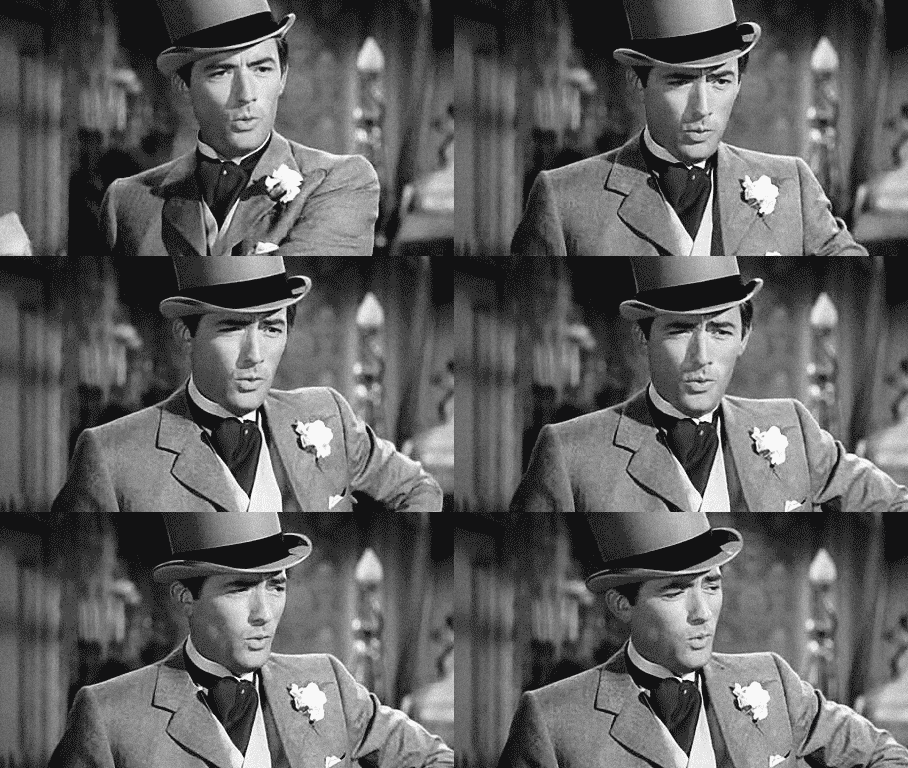
Sweet Smell of Success (Mackendrick, 1957) My roommate and I have been watching movies together every few nights during shelter-in-place, and the routine we've gotten into is that I pick 4 or 5 movies, he'll narrow it down to two, and I'll make the final call. A few nights ago, I discovered an unexpected wrinkle in our naturally-evolved method of selection: "See, the problem is that you’ve narrowed it to a movie I haven't seen and a movie that is quite perfect. If we watch the one I haven't seen and it's anything less than very good, the whole time I'll be thinking how I could've been watching Sweet Smell of Success..." I'm honestly a little surprised this missed the top 10 last time, and though there’s a healthy standalone thread for it, it doesn't seem to have garnered much discussion in the past or present decade threads. I assume that's because it needs no introduction, but just in case…
Generally speaking, I'm averse to notions of efficiency, precision, "tightness" as markers of some kind of inherent quality. Those qualities have their uses, but they are too readily used as shorthand praise (which I'm nevertheless guilty of). Give me excess, overflow, exaggeration (see my preceding and following blurbs…).
Sweet Smell is, though, one of those perfect cases of efficiency, doubly so for being coupled with a complimentary excess–a little fat to make it sizzle. The trick, I think, is in how carefully relentless it is: never overwhelming, always escalating, always a little sugared with overt cleverness, but perpetually on the brink. Act breaks, as much as they exist, last as long as a cut and an establishing shot; breathing room in a scene comes not so much from deescalation but attention's porousness to verbal wit as you’re briefly distracted by parsing a turn of phrase, and so miss the next one. (In that light, I actually think Steve's oft-criticized blandness, both as an actor and as a character, works well—he's your only chance to relax and take someone at face value.) But while the script’s distracting verbal excess serves a tactical purpose, by acting as a kind of release valve for your attention, it also rounds out the characters, who are dazzling and befuddling the people who just can’t quite keep up—like Steve—just as much as they’re dazzling us. "People" don't talk "like that," but these people do, and they know how odd it is and the power it has. Every word of every sentence is a parry and thrust, for everyone in their racket but especially for Falco and Hunsecker, such that even someone landing a blow against them is admirable; imitation is sincerest flattery, and they're keeping form even against unprepared opposition: "You're picking up my lingo, hon." "I read your column every day." And, whether you think them clever or too much by two halves, the lines that take a few half-seconds to process, not even appreciate, are so densely packed that different fireworks go off every single time I see this movie.
In talking about efficiency vs expansiveness after the movie, my roommate made the comparison to the opening narration over the visual dramatis personae of
All About Eve, another recent watch for us. In
Eve, that expansiveness establishes the ground for a very long arc, during which we see Eve and Margot and most of the other characters becoming wildly different people to us, maudlin or sympathetic, empathetic or raging, under the different pressures of the narrative. Comparatively, in
Success, no one, save one, changes in the least. There’s no time. The first table scene at 21 briefs us on everything we will ever know or need to about the two leads and their relationship; if they change, it happens as the credits roll. Even
before that table scene, we get the idea from Falco rushing the street merchant for the early edition and throwing away his half-eaten hotdog, and of Hunsecker after a single line of dialogue delivered over the phone: one’s hungry for an exact something and knows what he needs to get it, the other's got it and knows what he’s got. And they never even get
tired of being this revolting. The two scenes where they spar with Dallas, in Falco's office and in Hunsecker's theater, reveal nothing so much as the single-mindedness behind every face each shows. Every revelation the script paces out is not shades of character or complexity of motivation; the shock, the surprise buried in each scene is only that everything you see is
still and
only a new manifestation of that same desire for power.
So much of that depends on the unspeakably smooth performances of Curtis and Lancaster. Watching them play off each other without even looking at each other during the theater scene is thrilling—both those characters know the game they’re playing so well they can do it with a blindfold on. And the final twist is wonderful because it’s the only barely ambiguous motive in the movie:
is she sinking to their level out of expediency, putting them at each others' throats because she thinks that will give her a brief window to get out of the muck herself, or is she just sinking to their level, period, ruining the lives of the men who ruined hers because that's what she's finally learned?
And that’s not even mentioning Elmer Bernstein, Chico Hamilton, James Wong Howe…
(As an aside: I wish someone could tell me who Mr. Hasenpfeffer is. Is it just supposed to be an inside joke between Susie and Steve, or is there a cultural reference I can't dig up there?)
And after that, a movie that hardly needs my bolstering, now on to what will almost certainly be one of my orphans—a sad panda avant-la-lettre.
Member of the Wedding (Zinneman, 1952) I was all in my feelings a few nights ago, because those are riding high these days anyway and I had a frustrating day at work, so I decided I wanted to wallow instead of taking a chance on something new that might fail at pulling me out of it… That’s the mindset going in, so you’re prepared. And I should confess at the start to having a soft spot for Julie Harris' particular brand of histrionics—I also have an unreasonably profound love for
The Haunting and
Reflections in a Golden Eye. I should
also confess that the self-identification is strong: I
was that weird, precocious, emotional kid in a small Southern town, who knew early on and only that Not Here was exactly where I needed to be. And if feeling you're slow on the uptake today, "weird, precocious, emotional" is code for gay, which this movie is. Very. Not just for 1952. Not even codedly or guiltily so. A boy is excited and incredulous that he's been given—allowed to be given—a doll and impersonates a womanly hip-swagger walk and puts on a tutu at one point and heels and a hat and a purse at another and gets called both "candy" and "butch" as loving nick names, and no one chastises him
for any of those things. The titular character is a girl with short hair, overalls, and dirty elbows. If it's coded, it's coded like pig latin: no one needs to explain it. But getting beyond all those reasons that I sympathize with the movie, I still, presumably, should try to argue that it's good, and worth your 89 minutes, and maybe even worth giving $7 to Twilight Time in their going-out-of-business sale.
So I'll say that I sometimes wonder what this movie's reputation would be if, in general, emotional excess were seen as arguably valuable or inherently thrilling as violent excess. Excessive violence is, supposedly, edifying or poignant in a roundabout, self-reflexive way; no one needs to explain anymore why Peckinpah opens a movie featuring historic on-screen violence with kids torturing insects for fun, and if anyone ever feels the latest Tarantino is unnecessarily violent, the burden of proof is on them. And if it's not edifying, it's just excessive movie fun for its own sake, you spoilsport. Or it's both. Talk amongst yourselves—I don't really care. Plenty of people are arguing about violence and its concerns and I don’t have much to add. But emotion... give me surfeiting excess. And does this movie ever. It is the mood swings of puberty captured on film. It is wailing-and-slamming-the-door condensed and canned. It is not realistic; it is not reasonable; and most likely neither were you at 12. And neither are you now, really, but you've learned to mitigate those excessive emotions with reason and understanding so that you can function as an adult.
F. Jasmine Adams fails profoundly at understanding anyone else. She is willful and cries and resists and is figuring out, vividly, what it means to want to be "an I person" and "a we person.” She has learned a little better how to do it by the end—or, if you're cynical, at least learned some ways that it can be easier to get to be a "we person" with the "we" you want to be, at the expense of being an "I person" with the "we" you have, as she trots off to be a third wheel and leave her long-suffering nanny quietly sing-sobbing in the kitchen. (If someone ever writes about queer movies where, rather than "getting to choose your family," sometimes, for better or for worse, you take what queer—in a very broad sense—family you can get...) But she's forgotten, for now, that Berenice got her there: "We go round tryin', first one thing, then another, but we're still caught—that's how I see it in my mind's eye." The emotional climax, a gently sung, soul-balming hymn with Frankie's sharp angles and John Henry's precociously mooning face crowded close around Berenice, is an unchosen, incongruous "we" for Frankie, one she'll be oblivious to, valuing a part of it in retrospect but oblivious to what remains. I confess this is the point where the movie gets bogged down in itself. It probably could or should rightly have ended with that fade to black. The town interlude and the short skip forward in time are both too strictly functional to be effective—excepting that the latter allows us the balance of Berenice's hymn, bitter comfort for being newly, still, caught. But it’s the stage-bound, pubescent intensity of the first 2/3 and the final scene, and Harris's burning, incongruous, unreasonable intensity, that send this one into orbit for me.
Touchez Pas au Grisbi (Becker, 1954) grows in my estimation every time I see it. It takes a plot and themes that a million other noir/gangster/heist movies will treat as rote justifications, and turns them into a kind of subdued male melodrama, skating lightly past the causes and effects (and displays) of disappointment, inadvertent betrayal, and resignation, to dwell instead on the emotional tolls they take. The first hour spends so much time, both in dialogue and in camera focus, showing us just how tired Jean Gabin's Max is. He doesn't even want to wait for his significantly younger showgirl girlfriend to get done—it'll be after midnight! He just wants to retire, tonight and forever. The transitions in the plot happen almost in the background—we see something happen, and then a few scenes later, after we've watched Max slog through the interim, he explains why it matters. Which means we retroactively realize that the near-lethargy we've been seeing in him is the weight of holding that knowledge until he can explain to these people—whom he loves—just how badly things have gotten fucked. It's a weirdly subdued play on how criminal friendship is what allows and enforces the kind of sociopathy you often see presented more strongly in movies of this sort; Max isn't sitting down to lunch at the end because he wants to, but because he has to. But still he's able to, convincingly.
In Heaven, where movie palaces grow like mushrooms, there's a dingy one with a closed balcony playing this and
Le Doulos on a permanent double feature.