Shirin
Posted: Wed Apr 01, 2009 10:59 am
Alonso is immune from this criticism?Nothing wrote:Hardly an original idea (the aforementioned [...] Goodbye Dragon Inn, Fantasma).
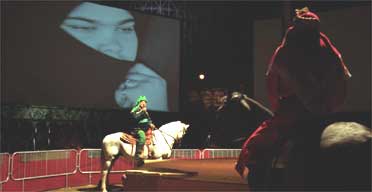
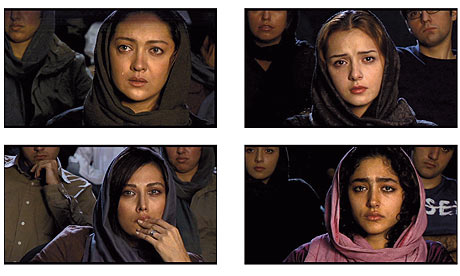
...His video installation based round the traditional Iranian drama TAZIYEH, which depicts the martyrdom of the Imam Hossain, is played out in mannered fashion (the bad guy dressed in red, the good in green, an actor appearing in lion costume, and copious rich red paint doubling for blood). This drama he places on a central plasma screen, but as it is played out, we simultaneously watch above on two large projected screens, images of the ordinary men and woman in the Iranian audience. Kiarostami has cited the influence of the TAZIYEH (rather than Brecht) on his use of distancing techniques in his cinema, but in the installation we also see a remarkable and pure manifestation of Aristotleian dramatic progression, as registered on the faces of the audience, through from initial engagement and mimesis, to emotional upset and catharsis. We see them chatter and drinking tea, then their growing interest and identification, fast followed by silence and rapt attention, developing finally into anguish and tears. It was simple but stunning.
...and his WHERE IS MY ROMEO? segment of CHACUN SON CINEMA (as DB notes) - which can be glimpsed here...So in FIVE (2003), ‘Five long takes dedicated to Yasujiro Ozu’, there is no narrative progression, no mimetic character portrayal, only a piece of wood on a shoreline of the Caspian Sea, a seaside promenade, dogs and ducks on the beach, and frogs in a pool, croaking their way through a moonlit and rainy night towards rebirth of the day and the calm bright light of morning. The statically shot sequences vary from the unmediated to the heavily manipulated, but despite the excision of so many elements, there is still pure sound and image, and out of this cinema, shorn of plot and characters, there remains transformation and transition. Where the prose is slowed to a standstill emerges poetry, simple and undirected.
So true!... AK is engaged in a fundamental exploration of cinematic Narrative Structure, finding and extending classical models in new settings...Abbas Kiarostami has the widest octave range of any filmmaker I know.... Indeed, I think that one of the great accomplishments of much modern Iranian cinema, with Kiarostami in the vanguard, has been to reintroduce classic dramatic suspense into arthouse moviemaking.
Iran's women face the camera - As images of Neda Agha Soltan's lifeless face circumvent the globe, Iranian filmmaker Abbas Kiarostami has made a compelling study of the female face with Shirin
I wouldn't say that at all - Kiarostami has indeed worked in his home country Iran before and after the revolution, but has not supported any regime particularly - he's an artist, not a prophet or politician... He also spends quite a lot of time living in Paris... I have published this elsewhere previously...Nothing wrote:Except that Kiarostami has worked within (and tacitly supported) the Iranian system for his entire career. How about an article on Ghobadi, recently imprisoned for 'severe criticism' of the government, instead?
Ghobadi is a Kurdish Iranian director, which introduces separate additional issues in respect of any central Iranian government... I believe however the film director Mohsen Makhmalbaf (who featured in CLOSE UP) has been appointed a spokesman for Moussavi's campaign abroad (but as Barack Obama says there's not much essential difference between Ahmadinejad and Moussavi, as the latter was prominent under Ayatollah Khomeini). Makhmalbaf has his own path to political awareness (including facilitating his wife and daughters' filmmaking careers)...Kiarostami’s immediate post-revolutionary films (shorts and one hour pieces), feature intriguing strategies which would be subversive, if only he was interested in something as direct as a political response. In the wake of revolutionary chaos and turmoil, TOOTHACHE (1980) is a bizarre gem focussing on the subject of dental hygiene, while the probing masterwork ORDERLY AND DISORDERLY (1981), uses self-reflexivity and repetition to interrogate order and disorder and the ability to engineer both. While SOLUTION (1978) bursts unexpectedly into an unfettered celebration of freedom and nature, out of the story of a man seeking to return with his puncture repaired tyre to his abandoned car.
Longer pieces CASE NO 1 NO 2 (1979) features disruption in a school classroom and seven students suspended for a week by the teacher, because no one will own up. Adults, including parents, educational experts, tv pundits, mullahs and government ministers, wrangle over the nature of rebellion and resolution, issues of honesty, discipline, solidarity and betrayal. The prevailing thought is to recommend that the students should stick to their guns and stay silent, and even suggests a form of re-education for the teacher. The sore memory of the Shah’s secret police is raw and recent. A wily Ayatollah judge from the revolutionary religious courts opines that the pupils may have held out for a greater good for the full seven days, but when they are readmitted to the classroom, they will have changed nothing, as the system and the teacher and they themselves remain just as before. Finally FELLOW CITIZEN (1983), with a foretaste of 10, intriguingly spends an hour focussing on the heated conversations of a harassed traffic warden and the motorists who are trying to gain access to a restricted traffic zone. In a theocracy that bans exposure of the human body, irate hospital bound drivers are shown waving chest x-rays under the nose of the put upon public official!
A Moment of Innocence
Capsule by Jonathan Rosenbaum
From the Chicago Reader
This 1996 film by Mohsen Makhmalbaf is one of his most seminal and accessible--a reconstruction of a pivotal incident during his teens that landed him in prison for several years during the shah's regime. A fundamentalist and activist at the time, Makhmalbaf stabbed a policeman; as a consequence he was shot and arrested. Two decades later, while auditioning people to appear in his film Salaam Cinema, he encountered the same policeman, now unemployed, and the two wound up collaborating on this film about the incident involving them, trying (with separate cameras) to reconcile their versions of what happened. Though no doubt prompted in part by Abbas Kiarostami's Close-Up (1990), this is a fascinating humanist experiment and investigation in its own right, full of warmth and humor as well as mystery. The original Persian title, incidentally, translates as "Bread and Flower."