Page 1 of 1
Stray Dog
Posted: Thu Nov 07, 2024 1:42 pm
by yoloswegmaster
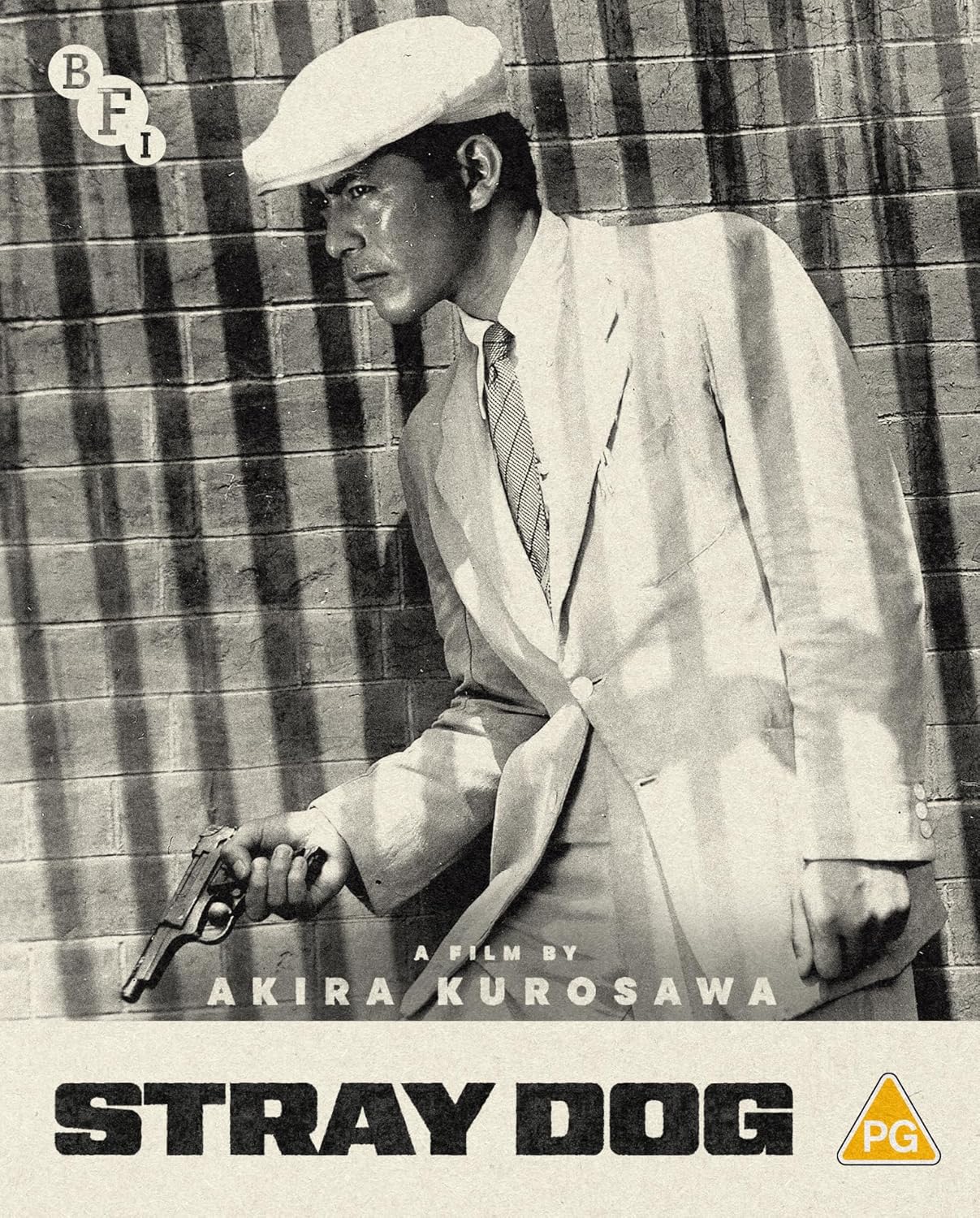
A masterful mix of film noir and police thriller set on the sweltering mean streets of occupied Tokyo.
When rookie detective Murakami (Toshiro Mifune) has his pistol stolen from his pocket while on a bus, his frantic attempts to track down the thief lead him to an illegal weapons market in the Tokyo underworld. But the gun has already passed from the pickpocket to a young gangster, and Murakami’s gun is identified as the weapon in the shooting of a woman.
Murakami, overwhelmed with remorse, turns for help to his older and more experienced senior, Sato (a superb performance by Takashi Shimura). The race is on to find the shooter before he can strike again…
Extras:
Presented in High Definition
Newly recorded interview with Japanese film expert Jasper Sharp
Newly recorded audio commentary by Kenta McGrath
Akira Kurosawa: It is Wonderful to Create – Stray Dog (2002, 32 mins)
**FIRST PRESSING ONLY** Illustrated booklet with new writing on the film by Barry Forshaw, archive essay by Philip Kemp and original review
Re: Stray Dog
Posted: Thu Nov 07, 2024 11:33 pm
by ryannichols7
I thought Kenta McGrath delivered a pretty good commentary for Nobody Knows, in fact it was the only one I liked from that Kore-eda box. I look foward to him talking about Kurosawa, and looking forward to seeing this incredible film in better quality than ever
Re: Stray Dog
Posted: Fri Nov 08, 2024 12:49 am
by Finch
I remember liking the film a lot but finding that 8 minute tracking sequence a bit interminable. That was ages ago though so it's time to revisit.
Re: Stray Dog
Posted: Fri Nov 08, 2024 12:54 am
by ryannichols7
to me the movie has a thrilling, hit-the-ground-running energy that no other Kurosawa (or anyone, for that matter) matches. loved it the only time I've watched it so far, I'd probably put it in my personal top 5 from the director. been a good 3 years since then though so I'll be sure to expand my thoughts after watching this disc
Re: Stray Dog
Posted: Fri Nov 08, 2024 3:10 am
by therewillbeblus
Same, it's right at the Kurosawa's ceiling. My writeup:
therewillbeblus wrote: Sun Jul 21, 2019 6:31 am
Stray Dog: Arguably the best “buddy cop” movie, and understandably so since many have pointed to it as the initial entry into the subgenre, with plenty of noir and police-procedural elements overshadowing this categorical assignment. Mifune and Shimura have excellent chemistry, not just between one another but with all the other actors they encounter, with Shimura’s presence particularly striking in its reserved wisdom with doses of pathos against Mifune’s young, intense novice. What really sells this, though, is the engrossing story with plenty of exciting twists, turns, and setpieces, and Kurosawa’s use of mise-en-scène effectively transports the viewer into the story. The most consistent example of this is that, much like
Do the Right Thing, we feel the strength of the heat wave as if side by side with the characters, watching them vigorously sweat, wave their fans, break down and lose tempers under the beating sun, as if we were right there with them.
The noir plot effectively provides many seedy hidden cultures of criminals, and watching our detectives move through them is exhilarating, with some minor characters exhibiting bizarre behavior that could be part of a horror film out of context (and within context, descending into unknown spaces and disrupting our sense of cultural competency is quite a scary experience even for our ‘heroic’ policemen). The high stakes are always felt throughout the narrative, and we find ease in reason to care about the mission and our protagonists. This isn’t a ‘good guys vs. bad guys’ story in celebrating the protectors of the state vs. its enemies for nationalist reasons, but one where Mifune makes a mistake by losing his gun (or allowing it to be taken), emasculating himself, and the rest of the film is spent trying to get it back and retrieve his manhood, the bolt holding all of his self-worth together, while unknown assailants use it to hurt or kill others. Despite the obviously Japanese-specific cultural norms emphasizing the effects of shame, losing face, the ease of losing one’s masculinity, and loyalty to one’s profession forged with identity, there are universal humanistic principles at play here that make the entire film relatable. The sense of ‘responsibility,’ significant for most viewers in both individually existential and social realms, is omnipresent, and we have as much stake in this mission as the police, suspended against the uncontrollable nature of time, and the unknown forces who may be using this weapon to bear more weight on our hero’s, and our collective, conscious. Kurosawa’s camera compulsively details suspects, increasing movement to focus on clues as the film continues, as if to match Mifune’s desperation, obsession, and skill, as he remains in the field and models his veteran partner’s habits while simultaneously exhausting his energy. In the end, we feel how tired everyone is, and as the showdown ends, laying in the grass, crying and screaming, that exasperation, the final depletion of all will power to hold onto social norms, masculine ideals, ideologies of purpose, mission, duty, is all expressed vividly in one of the most strikingly real depictions of ‘surrender’ on screen; humble, stripped, and beaten, even if arguably having ‘won’ in the aims of the mission.
While I consider myself a Kurosawa fan, my mileage varies considerably within his filmography, though this is close to the top, and while I prefer
High and Low overall as a film, this utilizes the detective mystery design to concoct the more purely fun film of the two, and possibly within his entire canon.
Re: Stray Dog
Posted: Fri Nov 08, 2024 4:24 am
by Finch
High and Low is my own favorite of his so I really need to rewatch Stray Dog.
Re: Stray Dog
Posted: Fri Nov 08, 2024 5:43 am
by feihong
A scene from this film frequently unfolds in my mind unbidden, and that's the scene where Mifune's detective catches the kid who's taken his gun after an exhaustive chase. Both of them lie in the grass next to one another, gasping for breath, and we hear someone playing elementary piano off in the distance, from some new suburban homes nearby. That encounter is burned into my brain, and it makes the film great. I really love the look at postwar reconstruction as it was happening, and the film offers what I think of as the most successful creation of Kurosawa's most enduring cinematic pairing: the grizzled mentor and the brash young man who must learn the way of the world from him. This character relationship is in so many of the Kurosawa films, and I think of it as a kind of conflation of a connection Kurosawa himself wanted as a young man (reaching out for an older mentor figure) and the mentor/mentee relationship he actually had with his elder brother. The vision of the world the elder detective presents in this movie is supremely chaotic, and the emphasis is so much on how the older man models a way of confronting the chaos, as a patient observer, trying to maintain his own moral center in spite of the instability. Red Beard obviously does this relationship again, but I think it's much more powerful and modern and ambiguous in Stray Dog. The younger cop's angry engagement in the world, his "dangerous" empathy, might make more sense in the end than Shimura's world-weary resignation, and Kurosawa isn't sure. By Red Beard, he's very certain of himself, but in Red Beard he has managed a more starry, movie-like trick of combining the impassioned revolutionary and the weathered old stoic into the same figure, and made the brash young man into a brash young straw man, so the argument doesn't work as well.
There is a remake of Stray Dog from the 70s, starring Tetsuya Watari in the Mifune role. That movie is a fantastic contrast to the Kurosawa film, illuminating so many things Kurosawa did well in this original version, as well as Kurosawa's early-career socialist political leanings (the remake, like other cop movies from the 70s such as The Black Battlefront Kidnappers, is grotesquely reactionary and right-wing––amongst other changes, the gun-thief is a drooling, violent pervert with a strictly nihilistic bent, and not someone worth taking the time to understand).
Re: Stray Dog
Posted: Fri Nov 08, 2024 12:22 pm
by Mr Sausage
I'm normally not a fan of Dostoyevskian moralisms, but this one's Dostoyevskian moral doubling, with the implied pit of nihilism suspended underneath all the very small (but important) choices made, is terribly effective. There is nothing essential to anyone's character to make them good or bad; they make a choice, but they could easily make another choice, and socio-political contexts and even straight up luck have an outsized influence on those choices. Kurosawa can rely on existentialism to paper over the cracks of that nihilism, not needing to wrench back hard in an artificial way as in Rashomon. But Mifune and the thief lying together exhausted, muddy, and indistinguishable while schoolkids wander past is a hell of an image.
That said, one of the movie's most praised aspects I've come to see as a weakness. I think I talked with Kerpan about this some years ago, but Kurosawa's interest in the underclasses could be quite shallow, lacking lived experience. That vaunted tracking shot through the slums is a masterpiece of visual filmmaking, but it's hard to miss how decorative these people's lives are. Kurosawa shows no real interest in their existence except as atmosphere, a painting of urban decay to spice up the larger moral arguments. It's the polar opposite of how Imamura or even Mizoguchi (tho' I have some problems with the latter) approach the underclasses. You'd never get such a bravura shot of the dispossessed as this indistinguishable mass meant to provoke an emotional response in their movies. They'd never pan past them, but centre them.
It took me a while to realize this, but Kurosawa was an aristocratic filmmaker. He does better with lords, rich men, and samurai than with the working class (tho' he can be good with peasants). That's part of why the best section of High and Low centres on Gondo, and the other section about the kidnapper is less brilliant. It's also why he's so good at Shakespeare tragedies, but his movies about the poor, The Lower Depths and Dodes Ka Den, feel so artificial and contrived. Kurosawa did well with the blood and thunder of human existence, the grand tragedies and larger-than-life people who trod through them, and the large and universal themes that transformed everyday-seeming dramas into battles for the human soul (eg. Stray Dog, Ikiru, I Live in Fear). Less so when it came to the everyday lives of the poor and dispossessed. His sympathies didn't lie there.
But Stray Dog is still a great movie. It does effectively use a Dostoevsky type moral argument to turn a petty, grimy cop story into an exhilarating moral drama in which the soul competes for goodness against the abyss of nothingness and wins a deeply contingent victory. Thrilling stuff brilliantly filmed. You just kinda have to accept the social context is there mostly as backdrop, or to make you shudder, rather than because Kurosawa has genuine sympathy for it.
When I was younger, Kurosawa was my very favourite filmmaker and I thought he could do no wrong. It took me a long time, and a greater familiarity with Japanese film, to admit or, in some cases, stop excusing his weaknesses. I still think he's a great filmmaker, but he's no longer my favourite. Imamura seems more urgent and wounding these days. But Kurosawa will always have a very important place in my life, and Stray Dog played a large part in that.
Re: Stray Dog
Posted: Fri Nov 08, 2024 1:38 pm
by Michael Kerpan
Mr S -- I remember that discussion. That is one aspect of Kurosawa that I find very distressing. Most of the time, the other virtues of his films outweigh this. But it is always a "burr under the saddle".
Re: Stray Dog
Posted: Sat Nov 09, 2024 6:16 pm
by Altair
Can I just Mr Sausage, that's a brilliant analysis of Kurosawa and his approach to his characters.
Re: Stray Dog
Posted: Sat Nov 09, 2024 9:24 pm
by JSC
That said, one of the movie's most praised aspects I've come to see as a weakness. I think I talked with Kerpan about this some years ago, but Kurosawa's interest in the underclasses could be quite shallow, lacking lived experience.
It is certainly a weakness in Kurosawa, but I'd argue that this could be applied to other filmmakers (and let's face it, many of whom
are not from a lower or working class background). Visconti and Bergman's early work have also had settings and situations within a
lower class milieu.
Re: Stray Dog
Posted: Sat Nov 09, 2024 9:58 pm
by Mr Sausage
I guess I should clarify that I don’t think a filmmaker needs to’ve been working class to represent it properly on screen, just that what they represent needs to feel lived in, and I don’t think Kurosawa manages it. In his films the underclasses tend to become a vehicle for audience emotions, and therefore sentimental, or for ideas, and therefore kept at a distance. That descent into the underworld in Stray Dog is an impressive tableaux of urban squalor, but you don’t come away with the impression that these are people living real lives in a real community, and Kurosawa shows no curiosity for what they think, feel, or have to say. You don’t need to know much about poverty and addiction to show the things Kurosawa does. They’re conventional. And that’s the problem: not that Kurosawa lacks sympathy or that he condescends, but that his relative lack of interest leads him to conventional ideas that make certain scenes and even whole movies feel inauthentic. It’s not a moral failing but an artistic one.
This by no means lessens the film, and it’s far from Kurosawa’s most egregious example, but I’m not inclined to praise that mid-film tableaux the way I would’ve 15 years ago. I think the film has other strengths (lots of them).
Re: Stray Dog
Posted: Sat Nov 09, 2024 10:24 pm
by JSC
To play devil's advocate for a moment, maybe we should also consider that we're looking at the film with our
knowledge of Kurosawa as to the filmmaker he would become as to what films he was directing at the
time, that is to say a studio director making genre pictures (admittedly with a highly personal stamp). Actually,
what fascinates me about Kurosawa's early work is the sheer variety of different kinds of films he made for the
studio (basically anything before Rashomon).
The Lower Depths is perhaps a good litmus test for the same argument as at this point he was an established
director with nearly complete control over his films.
Re: Stray Dog
Posted: Wed Dec 18, 2024 10:10 am
by MichaelB
Full specs announced:
STRAY DOG
A film by Akira Kurosawa
4K restoration released on Blu-ray, iTunes and Amazon Prime on 27 January 2025
A masterful mix of film noir and police thriller set on the sweltering mean streets of occupied Tokyo, Akira Kurosawa’s 1949 feature Stray Dog stars Toshiro Mifune and Takashi Shimura. On 27 January (previously listed as 20 January) the BFI brings it to Blu-ray for the first time in the UK (alongside the BFI Blu-ray release of the director’s High and Low), newly restored in 4K resolution by Toho Co., Ltd using an original 35mm master positive element and presented in its original aspect ratio of 1.37:1. Special features include a newly recorded audio commentary.
When rookie detective Murakami (Toshiro Mifune) has his pistol stolen from his pocket, his frantic attempts to track down the thief lead him to an illegal weapons market in the Tokyo underworld. But the gun has already passed from the pickpocket to a young gangster, and is soon identified as the firearm used in a shooting. Murakami is overwhelmed with remorse and turns for help to his older and more experienced senior, Sato (a superb performance by Takashi Shimura). The race is on to find the gunman before he can strike again…
Special features
• Presented in High Definition
• Newly recorded audio commentary by Japanese-Australian filmmaker Kenta McGrath
• A Japanese Tale (2024, 31 mins): Kurosawa scholar Jasper Sharp discusses Stray Dog and its position within the director’s cinematic oeuvre
• Akira Kurosawa: It is Wonderful to Create – Stray Dog (2002, 32 mins): a Toho documentary short examining Kurosawa’s compelling crime drama in detail
***First pressing only*** Illustrated booklet with a new writing on the film by Barry Forshaw, an archival essay by Philip Kemp, Akira Kurosawa writing on the film, notes on the special features and film credits
Product details
RRP: £19.99 / Cat. no. BFIB1528 / PG
Japan / 1949 / black and white / 122 minutes / Japanese language with optional English subtitles / original aspect ratio 1.37:1 // BD50: 1080p, 23.98fps, LPCM 2.0 mono audio (48kHz/24-bit)
Re: Stray Dog
Posted: Tue Jan 28, 2025 3:02 pm
by nicolas
I’ve got the new BD releases of Stray Dog and High and Low today and compared them with the Toho 4Ks.
Stray Dog is practically identical due to the battered nature of the film element Toho used for the transfer as the original negative is long gone. The film would’ve looked better had they refrained from using grain management. It’s what it is and unless Criterion does another surprising round of cleanup as well as restoring some of the grain, this is the best we get. Sound on the BFI is as dead and devoid of detail as on the Toho. Unlike their Seven Samurai 4K, subtitles have full stops included. Great release - enjoy!