Suppose the word is "honnête". My French is famously bad, but I think it means 'honest' in the sense of 'upright'. I'd also say it has connotations of 'old-fashioned', 'bourgeois', perhaps 'conservative' and so on, but I am not fully sure about it. As a description of Bernard, these adjectives would even make sense in a way if you use them without a value judgement, but for Truffaut these would have meant the direct opposite of the 'nouvelle vague'.Michael Kerpan wrote:I think the key word is "honest" -- which would appear to involve a certain degree of approbation -- on an important point.
But perhaps one might need to know the French word that is translated as "honest"' to be absolutely sure.
Eclipse Series 4: Raymond Bernard
-
Tommaso

- Joined: Fri May 19, 2006 2:09 pm

-
HerrSchreck

- Joined: Sun Sep 04, 2005 3:46 pm
My dad had a zen master named yoshi. Just shows it's not all in the name. But more laughs and fuel: remember before the "adios"yoshimori wrote:Ladies and gentlemen. Back to the pile-up after a nearly four [!] hour absence, our own second-rate Thomas Pynchon wannabe, master of the didactic and final arbiter of all things, I give you ...(Worst auto wreck on the forum. Adios.)
PS: Give me Burroughs and Joyce any day over Thomas' less effective combo platter of the two. His "superintelligence" aint 'art'... at least not all the time. Loved "V" & GR tho.and I'll pop in every here & there for laughs & fuel, deal? (not).
-
Tommaso
- Joined: Fri May 19, 2006 2:09 pm
Pynchon's 'superintelligence' is possibly due to his rummaging through all sorts of dictionaries for super-obscure facts. He even describes this method somewhat jokingly in his preface to "Slow Learner" (and for the record: Joyce did exactly the same sort of 'research' for "Finnegans Wake") Now that he has the wikipedia available, it's all gotten over the top of course. But I love "Against the Day" (and all the other books) nevertheless. The art is not in the 'intelligence', but in the way he juxtaposes things and ideas to make you see previously unthought-of connections, his use of language, but foremost in his humanity and individuality. I can't think of any other writer who even comes close to Pynchon nowadays both in style and in daring. If this guy doesn't make you think about politics and society, nothing else will. And he's dead funny on top of it. Even if some of the songs are not necessarily better than Schreck's Bernardian ode.
-
gubbelsj

- Joined: Fri Apr 14, 2006 6:44 pm
- Location: San Diego
Having watched Wooden Crosses back-to-back with Ichikawa's Fires on the Plain within the past week, I'm on a serious downer kick. As others have noted, the special effects and battle sequences within this film are astonishing, and I also found Bernard's use of sound to be quite effective, especially when creating suspense (such as the sequence involving tunneling under the trenches). There's an impressive control of the medium for so early a sound film. And I was struck by the way Bernard draws viewers into his film. The opening moments suggest this may be just another war picture, featuring a regiment filled with colorful characters exuding bravery and nobility. It's easy to get comfortable. But when the picture moves into a much bleaker trajectory, there was a conscious desire on my part to adjust, to re-think my attitude towards the characters. Fires on the Plain begins in despair, with a barely-conscious soldier getting slapped in the face, and only goes downhill from there. But Wooden Crosses fools you, leads the viewer on, and finally ends with a devastating calmness that was in many ways even more disturbing than the horrific final moments in Ichikawa. A major discovery for me, and a fantastic movie experience.
-
tryavna
- Joined: Wed Mar 30, 2005 8:38 pm
- Location: North Carolina
-
Zazou dans le Metro
- Joined: Wed Jan 02, 2008 2:01 pm
- Location: In the middle of an Elyssian Field
Dudley Andrew notes in 'Mists of Regret' that Fox bought the rights for use as stock shots with no intention for further distribution. It is apparently also used in Hawks' 'The Road to Glory'.tryavna wrote:Has anyone else noticed this yet? Several sequences from Wooden Crosses appear in John Ford's The World Moves On (included in the wonderful Ford at Fox boxset). What's the story here? Was Wooden Crosses distributed in America by Fox?
-
zedz

- Joined: Sun Nov 07, 2004 11:24 pm
I thought my mind was playing tricks on me. It didn't help that The World Moves On nearly put me to sleep. One bizarre choice was the use of a severely truncated version of the 'soldiers marching in the sky' shot, so that you barely notice (and quite probably are not meant to notice) the superimposition.tryavna wrote:Has anyone else noticed this yet? Several sequences from Wooden Crosses appear in John Ford's The World Moves On (included in the wonderful Ford at Fox boxset).
-
tryavna
- Joined: Wed Mar 30, 2005 8:38 pm
- Location: North Carolina
Actually, considering Ford's interest in keeping the dead "among us," I thought the use of that shot made a great deal of sense. At least, I can imagine Ford "getting" it and thinking it entirely appropriate -- even though he may not have had much say in the editing process. (That would be interesting to know.) I'm thinking particularly of the final shots of 3 Bad Men and Fort Apache.zedz wrote:One bizarre choice was the use of a severely truncated version of the 'soldiers marching in the sky' shot, so that you barely notice (and quite probably are not meant to notice) the superimposition.
The World Moves On is indeed a mess, but I found it bizarrely captivating. It strikes me as an obvious riff on (rip-off of?) the George Arliss films of the early 30s, especially Twentieth-Century's House of Rothschild. But then there's the totally unexpected appearance of Stepin Fetchit, who seems to be acting in an entirely different movie, taking the piss out of the stuffiness of everyone else.
-
HerrSchreck
- Joined: Sun Sep 04, 2005 3:46 pm
(annoying nasal twang prompted by thick glasses pinching goofball nose):
READ YOUR BOOKLETS PEOPLE!
The booklet for Les Miz talks about the appropriation of this footage by Fox. It says, in ref to Les Miz being butchered for stateside distrib, "This wasnt the first time Bernard had seen his footage taken from him, chopped up... In '32, TCFox so impressed by the... battle scenes of WC, purchased the film from Pathe Nathan for 140K, for US distrib. Ultimately however Fox decidednot to open WC but instead to use footage of battles and parading soldiers from the film into other Fox prods, such as the best pic-winning Cavalcade, The World Moves On, and a remake of Seventh Heaven-- a right covered in the fine print of the contract. Meanwhile WC novelist R Dorgeles entered into court battles w Fox over Hawks The Road to Glory, which DOrgelkes and others maintained was plagarized from the French screenplay of the film. Through all of this WC sat on the shelves unreleased, at TCFox."
Nice huh? Can you imagine your film being raped pillaged and assasinated from doing US business like that?
Probably done as a favor to another low rent studio at the time straining for hits: Universal, so that All Quiet could go off unimpeded.
READ YOUR BOOKLETS PEOPLE!
The booklet for Les Miz talks about the appropriation of this footage by Fox. It says, in ref to Les Miz being butchered for stateside distrib, "This wasnt the first time Bernard had seen his footage taken from him, chopped up... In '32, TCFox so impressed by the... battle scenes of WC, purchased the film from Pathe Nathan for 140K, for US distrib. Ultimately however Fox decidednot to open WC but instead to use footage of battles and parading soldiers from the film into other Fox prods, such as the best pic-winning Cavalcade, The World Moves On, and a remake of Seventh Heaven-- a right covered in the fine print of the contract. Meanwhile WC novelist R Dorgeles entered into court battles w Fox over Hawks The Road to Glory, which DOrgelkes and others maintained was plagarized from the French screenplay of the film. Through all of this WC sat on the shelves unreleased, at TCFox."
Nice huh? Can you imagine your film being raped pillaged and assasinated from doing US business like that?
Probably done as a favor to another low rent studio at the time straining for hits: Universal, so that All Quiet could go off unimpeded.

-
Napier

- Joined: Wed Nov 03, 2004 1:48 pm
- Location: The Shire

-
HerrSchreck
- Joined: Sun Sep 04, 2005 3:46 pm
In terms of Bernard, I'll gleefully cop without plea bargain to being guilty of not wanting to miss much, and finding it all unforgettable.Napier wrote:That's why HerrSchreck is THE Richard Cranium. He doesn't miss much. #-otryavna wrote:In my defense, I did take another look at the liner notes for Wooden Crosses, but didn't think to look in the other one again.HerrSchreck wrote:READ YOUR BOOKLETS PEOPLE!
In terms of Napier, if the sum of the whole of internet chit chat could be dumped into a single human, it would be fourteen and would speak the essence of his words above:
"Knowledge is embarrassing."
Yo N-Rock, you freaked it my nigga. Peace out, son.
-
Napier
- Joined: Wed Nov 03, 2004 1:48 pm
- Location: The Shire
Just having a little fun to pass the day at work. 
The truth is HerrSchreck, I enjoy your posts as much as anyone else's on the board. I always find them insightful and humorous, .i.e. see last post above. As far as Eclipse set 4 goes, it has to be my favorite. Wooden Crosses has been lingering in my mind since I watched it twice, about a month ago. But there is a part of me, and my well stocked Criterion shelf, that this particular title had a Wacky "C" instead of a wacky "E". And by the way, Schreck you were truly deserving of your vote.
The truth is HerrSchreck, I enjoy your posts as much as anyone else's on the board. I always find them insightful and humorous, .i.e. see last post above. As far as Eclipse set 4 goes, it has to be my favorite. Wooden Crosses has been lingering in my mind since I watched it twice, about a month ago. But there is a part of me, and my well stocked Criterion shelf, that this particular title had a Wacky "C" instead of a wacky "E". And by the way, Schreck you were truly deserving of your vote.
-
jbeall

- Joined: Sat Aug 12, 2006 1:22 pm
- Location: Atlanta-ish
Finally finished Les Miserables last night. I watched parts 1 and 2 awhile back, and just got bogged down with other stuff. Part 3 was by far my fave, esp. with the atmosphere he creates during the night scene on the barricades. I was blown away by the miniature Paris he creates for the rooftops-at-night shot. I'd found part 2 of Les Mis a bit ponderous, but part 3 made up for it, and then some!
Somebody needs to put out more Bernard. This set is just too good.
Somebody needs to put out more Bernard. This set is just too good.
-
colinr0380

- Joined: Mon Nov 08, 2004 8:30 pm
- Location: Chapel-en-le-Frith, Derbyshire, UK
I opened up my copy of the Bernard set last night and watched Wooden Crosses. What a film, and it is almost criminal that it has been so neglected over the years! Something I didn't see mentioned in the thread yet, but was extremely impressed by was the use of montage in key sequences and the use of contrasting silence and sound (up there with M in my opinion. Is is just me or was there more confidence in using complete silence to highlight moments or against moments of great noise in films of this era that was lost somewhat when sound needed to be used constantly as if to continually affirm its presence? I love these early sound films where you can have a seeming disconnect between sound and image that works emotionally and artistically without having to provide a concrete cause for that incongruity).
There are also some neat visual connections - I particularly liked in the ten day assault scene the throwing of grenades from the shoulder mounted bags that made the soldiers seem sort of like farmer spreading seeds on a field. Though these particular 'seeds' were going to destroy rather than cause new growth.
I also liked the way that the imagery of happy pre-war lives was presented as little tableaus. Similarly I thought the imagery of Sulphart's obliviously exuberant description of the squad's activities to Gilbert's shocked and disturbed parents was a comic highlight! There seemed to be lots of actions that raised disturbing parallels - the men entering the mined bunker to their certain death while our squad barely escape had me thinking about the way that seeing someone die seemingly 'in your place' or through bad timing could push people to the edge of sanity. Why did they die and you survived? Will you be able to fight for them as well as yourself? Will you be able to take on the responsibilities of informing their families? And what happens if you take on this generalised guilt and then die yourself? Those who initially died are then yet another degree of separation away from acknowledgement.
I'm glad to see comments about the pyrotechnics during the battle sequences and agree with zedz that the sequences were made immeasurably more powerful by seeing people and explosions in the same frame, and to not immediately cut away but instead see the landscape changing as smoke drifts across the scene. It felt very close to a vision of hell, especially following the final benediction in the church scene before the despatching to the battlefield.
One of the other aspects of the film that I particularly liked was the introduction of 'sentimental' notes only to deepen their impact through 'real world' application. Such as the scene moving from Gilbert at Varion's graveside to the church where we initially get the mass and Ave Maria tugging the heartstrings in a classical manner, along with the introduction of the wounded in the barricaded off area of the church. Then it shifts from that to Gilbert's speech about accepting anything as long as they can live and not lose faith, with the groaning of the wounded providing a new soundtrack (which prefigures the final scene).
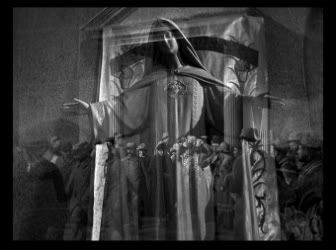
Incidentally, this is another scene where the layers of imagery comment on the action. The DVD Beaver review has a capture of the statue Gilbert speaks to, yet I think the scene becomes more powerful during the moments of transition to the crowd leaving the church. This might have been a better capture:
Then there's the scene of Bréval's dying speech. Surrounded by his companions, already laid out in a tomb, he delivers an unexpectedly scathing indictment of his philandering wife and then recants for the sake of his daughter. It not only blows up (literally in the barrage which follows that explodes the tomb he has been laid in! Even the dead are assaulted) those cliches of "tell my...wife I...loved...her *flump*", it gives Bréval a chance to open his heart to his companions and yet still allow his family to live in blissful ignorance in the constancy of his love.
It also feeds in to Gilbert's understated (thankfully!) relationship with his own girl back home. The usual photograph and perfume are there but that highlighted phrase in her letter about having broken a heel while dancing that Gilbert reads in the grave/trench in the same cemetery just before Bréval's shooting, shows she is similarly living a very different life, that the frivolous world still continues barely touched by the war while soldiers are dying.
In a way this connection underlines that the film is truly Gilbert's story - it begins with his billeting to a squad and ends with his death. He also mourns Varion perhaps more because a tenuous link with his home town has been severed early on. He is the one standing for the many, just another dead soldier with a mother at home. For me that point of view shot just after Gilbert is shot is devastating - he looks around at the other bodies of anonymous soldiers lying dead and there's that realisation that this is his fate as well - he's not special except to us (this also reminded me of those scenes in the shop, the church, the pub or the mess halls where there are lots of other groups of soldiers having conversations like our group, whose stories we don't follow but can maybe infer will have a similar trajectory).
I found that moment almost physically painful myself with that revelation as we are so forcefully shown the world through his eyes throughout the film (unlike say Bréval or Varion, though their deaths touch us) that his impending and inevitable return to anonymity adds to that sense of waste. He's as anonymous to anyone else as those soldiers entering the bunker to die in the explosion were earlier on - we don't want to look at them as individuals because there's no way they'll live, but with Gilbert there is no escape from an emotional connection and so the audience dies with him. His dragging himself a little further on seems less an attempt to survive but more a futile attempt at escaping a spot on which he is destined to die. The masterfully complex montage of his companions, his girl breaking her heel, his parents, the city, the soldiers provides an extremely moving representation of a dying man's final thoughts. The layers of imagery of imagined moments, remembered moments, comments on a life, condemning of it and their blending together and slipping away all at the same time until he joins the procession of the dead.
It took a long while for me to recover from the impact after the film had come to an end, and to reflect on it.
There are also some neat visual connections - I particularly liked in the ten day assault scene the throwing of grenades from the shoulder mounted bags that made the soldiers seem sort of like farmer spreading seeds on a field. Though these particular 'seeds' were going to destroy rather than cause new growth.
I also liked the way that the imagery of happy pre-war lives was presented as little tableaus. Similarly I thought the imagery of Sulphart's obliviously exuberant description of the squad's activities to Gilbert's shocked and disturbed parents was a comic highlight! There seemed to be lots of actions that raised disturbing parallels - the men entering the mined bunker to their certain death while our squad barely escape had me thinking about the way that seeing someone die seemingly 'in your place' or through bad timing could push people to the edge of sanity. Why did they die and you survived? Will you be able to fight for them as well as yourself? Will you be able to take on the responsibilities of informing their families? And what happens if you take on this generalised guilt and then die yourself? Those who initially died are then yet another degree of separation away from acknowledgement.
I'm glad to see comments about the pyrotechnics during the battle sequences and agree with zedz that the sequences were made immeasurably more powerful by seeing people and explosions in the same frame, and to not immediately cut away but instead see the landscape changing as smoke drifts across the scene. It felt very close to a vision of hell, especially following the final benediction in the church scene before the despatching to the battlefield.
One of the other aspects of the film that I particularly liked was the introduction of 'sentimental' notes only to deepen their impact through 'real world' application. Such as the scene moving from Gilbert at Varion's graveside to the church where we initially get the mass and Ave Maria tugging the heartstrings in a classical manner, along with the introduction of the wounded in the barricaded off area of the church. Then it shifts from that to Gilbert's speech about accepting anything as long as they can live and not lose faith, with the groaning of the wounded providing a new soundtrack (which prefigures the final scene).
Incidentally, this is another scene where the layers of imagery comment on the action. The DVD Beaver review has a capture of the statue Gilbert speaks to, yet I think the scene becomes more powerful during the moments of transition to the crowd leaving the church. This might have been a better capture:
Then there's the scene of Bréval's dying speech. Surrounded by his companions, already laid out in a tomb, he delivers an unexpectedly scathing indictment of his philandering wife and then recants for the sake of his daughter. It not only blows up (literally in the barrage which follows that explodes the tomb he has been laid in! Even the dead are assaulted) those cliches of "tell my...wife I...loved...her *flump*", it gives Bréval a chance to open his heart to his companions and yet still allow his family to live in blissful ignorance in the constancy of his love.
It also feeds in to Gilbert's understated (thankfully!) relationship with his own girl back home. The usual photograph and perfume are there but that highlighted phrase in her letter about having broken a heel while dancing that Gilbert reads in the grave/trench in the same cemetery just before Bréval's shooting, shows she is similarly living a very different life, that the frivolous world still continues barely touched by the war while soldiers are dying.
In a way this connection underlines that the film is truly Gilbert's story - it begins with his billeting to a squad and ends with his death. He also mourns Varion perhaps more because a tenuous link with his home town has been severed early on. He is the one standing for the many, just another dead soldier with a mother at home. For me that point of view shot just after Gilbert is shot is devastating - he looks around at the other bodies of anonymous soldiers lying dead and there's that realisation that this is his fate as well - he's not special except to us (this also reminded me of those scenes in the shop, the church, the pub or the mess halls where there are lots of other groups of soldiers having conversations like our group, whose stories we don't follow but can maybe infer will have a similar trajectory).
I found that moment almost physically painful myself with that revelation as we are so forcefully shown the world through his eyes throughout the film (unlike say Bréval or Varion, though their deaths touch us) that his impending and inevitable return to anonymity adds to that sense of waste. He's as anonymous to anyone else as those soldiers entering the bunker to die in the explosion were earlier on - we don't want to look at them as individuals because there's no way they'll live, but with Gilbert there is no escape from an emotional connection and so the audience dies with him. His dragging himself a little further on seems less an attempt to survive but more a futile attempt at escaping a spot on which he is destined to die. The masterfully complex montage of his companions, his girl breaking her heel, his parents, the city, the soldiers provides an extremely moving representation of a dying man's final thoughts. The layers of imagery of imagined moments, remembered moments, comments on a life, condemning of it and their blending together and slipping away all at the same time until he joins the procession of the dead.
It took a long while for me to recover from the impact after the film had come to an end, and to reflect on it.
-
Tommaso
- Joined: Fri May 19, 2006 2:09 pm
Great post, Colin. You almost make me want to rewatch the film immediately.
But it's interesting to see that apparently audiences at the time were not averse to the 'unrealistic' silences, which I believe wouldn't be the case today on a broad basis. But then, at the time, "M" wouldn't have been as silent as it is today. Apart from the projector noise, surely also the soundtrack's crackles and pops would have created some reassuring ambient sound.
Absolutely. I think the effect in "M" is more irritating, because in "Wooden crosses" the absences of sound might perhaps be interpreted as somehow indicating the state of mind of the protagonists (and, by implication, the effect on the audience) whereas in the Lang film there is a far greater distance between what is going on on the screen and the viewer, at least in the first half or so. The completely silent night streets in "M" almost have a disorienting effect on me. I guess the reason for the silences in many of those early films is the often discussed mistrust in the new technology by many of the more famous silent film directors then, only few of which embraced the new medium whole-heartedly, and if so, then with the caveat of using sound only when needed, and then as artistically as they used the 'pure' images of silent film ( I think of the theoretical writings of Eisenstein especially, but also of the use of sound in Vertov's "Entuziasm" or in Clair's "Million"). In other words: it took a few years - outside Hollywood - to fully establish a 'realistic', 'unintrusive' use of sound and silence. And this realistic use of sound and ambience has been dominating filmmaking ever since, if you disregard decidedly 'experimental' or 'art' films for a moment.colinr0380 wrote: the use of contrasting silence and sound (up there with M in my opinion. Is is just me or was there more confidence in using complete silence to highlight moments or against moments of great noise in films of this era that was lost somewhat when sound needed to be used constantly as if to continually affirm its presence?
But it's interesting to see that apparently audiences at the time were not averse to the 'unrealistic' silences, which I believe wouldn't be the case today on a broad basis. But then, at the time, "M" wouldn't have been as silent as it is today. Apart from the projector noise, surely also the soundtrack's crackles and pops would have created some reassuring ambient sound.
-
colinr0380
- Joined: Mon Nov 08, 2004 8:30 pm
- Location: Chapel-en-le-Frith, Derbyshire, UK
That is a good point about the ambient sound that would have been present in the environment that is disturbingly absent from our modern versions. Perhaps it is a more extreme version of the film grain debates, only instead of being consciously 'scrubbed clean' to present a version of a film more in keeping with modern tastes it is more perhaps that it is impossible to provide that comforting ambience with an on-DVD projector sound!
I guess this speaks more to the pre-codified world of film, when the rules for the use of sound had not yet been set into 'right' and 'wrong' forms, which in the end are just agreed popular conventions. Whether that slows progress in filmmaking and film technique to a crawl as every film follows the same conventions or whether that allows the use of audience-understood shorthands to let a film focus on other aspects of their material is open to debate I suppose. I guess both ways are important - too much experimentation with forms and contents can lose an audience; too much reliance on well trod convention can bore an audience and remove the point of making the film in the first place.
I suppose one of the best ways to praise Wooden Crosses is that I came to the film with having lowered expectations of poor print quality, especially with the opening disclaimer, and I completely forgot about any of those caveats while watching the film, ending up feeling it should be thought of as one of the finest First World War films.
I guess this speaks more to the pre-codified world of film, when the rules for the use of sound had not yet been set into 'right' and 'wrong' forms, which in the end are just agreed popular conventions. Whether that slows progress in filmmaking and film technique to a crawl as every film follows the same conventions or whether that allows the use of audience-understood shorthands to let a film focus on other aspects of their material is open to debate I suppose. I guess both ways are important - too much experimentation with forms and contents can lose an audience; too much reliance on well trod convention can bore an audience and remove the point of making the film in the first place.
I suppose one of the best ways to praise Wooden Crosses is that I came to the film with having lowered expectations of poor print quality, especially with the opening disclaimer, and I completely forgot about any of those caveats while watching the film, ending up feeling it should be thought of as one of the finest First World War films.
-
aox

- Joined: Fri Jun 20, 2008 4:02 pm
- Location: nYc
Re: Series 4: Raymond Bernard
I watched Wooden Crosses tonight and I am really impressed. I was astonished how well the battle scenes came off. I have to join the praise of the sound and the use of montage. Some of the scenes between the soldiers came off as cheesy, but the movie was so well done that it didn't detract too much.
Honestly, and not to be a troll, I think this film easily trumps All Quiet on the Western Front. I haven't seen AQotWF in a few years, but my general impression between these two films was that the AQotWF was overly long, even more sappy, with less believable battle scenes.
Honestly, and not to be a troll, I think this film easily trumps All Quiet on the Western Front. I haven't seen AQotWF in a few years, but my general impression between these two films was that the AQotWF was overly long, even more sappy, with less believable battle scenes.
-
HerrSchreck
- Joined: Sun Sep 04, 2005 3:46 pm
Re: Series 4: Raymond Bernard
That's nowhere near trolling-- it's a comparison often made. And a conclusion I think many if not most (including me) would agree with.
-
Noiretirc

- Joined: Tue Dec 09, 2008 10:04 pm
- Location: VanIsle
- Contact:
Re: Series 4: Raymond Bernard
Agreed. Bernard must be the most overlooked filmmaker ever.aox wrote:I watched Wooden Crosses tonight and I am really impressed. I was astonished how well the battle scenes came off. I have to join the praise of the sound and the use of montage. Some of the scenes between the soldiers came off as cheesy, but the movie was so well done that it didn't detract too much.
Honestly, and not to be a troll, I think this film easily trumps All Quiet on the Western Front. I haven't seen AQotWF in a few years, but my general impression between these two films was that the AQotWF was overly long, even more sappy, with less believable battle scenes.
-
Noiretirc
- Joined: Tue Dec 09, 2008 10:04 pm
- Location: VanIsle
- Contact:
Re: Series 4: Raymond Bernard
I watched Wooden Crosses again tonight, and I'm still floored by how shockingly good this is. It really is miles ahead of All Quiet, and most other early 30s films, in terms of technical achievements, and achingly sad subtle touches. I was blown away by the short graveside scene where the letter is scattered, and a bird sings, ....that face says it all......and the tilted angle.....one of the most beautiful scenes in all of filmdom, surely. Also, the church service, where a wooden fence hides the maimed....such a harrowing depiction......painful moans amongst the singing and prayers....
The battle scenes are truly breathtaking.
I have to say it again. Bernard is surely the most overlooked Director in film history. Wooden Crosses is a magnificent achievement.
The battle scenes are truly breathtaking.
I have to say it again. Bernard is surely the most overlooked Director in film history. Wooden Crosses is a magnificent achievement.
-
colinr0380
- Joined: Mon Nov 08, 2004 8:30 pm
- Location: Chapel-en-le-Frith, Derbyshire, UK
Re: Eclipse Series 4: Raymond Bernard
I've finally finished Les Misérables and have to add to the praise, with reservations. This is probably the best adaptation of the material I have yet seen, though I’ve by no means watched all the various versions. I’m not quite as fond of it as I am Wooden Crosses (which I found absolutely perfect in every way) simply because of the melodrama inherent in the source material where Wooden Crosses seemed to sidestep those issues, or raised melodramatic or cliché moments in order to counterpoint them with powerful real world application. Les Misérables seems very dangerous to adapt properly, as it doesn’t take much (as with Dickens) to push into reductive parodical characters, and if the great temptation to play things broad is indulged can end up overpowering the greater goals of the story itself.
However I found that this Les Misérables was mostly a wonderful literary adaptation, especially in the more intimate stretches where the story boils down to personal conflicts and away from the more broadly defined surroundings. (It is a story where the conflicts of an outside world end up feeling as if they arise from, and are only important in relation to, the stories of the individuals we have been following - making it a good contrast to Wooden Crosses where the individual is destroyed by ‘bigger’ events)
I’ve always felt that it was a story about trying to have a ‘normal’ and peaceful life, and then willingly destroying yourself in order to advance the next generation after it becomes obvious that you will never be able to escape your past and turn over a new leaf somewhere else. Valjean’s attempts to remake himself and escape from his past are being constantly thwarted, yet he tries to ensure Cosette escapes where he could not. And then this positive view of trying to better yourself, and the next generation, is parodied by the grotesque Thénardiers, grasping for every possible short term advantage. However then ironically while the grown up Cosette ends up rather cosseted (more naïve than evil though, and not through her own fault) the younger generation of Thénardiers end up sacrificing themselves for nebulous, ill fated and unattainable goals, although in the process they manage to restore some dignity to their family name.
I think Valjean and Cosette are placed in between the poor, grasping Thénardiers and the rich, grasping Gillenormand (who also puts in a broadly comical display of semi-villainous, but mostly just blinkered, imbecility with regard to his grandson). Yet they don’t really fit in either world, just as they don’t really fit in with the romantic student revolutionaries. Or rather Cosette possibly could fit in with Marius’s help, and maybe work to bring the worlds of poverty and privilege closer together but Valjean would not, even without Javert hounding him.
It has been a while since reading the novel but while I think the Bernard is the best of the adaptations I have seen so far, it was a shame to lose the Valjean’s escape from the prison ship which not only gives proper motivation to Javert’s pursuit, but also underlines Valjean’s essential qualities of decency and help for others as well as giving greater resonance to his sight of the convicts being transported to the penal colonies later on. Perhaps this would have been a spectacle too far for the film though. Also I feel that losing Valjean’s hide out inside the convent garden, while Cosette is educated inside, loses a significant next stage of Valjean’s moral ‘enlightenment’ that began with the kindly Vicar’s actions following the theft at the opening of the story. It is strange how significant such unimportant seeming passages feel when they are removed.
I did also have a little problem with the canted camera angles throughout the film – they were visually interesting but often seemed emotionally unmotivated. It often felt as if the film were straining for a widescreen ratio and without that extra space the shot had to be tilted to fit everything in!
Having said that however all the films look beautifully composed, and I agree with a previous comment that the model work of Paris is breathtaking – Rene Clair must have been green with envy! The eventual funeral riot and siege of the barricades in the final film felt like the film’s reason for being and, as could be expected from the director of Wooden Crosses, superbly shot as the camera becomes completely unmoored from all bearings among the screaming crowd. In these sequences and as the characters on the barricades band together to recreate iconic poses the film becomes truly spectacular and momentarily escapes from its rather stifling literary adaptation straitjacket.
However I found that this Les Misérables was mostly a wonderful literary adaptation, especially in the more intimate stretches where the story boils down to personal conflicts and away from the more broadly defined surroundings. (It is a story where the conflicts of an outside world end up feeling as if they arise from, and are only important in relation to, the stories of the individuals we have been following - making it a good contrast to Wooden Crosses where the individual is destroyed by ‘bigger’ events)
I’ve always felt that it was a story about trying to have a ‘normal’ and peaceful life, and then willingly destroying yourself in order to advance the next generation after it becomes obvious that you will never be able to escape your past and turn over a new leaf somewhere else. Valjean’s attempts to remake himself and escape from his past are being constantly thwarted, yet he tries to ensure Cosette escapes where he could not. And then this positive view of trying to better yourself, and the next generation, is parodied by the grotesque Thénardiers, grasping for every possible short term advantage. However then ironically while the grown up Cosette ends up rather cosseted (more naïve than evil though, and not through her own fault) the younger generation of Thénardiers end up sacrificing themselves for nebulous, ill fated and unattainable goals, although in the process they manage to restore some dignity to their family name.
I think Valjean and Cosette are placed in between the poor, grasping Thénardiers and the rich, grasping Gillenormand (who also puts in a broadly comical display of semi-villainous, but mostly just blinkered, imbecility with regard to his grandson). Yet they don’t really fit in either world, just as they don’t really fit in with the romantic student revolutionaries. Or rather Cosette possibly could fit in with Marius’s help, and maybe work to bring the worlds of poverty and privilege closer together but Valjean would not, even without Javert hounding him.
It has been a while since reading the novel but while I think the Bernard is the best of the adaptations I have seen so far, it was a shame to lose the Valjean’s escape from the prison ship which not only gives proper motivation to Javert’s pursuit, but also underlines Valjean’s essential qualities of decency and help for others as well as giving greater resonance to his sight of the convicts being transported to the penal colonies later on. Perhaps this would have been a spectacle too far for the film though. Also I feel that losing Valjean’s hide out inside the convent garden, while Cosette is educated inside, loses a significant next stage of Valjean’s moral ‘enlightenment’ that began with the kindly Vicar’s actions following the theft at the opening of the story. It is strange how significant such unimportant seeming passages feel when they are removed.
I did also have a little problem with the canted camera angles throughout the film – they were visually interesting but often seemed emotionally unmotivated. It often felt as if the film were straining for a widescreen ratio and without that extra space the shot had to be tilted to fit everything in!
Having said that however all the films look beautifully composed, and I agree with a previous comment that the model work of Paris is breathtaking – Rene Clair must have been green with envy! The eventual funeral riot and siege of the barricades in the final film felt like the film’s reason for being and, as could be expected from the director of Wooden Crosses, superbly shot as the camera becomes completely unmoored from all bearings among the screaming crowd. In these sequences and as the characters on the barricades band together to recreate iconic poses the film becomes truly spectacular and momentarily escapes from its rather stifling literary adaptation straitjacket.