Well, I was really looking forward to this and came away rather disappointed. Am I the only one put off by the hokey "zany" music that cues up anytime something is supposed to be amusing? I found it incredibly jarring and against the grain of the rest of the film. There's something to be said for subtlety and this is a picture that has very little. Brad Dourif is indeed a crazy crazy man, and he's great in this - see it if only for his performance. But sadly, i'm glad I caught this on Flix or some other movie channel before making the intended blind buy.
Most problematic for me, however is that it tries to tread a line between farce and profound social commentary and does neither very well - with each element dragging down the other. I kept waiting for Clint eastwood to appear with an orangutan in tow after picking up Nurse Ratchet to come take poor Hazel to the hospital. The "misfits" peppering dourif's world all just ended up being a bit too much. We are supposed to believe that the South is really like this...that "niggers" are the root of all our car problems, etc etc etc...but at the same time are there really corner preachers putting their own eyes out? And again, in the midst of all this, that silly music appears far too often to remind us it is indeed a zany crazy place! I don't need benny hill to see the humor in a cop pushing his car down a hill into a lake. It just felt like a movie that was taken from a great novel and hit that wall that so many adaptations do where it simply becomes impossible to translate the tone of the pages onto the screen. It was all just too messy for me.
I dunno....just terribly underwhelmed by this one, but i'd love to be told I missed something if it is indeed worth revisiting. I had every intention of this extending my collection one more title....but alas that money will be going to Repulsion this summer instead.
470 Wise Blood
-
Doctor Sunshine

- Joined: Wed Nov 03, 2004 2:04 am
- Location: Brain Jail
Re: 470 Wise Blood
I had high expectations going into this too. They weren't fully met but I still liked it a lot. On the music, it's definitely incongruous but I think it worked in a weird sort of way. One, the movie takes place in a world that hasn't been explored in other films -- as how no one's done anything like Rossellini's history films which feel like living museums in the best possible sense, or Gangs of New York showing another part of America I've never seen before (even though I didn't love the film) -- and the cognitive dissonance wrought by joining Dourif's intense seriousness with the Mad Mad World score takes me there immediately. Two, I'd never expect anything with that score to get that dark. Which pleased me greatly.
Dourif lost me in some of his sermons and the language didn't wow me as much as it did the writer/producer, so, I suspect the film has the potentially to grow on me or win me over more thoroughly should I suddenly "get" one or the other on future viewings. However, for the funny-sad characters that never manage to connect, teetering on the brink of blasphemy in such and interesting manner, confusing me with the soundtrack and Dourif's best performance this side of Exorcist 3, I'll call it a success. That said, you can't go wrong spending your money on Repulsion.
Dourif lost me in some of his sermons and the language didn't wow me as much as it did the writer/producer, so, I suspect the film has the potentially to grow on me or win me over more thoroughly should I suddenly "get" one or the other on future viewings. However, for the funny-sad characters that never manage to connect, teetering on the brink of blasphemy in such and interesting manner, confusing me with the soundtrack and Dourif's best performance this side of Exorcist 3, I'll call it a success. That said, you can't go wrong spending your money on Repulsion.
-
mikebhryan
- Joined: Mon May 18, 2009 10:53 am
Re: 470 Wise Blood
"Jesus is just a trick on niggers" was well delivered and one of the truest lines (in book or movie) ever spat (the KKK came up w/ their costume due to the extreme superstition of blacks and they're mostly--southern baptists!(evangelicals!))
-
HerrSchreck

- Joined: Sun Sep 04, 2005 3:46 pm
Re: 470 Wise Blood
That's been my response quite a bit lately: this, Eddie Coyle, White Dog.. don't even ask me about Danton, Bottle Rocket, Button, LDDisco, etc. A mush of slightly memorable 3rd quarter 20th century mediocrity I have no intentions of wasting top tier dollars on.HistoryProf wrote:Well, I was really looking forward to this and came away rather disappointed.
I dunno....just terribly underwhelmed by this one, but i'd love to be told I missed something if it is indeed worth revisiting. I had every intention ....
-
HerrSchreck
- Joined: Sun Sep 04, 2005 3:46 pm
Re: 470 Wise Blood
Well, there's one defense (actually two) I can mount for the film which is this: it really doesn't mean much, and that it's impressive that something so whacked out could be made by such an old man. If anything the film is testament to what an incredibly cool old gentleman Huston was even in his old age.
On the other hand there are films that don't really mean anything-- and in doing so they strike you like a cannonball in the groin, in that by refusing to gather all the little pieces into a perfecttly prearranged little potpourri where everything fits just so, the randomness and all the loose-endedness of life, with all its sadness and hilarious tragedy, hits you full force with a special authenticity. And then there are films that just don't mean anything. They run their spools off, it was okay, you go home and forget about it. This was a movie quirky as fuck, it cracked me the hell up many times, but it just didn't gather any depth beneath the unfolding surfaces.
What was its point, really? That people are really fucking weird sometimes? Whoop de frick, I'm one of em. That religion turns people into street freaks and self-immolating time bombs? That people from the south are so rampantly stupid they really need to provided with three years worth of tax free steamer shipments of building materials so that more schools will be built, and pronto?
It was a funny little slice of life over the course of the stretch of time vis a vis a few human cartoons. I think its really cool that Huston made the film, which I don't think really sucked. I just have no desire to pay platinum key prices to watch muppets like these go blooey in ancient stereotype.
On the other hand there are films that don't really mean anything-- and in doing so they strike you like a cannonball in the groin, in that by refusing to gather all the little pieces into a perfecttly prearranged little potpourri where everything fits just so, the randomness and all the loose-endedness of life, with all its sadness and hilarious tragedy, hits you full force with a special authenticity. And then there are films that just don't mean anything. They run their spools off, it was okay, you go home and forget about it. This was a movie quirky as fuck, it cracked me the hell up many times, but it just didn't gather any depth beneath the unfolding surfaces.
What was its point, really? That people are really fucking weird sometimes? Whoop de frick, I'm one of em. That religion turns people into street freaks and self-immolating time bombs? That people from the south are so rampantly stupid they really need to provided with three years worth of tax free steamer shipments of building materials so that more schools will be built, and pronto?
It was a funny little slice of life over the course of the stretch of time vis a vis a few human cartoons. I think its really cool that Huston made the film, which I don't think really sucked. I just have no desire to pay platinum key prices to watch muppets like these go blooey in ancient stereotype.
-
ezmbmh
- Joined: Tue Nov 02, 2004 8:05 pm
Re: 470 Wise Blood
Like or dislike what you want to, Herr S, but I see lots more to the movie. First, the obligatory rhetorical joust: you suggest, it seems to me, that obsession (religious freaks, self-immolating time bombs) are, if not irretrievably banal, than at least passe. So what pops into my head are Kane, Seventh Seal, Searchers, Dr Strangelove, Psycho, Joan D'Arc, all of Ophuls--what great movie/art isn't about obsession? I myself couldn't care less about the grotesqueries assigned to all O'Connor's works, dismissing them as side-show melodramas, when her method and ethos were deep seriousness misdirected with humor. If the humor occludes the deeper message, it may be her fault, or Huston's, or it may be too light a trigger finger on dismissing a different way of approaching art.HerrSchreck wrote:This was a movie quirky as fuck, it cracked me the hell up many times, but it just didn't gather any depth beneath the unfolding surfaces.
What was its point, really? That people are really fucking weird sometimes? Whoop de frick, I'm one of em. That religion turns people into street freaks and self-immolating time bombs? That people from the south are so rampantly stupid they really need to provided with three years worth of tax free steamer shipments of building materials so that more schools will be built, and pronto?
In the preface to the second edition of WB O'Connor says (forgive me, I'm paraphrasing from memory) that Hazel is being chased by a shadowy figure moving behind him (you know who). While most people praise him for evading Jesus, O'Connor thinks his nobility lies in exactly his failure to outrun him. Like the characters in her other stories, our version of Greek dramas (boy, someone's gonna take a bite out of that), these are people who run as hard as they can from what they need most, an allegory for a lot of us these last millenia.
Have a distinct feeling none of this will change your mind a whit. Fair enough. I think it's a terrific film, and as I've said before somewhere above, one of the best adaptations of a major and serious literary work in the last few decades. Have you read the original?
-
Mr. Ned
- Joined: Sun Apr 05, 2009 10:58 pm
Re: 470 Wise Blood
This is a great post ezmbmh. I've meant to come in here and speak my share in defense of this movie but I think you've covered all my points, more or less. I first saw this film in college, believe it or not, for a course called 'The Waste Land and After.' I can't list them all from memory, but the parallels of imagery and narrative (fragmented and obnoxious as Eliot's is) have so many concurrences it's eerie. The novel would not exist without Eliot's poem, and being exhausted and too lazy to explain completely...the film and its peculiarity stand up much better when juxtaposed with the poem too. Those with the patience (I personally loathe Eliot) and/or curiousity should read the novel and poem side by side and watch the film again--it'll make you appreciate it that much more. I can't say I liked this film a whole lot, but it's a respectful and respectable adaptation of O'Connor's work. I only wish more of it would be translated into the sound + image medium.
-
HerrSchreck
- Joined: Sun Sep 04, 2005 3:46 pm
Re: 470 Wise Blood
I've read both posts a few times, and I don't see anything about Wise Blood, the movie by John Huston.
My problem with the film-- if you want to categorize my thoughts on Why I Think This Is A Good Film But Not A Great Film as a 'problem'-- is not that it renders these points about religion.. not that it concerns itself with them thematically and renders aforesaid human critique as the vast bulk of its substantive freight.. rather it's the method with which it goes about affecting this task, and the residue it leaves for the viewer when it's done, which I find so simplistic as to be nearly juvenile.
It's a freak show, essentially. Just about everyone, save the handless tow truck driver, is dumb and lost and mateless as a wretched thong sandal sitting along the side of the road roasting in its own malodorous bacteria. The lead character, though charmingly eclectic, is utterly devoid of depth. The cab driver, the whore, her john, the monkey obsessed sidekick, two hustling street proselytizers, Ned Beatty, his replacement preacher, the roominghouse mammy, all of them are simplistic, sunday morning funnie cartoons.
I love LOVE when eclictic, absurd characters and casts render a tale that comingles the ridiculous with the sublime. But in the end this film for me just wound up never cultivating much narrative sophistication, or should I say turning into something more than just a funny freak show comedy making religious people and American southerners look like mindless dorks. It's a more enjoyable version of the well that the Coen brothers keep going to with their films.. more palatable in that it was less openly condescending to its roster of characters. I kept expecting, because this was Huston, this film to bloom after setting up various narrative elements. I kept expecting The Church Without Christ to go somewhere or-- in either triumph or failure-- to mean something, but all it added up to was a couple of stuttering, brainless rants that didn't mean a thing-- Motes couldn't even get his shit together.
Especially cute was the religious symbolism, much of which I took a a signal for the cultivation of a bit more depth of cultural commentary, but it was never more than some funny absurdist renderings of the birth of christ, the virgin mary, etc (I'm talking mostly about the scenes in the rooming house with the mummified little guy).
A perfect example and sum up of the picture was the Dan Shor character-- just a dumb funny kid with no direction who did a bunch of weird stuff with very little significance. And the lack of significance, his lost-ness, was hardly poignant. He was just a funny guy up there for a couple of laughs, but his character never went anywhere and I have no idea what purpose he served.
Usually if you're going to take on an entire class or demographic, put yourself in the crosshairs by lathering up their ire via making them look ridiculous en masse, there's a greater purpose than simply making them look like a bunch of boobs stabbing themselves in the face with knitting needles (no they didnt do that in this film). So, it's not that this picture "deals with" the subject matter of obsession, or self-immolating religious fanatics, etc, as many great directors indeed have in the past-- it's what it did or did NOT do while doing this that causes me to be somewhat reluctant to see this thing as a masterpiece along with the other titles mentioned by the previous poster. Those other films are nuanced meditations on a whole host of issues (including the possibilities of the medium of cinema, which many of those examples happened to significantly expand) far beyond just a couple sociological bullet points. For me this one just was not.
And no I never read the novel.
My problem with the film-- if you want to categorize my thoughts on Why I Think This Is A Good Film But Not A Great Film as a 'problem'-- is not that it renders these points about religion.. not that it concerns itself with them thematically and renders aforesaid human critique as the vast bulk of its substantive freight.. rather it's the method with which it goes about affecting this task, and the residue it leaves for the viewer when it's done, which I find so simplistic as to be nearly juvenile.
It's a freak show, essentially. Just about everyone, save the handless tow truck driver, is dumb and lost and mateless as a wretched thong sandal sitting along the side of the road roasting in its own malodorous bacteria. The lead character, though charmingly eclectic, is utterly devoid of depth. The cab driver, the whore, her john, the monkey obsessed sidekick, two hustling street proselytizers, Ned Beatty, his replacement preacher, the roominghouse mammy, all of them are simplistic, sunday morning funnie cartoons.
I love LOVE when eclictic, absurd characters and casts render a tale that comingles the ridiculous with the sublime. But in the end this film for me just wound up never cultivating much narrative sophistication, or should I say turning into something more than just a funny freak show comedy making religious people and American southerners look like mindless dorks. It's a more enjoyable version of the well that the Coen brothers keep going to with their films.. more palatable in that it was less openly condescending to its roster of characters. I kept expecting, because this was Huston, this film to bloom after setting up various narrative elements. I kept expecting The Church Without Christ to go somewhere or-- in either triumph or failure-- to mean something, but all it added up to was a couple of stuttering, brainless rants that didn't mean a thing-- Motes couldn't even get his shit together.
Especially cute was the religious symbolism, much of which I took a a signal for the cultivation of a bit more depth of cultural commentary, but it was never more than some funny absurdist renderings of the birth of christ, the virgin mary, etc (I'm talking mostly about the scenes in the rooming house with the mummified little guy).
A perfect example and sum up of the picture was the Dan Shor character-- just a dumb funny kid with no direction who did a bunch of weird stuff with very little significance. And the lack of significance, his lost-ness, was hardly poignant. He was just a funny guy up there for a couple of laughs, but his character never went anywhere and I have no idea what purpose he served.
Usually if you're going to take on an entire class or demographic, put yourself in the crosshairs by lathering up their ire via making them look ridiculous en masse, there's a greater purpose than simply making them look like a bunch of boobs stabbing themselves in the face with knitting needles (no they didnt do that in this film). So, it's not that this picture "deals with" the subject matter of obsession, or self-immolating religious fanatics, etc, as many great directors indeed have in the past-- it's what it did or did NOT do while doing this that causes me to be somewhat reluctant to see this thing as a masterpiece along with the other titles mentioned by the previous poster. Those other films are nuanced meditations on a whole host of issues (including the possibilities of the medium of cinema, which many of those examples happened to significantly expand) far beyond just a couple sociological bullet points. For me this one just was not.
And no I never read the novel.
-
ezmbmh
- Joined: Tue Nov 02, 2004 8:05 pm
Re: 470 Wise Blood
Schrek, thanks for the thoughtful reply. I think we’ll end up on opposite sides here but it’s good to be able to talk over the barrier.
It may not be helpful but may be interesting to know O’Connor didn’t accept the labeling of her writing or her characters as “grotesque.” She saw them as a (my interpretation) kind of charged realism, which a quick drive through the deep south might corroborate. Meaning they weren’t freaks to her; if anything, we’re all freaks, deformed from the moment of the Fall (she was a devout Catholic and her dogma directs and underlies everything she wrote). Since the Fall, we’re all flailing, ugly, remorseless but these aren’t expressions of our freakness but of our failed and mutilated and still-trying humanity—this is the soil Hazel springs from.
The book’s not perfect (for perfection you have to go to her stories), and neither is the movie. In both the weaker, very weak, links are Enoch and the gorilla and baby Jesus parts, about which I offer little defense. (For my money the endless scene of Konga (if I’m remembering right) at the movie theater could happily be cut from both versions.)
But fanaticism, as evidenced every way you look every day, is a mixture of charisma and insanity, the power of fanatic commitment attractive to people who don’t know, therefore want to be told, what to believe. Again (as I mentioned in my last post about O’Connor’s preface), it’s not the actions of these people—their failed creeds and misguided ideologies—that interest her, it’s their need to keep trying. To me Huston captures this mania for belief and the violent mutations that mania takes on in Hazel, the Preacher, and his daughter. (What’s it mean I can remember Stanton and Wright but not the characters’ names from the book?) Just as he captured the perfect balance of superficial longwindedness, sentimentality with the real yearnings they conceal in the Dead.
It all comes down to what we see ourselves in the end, and what you see is not for me to say. Glad to chat awhile about it, though.
It may not be helpful but may be interesting to know O’Connor didn’t accept the labeling of her writing or her characters as “grotesque.” She saw them as a (my interpretation) kind of charged realism, which a quick drive through the deep south might corroborate. Meaning they weren’t freaks to her; if anything, we’re all freaks, deformed from the moment of the Fall (she was a devout Catholic and her dogma directs and underlies everything she wrote). Since the Fall, we’re all flailing, ugly, remorseless but these aren’t expressions of our freakness but of our failed and mutilated and still-trying humanity—this is the soil Hazel springs from.
The book’s not perfect (for perfection you have to go to her stories), and neither is the movie. In both the weaker, very weak, links are Enoch and the gorilla and baby Jesus parts, about which I offer little defense. (For my money the endless scene of Konga (if I’m remembering right) at the movie theater could happily be cut from both versions.)
But fanaticism, as evidenced every way you look every day, is a mixture of charisma and insanity, the power of fanatic commitment attractive to people who don’t know, therefore want to be told, what to believe. Again (as I mentioned in my last post about O’Connor’s preface), it’s not the actions of these people—their failed creeds and misguided ideologies—that interest her, it’s their need to keep trying. To me Huston captures this mania for belief and the violent mutations that mania takes on in Hazel, the Preacher, and his daughter. (What’s it mean I can remember Stanton and Wright but not the characters’ names from the book?) Just as he captured the perfect balance of superficial longwindedness, sentimentality with the real yearnings they conceal in the Dead.
It all comes down to what we see ourselves in the end, and what you see is not for me to say. Glad to chat awhile about it, though.
-
MoonlitKnight

- Joined: Fri Mar 20, 2009 2:44 am
Re: 470 Wise Blood
This totally reminded me of a Coen Brothers film...ableit before they themselves started making films.
-
knives

- Joined: Sat Sep 06, 2008 10:49 pm
Re: 470 Wise Blood
What's wrong with animated? I'm asking because I'm not sure how that is an insult, which I assume you intended it as.
-
tojoed

- Joined: Wed Jan 16, 2008 3:47 pm
- Location: Cambridge, England
Re: 470 Wise Blood
Surely "cliches" is the operative word.knives wrote:What's wrong with animated? I'm asking because I'm not sure how that is an insult, which I assume you intended it as.
-
knives
- Joined: Sat Sep 06, 2008 10:49 pm
Re: 470 Wise Blood
Cliche may be the operative word, but what is the purpose of animated. Is something being animated a bad thing? Is a cliche any worse when animated?
-
Venom

- Joined: Tue Jul 21, 2009 6:26 am
Re: 470 Wise Blood
John Huston! Brad Dourif! Harry Dean Stanton! William Hickey! Yeah I understand some of the criticisms, but this film does it for me.
-
Robin Davies
- Joined: Sat Sep 22, 2007 6:00 am
Re: 470 Wise Blood
Me too. I saw this back in the 80s and knew nothing at all about the book and very little about John Huston. I was amazed that a director who I had assumed was fairly mainstream could have produced such a weird item. I found it fascinating and also oddly moving. I'm sad enough to admit that I could identify with some of the misfits in the movie, particularly the lonely bloke who stole the gorilla suit and the fake preacher who Brad Dourif ran over in his car. As an atheist I also warmed to the basic theme that childhood indoctrination into religion can screw you up so badly that you keep coming back to it as fast as you try to run away from it.Venom wrote:John Huston! Brad Dourif! Harry Dean Stanton! William Hickey! Yeah I understand some of the criticisms, but this film does it for me.
-
HistoryProf

- Joined: Mon Mar 13, 2006 7:48 am
- Location: KCK
Re: 470 Wise Blood
This kind of proves the point of those expressing disappointment here.....i'm sorry, but if a film takes that kind of dedication, research, and WORK to appreciate, it's not worth it, and it's not a great movie. I'd rather watch Fargo againMr. Ned wrote:This is a great post ezmbmh. I've meant to come in here and speak my share in defense of this movie but I think you've covered all my points, more or less. I first saw this film in college, believe it or not, for a course called 'The Waste Land and After.' I can't list them all from memory, but the parallels of imagery and narrative (fragmented and obnoxious as Eliot's is) have so many concurrences it's eerie. The novel would not exist without Eliot's poem, and being exhausted and too lazy to explain completely...the film and its peculiarity stand up much better when juxtaposed with the poem too. Those with the patience (I personally loathe Eliot) and/or curiousity should read the novel and poem side by side and watch the film again--it'll make you appreciate it that much more. I can't say I liked this film a whole lot, but it's a respectful and respectable adaptation of O'Connor's work. I only wish more of it would be translated into the sound + image medium.

-
domino harvey

- Dot Com Dom
- Joined: Wed Jan 11, 2006 6:42 pm
Re: 470 Wise Blood
My immediate reaction during and after watching Huston's film was that it was a sort of prototype for the intentional ugliness of Gummo, and for me that's about as far gone as a film can get. Huston in general is a problematic director for me and here he falls into the aimless excesses that dragged down earlier misfires like the List of Adiran Messenger. At least that film had peek-a-boo cameos and a cheeky awareness of its own worthlessness to justify its existence. Wise Blood collapses under Huston's desire to exploit a sort of joking ugliness in the characters and plot to the service of nothing at all, reallyMichael wrote:[...]the film still weaves in the book's decaying coldness and the grotesque beauty of certain characters, esp. the obese whore who could make home easily in Gummo.
-
Crusser
- Joined: Wed Aug 05, 2009 9:43 pm
Re: 470 Wise Blood
B-buh-but!! There is a joking ugliness in the characters of the initial novel that had nothing to do with John Huston. To be honest, the fat whore wasn't exactly multi-dimensional in the book, so why ought she be in the film (with a tally of maybe five minutes of screen time)? Saying it was exploitative would make sense if it was faux documentary like "Gummo", which it is clearly not.domino harvey wrote:
My immediate reaction during and after watching Huston's film was that it was a sort of prototype for the intentional ugliness of Gummo, and for me that's about as far gone as a film can get. Huston in general is a problematic director for me and here he falls into the aimless excesses that dragged down earlier misfires like the List of Adiran Messenger. At least that film had peek-a-boo cameos and a cheeky awareness of its own worthlessness to justify its existence. Wise Blood collapses under Huston's desire to exploit a sort of joking ugliness in the characters and plot to the service of nothing at all, really
I am just kind of taken a bit aback by the negative reaction in this thread to the movie, as I have been mighty pleased and surprised with it. Haven't been so jiltedly amused by a movie and subsequently, oddly moved toward the end in a long, long while. And let's be real here, this is Dourif's movie, not Huston's!
-
Yojimbo
- Joined: Fri Jul 04, 2008 2:06 pm
- Location: Ireland
Re: 470 Wise Blood
I always thought Huston ingested it with a great sense of time and place; and the ending was beautifully done.domino harvey wrote:My immediate reaction during and after watching Huston's film was that it was a sort of prototype for the intentional ugliness of Gummo, and for me that's about as far gone as a film can get. Huston in general is a problematic director for me and here he falls into the aimless excesses that dragged down earlier misfires like the List of Adiran Messenger. At least that film had peek-a-boo cameos and a cheeky awareness of its own worthlessness to justify its existence. Wise Blood collapses under Huston's desire to exploit a sort of joking ugliness in the characters and plot to the service of nothing at all, reallyMichael wrote:[...]the film still weaves in the book's decaying coldness and the grotesque beauty of certain characters, esp. the obese whore who could make home easily in Gummo.
I thought the preponderance of drab, soft brown colours was perfect for the prevalent Southern Gothic sense of decay
(and I really must get around to reading some Flannery O'Connor one of these days)
I haven't seen 'Gummo' but I have a sense of what you're referring to, but I always thought Huston got the tone of this spot on, and a performance of a liftetime from Dourif
I'm looking forward to watching my Criterion which hopefully is winging its way to me as I type.
John Huston is often dismissed by auteurists but this, 'Fat City, 'The Dead', and the greatly underrated and unfairly-maligned 'Prizzi's Honor' all of which he made in his twilight years are films any contemporary director should feel honoured to have made
-
dad1153

- Joined: Thu Apr 16, 2009 2:32 pm
- Location: New York, NY
Re: 470 Wise Blood
Saw this on a Criterion disc borrowed from the local library. Brad Dourif gives an intense (duh!) and passionate performance as a young and troubled wannabe-preacher in this adaptation of Flannery O'Connor's novel... and that's pretty much all this movie has going for it. Despite packing cameos by heavyweight character thesps (Stanton, Beatty, Hickey, etc.), authentic Southern locations circa 1979, Amy Wright & Dan Shor in supporting roles (the latter in his own private universe within the main story) and John Huston's assured direction "Wise Blood" meanders from one depressing/surreal/histrionic/silly/shocking scene to the next. All that and Alex North's infrequent score seems to exist only to point out for the audience when/where to laugh, usually at (not with) the characters. There is rhyme, reason and method to the madness of the O'Connor story Huston is trying to capture in moving pictures (an individual's attempt to escape the undeniable existence of Christ in his life) but it doesn't make for a pleasant or even entertaining movie to watch. Worth seeing just to watch a young Dourif totally commit to his character's growing insanity with the intensity of a religious zealot (ding).
-
colinr0380

- Joined: Mon Nov 08, 2004 8:30 pm
- Location: Chapel-en-le-Frith, Derbyshire, UK
Re: 470 Wise Blood
I found this to be a fascinating and blackly funny yet also a rather unlikeable film (although my only problem with the actual film itself were the rather too forced and desperate "zany music cues" that HistoryProf notes above, almost in opposition to the black humour elsewhere and the dry wit on display in the Flannery O'Connor audio recording on the disc), perhaps more interesting to discuss than actually watch. Yet it is definitely a film that I want to revisit a few times in the future and see how I react to it again - this time in particular I was struck by those opening photographs being a less militantly political and more religious (yet with the same kind of subversive humour) version of the photos at the end of Dogville and Manderlay; as well of that opening hitch-hike to the decrepit family home being a kind of return of the repressed that felt very similar to the opening of Track 29 years later.
The 'return of the repressed' is perhaps the most interesting aspect of the film, though I think it could more precisely be called the "Methinks the lady doth protest too much" film! The suggestion is that the more militant you are about your anti-religious (not exactly the same as aetheist) qualities that the more it is exposing your deep fascination with the subject you are hating on so much. I suppose we could also see the same thing going on with the casual racism that shows that black people, like Jesus, are never far from the character's minds! I also think that this ties in with the language in an interesting way, with all of those Southern-style double negatives "You ain't no friend of hers are you?", "But if you didn't know and I told you, you'd know now", "If you join this church, nobody's going to be ahead of you. Nobody's going to know something that you don't know" (a statement worthy of Donald Rumsfeld if ever there was one!), "I ain't got no place to be", and so on, which are constantly affirming a statement by denying it twice over.
It is also about the possibility of becoming something through pure force of will, and whether that is actually possible or not, maybe all down to the misunderstanding about the hat that looks like a preachers' in the taxi cab planting the seed. I like that the Chuch of Truth Without Christ Crucified is less about being anti-religion but about Hazel Moat dragging Jesus off of the cross to make some room to get up there himself! That I guess makes Enoch and Sabbath his apostles, each struggling with their own issues and temptations too, I suppose.
Or maybe Enoch and Sabbath are elements of Hazel himself - they all espouse things that, like Hazel, they then come to problematically confront head on: Enoch's quest for human contact being constantly thwarted leads him first to mock the monkeys at the zoo about being better than them, needing the validation of being better than others, but eventually in a recognition of the similarities between himself and the caged animal he ends up in the monkey suit himself, still ostracised. Sabbath and Asa are taking the opposite trajectory from Hazel, going from faux-holier than thou piety to revealing that they are performers (and in Sabbath's case, taking the role of parody Mary with the dessicated mummy, the mummy also standing in for her alterior, thwarted desires for a relationship to take care of her and family to take care of - Sabbath is kind of the major figure of the three women of the piece: the prostitute and the landlady bookending her), and then bolting when confronted with someone who has really blinded themselves. Someone who has taken the joke too far, much as Enoch had removed himself from human contact entirely by donning the monkey suit.
Perhaps it is telling that in the confrontation between Hazel and Asa on the steps of the church, that the 'normal' churchgoers are passing by while they are being courted by both extreme ends of the spectrum, extremes who both eventually swap ideological roles, suggesting the inconsistency of extreme positions against the constancy and disinterest of the middle ground.
I particularly like the way that the line between hucksterism and supposed piety is underplayed, but still plays a big role with Asa's blind act along with Hazel's dream sequences which play like a cross between a outdoor revival meeting and a carnival freak show (with Huston himself playing the fire and brimstone preacher/carny ringmaster who seems to have had a pervasive influence on Hazel for the rest of his life. This element, combined with the final self-blinding reminds me, not just of Oedipus Rex as mentioned in the interviews, but also of the gory "If thine eye offends thee, then pluck it out!" climax to X-The Man With X-Ray Eyes) and then spilling into real life when Ned Beatty's Hoover Shoates tries to monetise Hazel's sermons and then to usurp him with a doppleganger preacher - a doppleganger all the way down to the car he is using as a pulpit to preach from! But the doppleganger preacher's car works better and has more gas to keep going under its own steam, while Hazel's is always in danger of running dry!
So the doppleganger needs his car to be run into a ditch and killed before he takes over Hazel completely! Is it murder motivated by hatred of a separate person, a commercialised parody of Hazel's intensity, or of the revelation of a part of himself possibly becoming successful at the act of a preacher? An exposing of him as a fraud (which is something that Asa and Sabbath revel in), which after the wonderfully comic scene of the policeman rolling Hazel's junkheap of a metaphorical car into the local lake (thus cementing the relationship between Hazel and the doppleganger), necessitates Hazel carrying out a much more extreme act to prove his worth.
Yet that act involves copying Asa's trademark one (albeit doing it successfully!), which immediately turns Hazel into another doppleganger! Someone whose intensity and naivety doesn't allow for half measures or the performance of a symbolic act without it having to really be carried out - someone who didn't realise that the magic trick was just a trick, and would have been just as effective as a trick, and ends up doing it for real. Much like the guy in the gorilla suit putting on a show in front of the movie theatre for excited kids who aren't fooled for a minute but like the spectacle, only to be confronted by an earnest man-child like Enoch trying to strike up a conversation with the monkey!
I like the comment Dourif makes in the interview about the film being about a Catholic's view of what a Protestant martyr would be like. That view, at least from the film, would seem to be of the martyr being naive and rather self-aggrandising. The interviews suggest that Hazel's conversion is a sincere one, and I do not really doubt that it is from the character's point of view, but the film to me appears to be suggesting a rather shocking level of self-delusion, as if by sheer force of will and self-mortification that Hazel can become a new prophet, or even the head of his own Church himself. Finally become Lord and Master of his own destiny and his home - yet he will always be someone else's tenant in a decrepit boarding house, or abandoned at the side of the road for his sins.
In a strange way like My Own Private Idaho, only the highways running through the scenes and off out of the picture (roads that Hazel finds it impossible to take to escape at a couple of points during the picture) seem to be pristine and new.
The 'return of the repressed' is perhaps the most interesting aspect of the film, though I think it could more precisely be called the "Methinks the lady doth protest too much" film! The suggestion is that the more militant you are about your anti-religious (not exactly the same as aetheist) qualities that the more it is exposing your deep fascination with the subject you are hating on so much. I suppose we could also see the same thing going on with the casual racism that shows that black people, like Jesus, are never far from the character's minds! I also think that this ties in with the language in an interesting way, with all of those Southern-style double negatives "You ain't no friend of hers are you?", "But if you didn't know and I told you, you'd know now", "If you join this church, nobody's going to be ahead of you. Nobody's going to know something that you don't know" (a statement worthy of Donald Rumsfeld if ever there was one!), "I ain't got no place to be", and so on, which are constantly affirming a statement by denying it twice over.
It is also about the possibility of becoming something through pure force of will, and whether that is actually possible or not, maybe all down to the misunderstanding about the hat that looks like a preachers' in the taxi cab planting the seed. I like that the Chuch of Truth Without Christ Crucified is less about being anti-religion but about Hazel Moat dragging Jesus off of the cross to make some room to get up there himself! That I guess makes Enoch and Sabbath his apostles, each struggling with their own issues and temptations too, I suppose.
Or maybe Enoch and Sabbath are elements of Hazel himself - they all espouse things that, like Hazel, they then come to problematically confront head on: Enoch's quest for human contact being constantly thwarted leads him first to mock the monkeys at the zoo about being better than them, needing the validation of being better than others, but eventually in a recognition of the similarities between himself and the caged animal he ends up in the monkey suit himself, still ostracised. Sabbath and Asa are taking the opposite trajectory from Hazel, going from faux-holier than thou piety to revealing that they are performers (and in Sabbath's case, taking the role of parody Mary with the dessicated mummy, the mummy also standing in for her alterior, thwarted desires for a relationship to take care of her and family to take care of - Sabbath is kind of the major figure of the three women of the piece: the prostitute and the landlady bookending her), and then bolting when confronted with someone who has really blinded themselves. Someone who has taken the joke too far, much as Enoch had removed himself from human contact entirely by donning the monkey suit.
Perhaps it is telling that in the confrontation between Hazel and Asa on the steps of the church, that the 'normal' churchgoers are passing by while they are being courted by both extreme ends of the spectrum, extremes who both eventually swap ideological roles, suggesting the inconsistency of extreme positions against the constancy and disinterest of the middle ground.
I particularly like the way that the line between hucksterism and supposed piety is underplayed, but still plays a big role with Asa's blind act along with Hazel's dream sequences which play like a cross between a outdoor revival meeting and a carnival freak show (with Huston himself playing the fire and brimstone preacher/carny ringmaster who seems to have had a pervasive influence on Hazel for the rest of his life. This element, combined with the final self-blinding reminds me, not just of Oedipus Rex as mentioned in the interviews, but also of the gory "If thine eye offends thee, then pluck it out!" climax to X-The Man With X-Ray Eyes) and then spilling into real life when Ned Beatty's Hoover Shoates tries to monetise Hazel's sermons and then to usurp him with a doppleganger preacher - a doppleganger all the way down to the car he is using as a pulpit to preach from! But the doppleganger preacher's car works better and has more gas to keep going under its own steam, while Hazel's is always in danger of running dry!
So the doppleganger needs his car to be run into a ditch and killed before he takes over Hazel completely! Is it murder motivated by hatred of a separate person, a commercialised parody of Hazel's intensity, or of the revelation of a part of himself possibly becoming successful at the act of a preacher? An exposing of him as a fraud (which is something that Asa and Sabbath revel in), which after the wonderfully comic scene of the policeman rolling Hazel's junkheap of a metaphorical car into the local lake (thus cementing the relationship between Hazel and the doppleganger), necessitates Hazel carrying out a much more extreme act to prove his worth.
Yet that act involves copying Asa's trademark one (albeit doing it successfully!), which immediately turns Hazel into another doppleganger! Someone whose intensity and naivety doesn't allow for half measures or the performance of a symbolic act without it having to really be carried out - someone who didn't realise that the magic trick was just a trick, and would have been just as effective as a trick, and ends up doing it for real. Much like the guy in the gorilla suit putting on a show in front of the movie theatre for excited kids who aren't fooled for a minute but like the spectacle, only to be confronted by an earnest man-child like Enoch trying to strike up a conversation with the monkey!
I like the comment Dourif makes in the interview about the film being about a Catholic's view of what a Protestant martyr would be like. That view, at least from the film, would seem to be of the martyr being naive and rather self-aggrandising. The interviews suggest that Hazel's conversion is a sincere one, and I do not really doubt that it is from the character's point of view, but the film to me appears to be suggesting a rather shocking level of self-delusion, as if by sheer force of will and self-mortification that Hazel can become a new prophet, or even the head of his own Church himself. Finally become Lord and Master of his own destiny and his home - yet he will always be someone else's tenant in a decrepit boarding house, or abandoned at the side of the road for his sins.
In a strange way like My Own Private Idaho, only the highways running through the scenes and off out of the picture (roads that Hazel finds it impossible to take to escape at a couple of points during the picture) seem to be pristine and new.
-
flansered
- Joined: Wed Feb 26, 2014 3:37 pm
Re: 470 Wise Blood
I work in downtown Macon where most of Wise Blood was filmed, and out of boredom I have begun trying to find some of the shooting locations. Here is the building that has the film's most famous image, Brad Dourif in front of the building that reads "Jesus Cares".
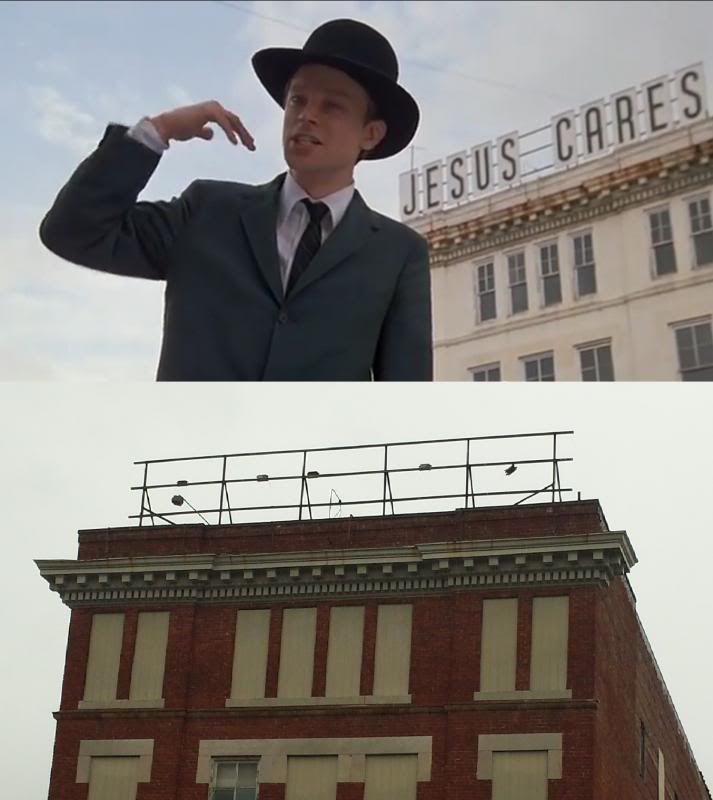
Futher information and pictures can be found here:
http://thomas-g.livejournal.com/12612.html" onclick="window.open(this.href);return false;

Futher information and pictures can be found here:
http://thomas-g.livejournal.com/12612.html" onclick="window.open(this.href);return false;
-
hearthesilence

- Joined: Fri Mar 04, 2005 8:22 am
- Location: NYC
Re: 470 Wise Blood
Possibly. He thought it was satire until Dourif questioned him about the closing scenes. This led to a meeting with the writers (one of whom was both the executor of O'Connor's estate and the producer who approached Huston about directing this film), and Huston decided to switch gears. This may have been in the middle of production (which would explain the shift in tone by the time it gets to the end), I can't remember, but the liner notes probably say when.drakula wrote:I don't know if I'm alone in this, but I really think the film misunderstands the tone of Flannery O'Connor's novel.
The music cues were definitely awful. Some of the humor was a little too crude in execution. (One that really sticks out - Emery's lousy disguise. I know it's supposed to be bad, and the idea does seem hilarious, but it didn't play that way simply because it looked bad in a banal way.) But I think it does a fine job of capturing the grotesqueness and humor of the book without going too far or (as some claim) coming off as condescending to its own characters. One thing that did throw me was the setting - it starts off feeling like a period piece, but then the 'modern' cars show up, and from there, there were a few times that felt like a weird mishmash of two periods. Possibly the result of the low budget?
BTW, Lincoln Center played this tonight right before There Will Be Blood (and appropriately followed by The Treasure of the Sierra Madre). Interesting to see their respective takes on religion - the latter fitting the Bush-era that spawned it, and the former initially shaped by a similar suspicion of the burgeoning evangelical movement in 1979.
-
hearthesilence
- Joined: Fri Mar 04, 2005 8:22 am
- Location: NYC
Re: 470 Wise Blood
Streamed this again this morning. Except for the straight instrumental of the Shaker hymn "Simple Gifts," I really hate the music, especially when it's recorded with synth sounds that were dated even in 1979. The occasional mishandling of Emery's comedic bits (the disguise, his disappointment after dressing up as a gorilla) disappoints too.
BUT, much of this plays better the second time around. It takes a while to get going, but Dourif's scenes with Stanton and/or Wright, the entire scene where Hazel confronts Hoover's "prophet" and the closing scenes with the landlady are especially great. As mentioned, it's a very flawed, but it's not that far from a masterpiece and the best thing Huston's done in the "latter" part of his career. Only Fat City comes close with The Man Who Would Be King a bit further behind.
BUT, much of this plays better the second time around. It takes a while to get going, but Dourif's scenes with Stanton and/or Wright, the entire scene where Hazel confronts Hoover's "prophet" and the closing scenes with the landlady are especially great. As mentioned, it's a very flawed, but it's not that far from a masterpiece and the best thing Huston's done in the "latter" part of his career. Only Fat City comes close with The Man Who Would Be King a bit further behind.
-
domino harvey
- Dot Com Dom
- Joined: Wed Jan 11, 2006 6:42 pm