My review of the Facets disc - hopefully this will be a significant improvement. At the very least, the subtitles should be properly in sync, which was my biggest bugbear with the Facets disc, though it could also do with a hefty upgrade in picture quality.The exciting rediscovery of František Vláčil was helped through our release of his 1967 masterpiece Marketa Lazarová. As a result of the wonderful response we have had to that film, Second Run are delighted to announce that we will be releasing more of this important filmmaker's work during 2009.
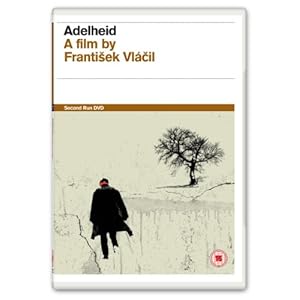
Adelheid
A film by František Vláčil
Czechoslovakia, 1969
SRDVD 041
Vláčil's first film in colour, Adelheid is a stunning drama set in the Czech border areas during the immediate aftermath of World War II. A tale of two lovers - a Czech man and a German woman - caught up in the bitter politics and powerful emotions of that time.
41 Adelheid
-
MichaelB

- Joined: Fri Aug 11, 2006 10:20 pm
- Location: Worthing
- Contact:
41 Adelheid
Announced in the new Second Run catalogue, included with Daisies.
-
Skritek

- Joined: Fri Jul 13, 2007 1:59 pm
- Location: Switzerland
Re: 41 Adelheid
Great news. If I remember correctly the Czech release isn't all that great either.
-
MichaelB
- Joined: Fri Aug 11, 2006 10:20 pm
- Location: Worthing
- Contact:
Re: 41 Adelheid
I suspect it'll be the Czech transfer with added English subtitles - Second Run generally can't justify brand new transfers where existing ones are available, especially for a film so obscure that it's never been released (possibly never even screened) in Britain before.Skritek wrote:Great news. If I remember correctly the Czech release isn't all that great either.
I also know from experience that the Czech national film archive isn't too keen on people accessing their mastering materials when video alternatives are available, which is why the short Johanes doktor Faust is presented non-anamorphically on the BFI's Svankmajer compilation.
-
perkizitore

- Joined: Thu Jul 10, 2008 7:29 pm
- Location: OOP is the only answer
Re: 41 Adelheid
I have been informed that this will be a summer release.
-
jbeall

- Joined: Sat Aug 12, 2006 1:22 pm
- Location: Atlanta-ish
Re: 41 Adelheid
Amazon.uk is listing the release date as 23 August.
-
MichaelB
- Joined: Fri Aug 11, 2006 10:20 pm
- Location: Worthing
- Contact:
Re: 41 Adelheid
The BFI's František Vláčil retrospective is scheduled for September, so that makes perfect sense.
-
jsteffe

- Joined: Sat Mar 31, 2007 1:00 pm
- Location: Atlanta, GA
Re: 41 Adelheid
I like the expressive simplicity of the cover design!
-
MichaelB
- Joined: Fri Aug 11, 2006 10:20 pm
- Location: Worthing
- Contact:
Re: 41 Adelheid
For once the title doesn't need a translation, so even the text is pretty barebones.
-
bigP

- Joined: Thu Mar 20, 2008 2:59 pm
- Location: Reading, UK
Re: 41 Adelheid
I've just noticed that The František Vláčil Collection upcoming boxset contains an exclusive documentary on Vláčil; Sentiment by Tomas Hejtmanek. I'm tilting over towards double-dipping on the already released films and buying this set but wondering if the documentary is worth the extra cost? Can anyone recommend this as a great release in its own right?
-
Jean-Luc Garbo

- Joined: Thu Dec 09, 2004 5:55 am
- Contact:
Re: 41 Adelheid
Damn, just when I bought Valley of the Bees last month now there's this box set!
-
MichaelB
- Joined: Fri Aug 11, 2006 10:20 pm
- Location: Worthing
- Contact:
Re: 41 Adelheid
Here's a full-on rave from Czech cinema expert David Sorfa:bigP wrote:I've just noticed that The František Vláčil Collection upcoming boxset contains an exclusive documentary on Vláčil; Sentiment by Tomas Hejtmanek. I'm tilting over towards double-dipping on the already released films and buying this set but wondering if the documentary is worth the extra cost? Can anyone recommend this as a great release in its own right?
(source)Faith in contemporary Czech cinema was, however, restored by the fabulously uncommercial Sentiment (Tomáš Hejtmánek, 2003) which recreates a documentary that Hejtmánek was planning to make of the 60's historical fantasy director, František Vlačil, who died before filming could begin. Vlačil's conversations with the director are masterfully replayed by Jiří Kodet, more well known as a comic actor, and Hejtmánek alternates between close ups of Kodet acting out Vlačil's lines (rewritten by FAMU lecturer, Jiří Soukup) and long takes of the various landscapes -- the woods, the snow, the sea -- that set the scene for Vlačil's films. In a brave and controversial move, it was decided that the film would only feature three extracts from the soundtracks of Vlačil's films and no clips whatsoever. While some thought that this tactic would alienate viewers who were not familiar with the films already, the effect seemed rather to be one of creating an intriguing sense that these films are worthy of further exploration. The film could, perhaps unfairly, be likened to the chance meeting of Tarkovsky and Bergman in a Czech pensioner's flat, but it is affecting and its formal experimental flourishes (the inclusion of various pieces of camera equipment in some of the "natural" shots) add to the feeling of watching two cinematic intelligences at play. An ascending crane shot of the burning of obsolete film stock in a snowy field says almost all there is to say about the hubris of the permanence of memory (technological or otherwise).
-
bigP
- Joined: Thu Mar 20, 2008 2:59 pm
- Location: Reading, UK
Re: 41 Adelheid
Thanks for posting that Michael, I am sold! and I've just pre-ordered the set from HMV for a damn fine price too.
-
MichaelB
- Joined: Fri Aug 11, 2006 10:20 pm
- Location: Worthing
- Contact:
Re: 41 Adelheid
Incidentally, just to defuse any conspiracy theories that Second Run is trying to screw its customers by forcing them to double-dip through offering exclusive box-set content, Sentiment was such a late addition to the box that it nearly didn't happen at all.
They've been trying to track down the rights for years - the original plan was for Marketa Lazarová to be a two-disc set in a double bill with Sentiment - but Hejtmánek sincerely believed that his film was marketable in Britain on its own, and it took several more years for him to bow to the inevitable and admit that if he didn't sell the rights to Second Run as an extra then it wouldn't get distributed at all. But by the time he'd signed on the dotted line, Adelheid had already been authored and was ready for release, so it was too late to add it to that.
So I think they've handled it as well as they could have done - by the time Adelheid is released it should hopefully be common knowledge that Sentiment is a bonus feature in the box, so even people who've bought Marketa and Valley of the Bees won't feel too miffed. And it's currently going for £17.99 as a pre-order on various sites, which is a bit of a bargain even if you already have two of the four films.
They've been trying to track down the rights for years - the original plan was for Marketa Lazarová to be a two-disc set in a double bill with Sentiment - but Hejtmánek sincerely believed that his film was marketable in Britain on its own, and it took several more years for him to bow to the inevitable and admit that if he didn't sell the rights to Second Run as an extra then it wouldn't get distributed at all. But by the time he'd signed on the dotted line, Adelheid had already been authored and was ready for release, so it was too late to add it to that.
So I think they've handled it as well as they could have done - by the time Adelheid is released it should hopefully be common knowledge that Sentiment is a bonus feature in the box, so even people who've bought Marketa and Valley of the Bees won't feel too miffed. And it's currently going for £17.99 as a pre-order on various sites, which is a bit of a bargain even if you already have two of the four films.
-
Jean-Luc Garbo
- Joined: Thu Dec 09, 2004 5:55 am
- Contact:
Re: 41 Adelheid
Will the collection be slimline or standard DVD cases?
-
MichaelB
- Joined: Fri Aug 11, 2006 10:20 pm
- Location: Worthing
- Contact:
Re: 41 Adelheid
If the Hungarian box is any guide, it'll be exactly the same three DVDs as released separately (i.e. complete with original covers and individual booklets) plus Sentiment.
-
MichaelB
- Joined: Fri Aug 11, 2006 10:20 pm
- Location: Worthing
- Contact:
Re: 41 Adelheid
A final production copy of Adelheid is playing on my laptop right now, and I'm happy to confirm that it's a definite advance on the Facets disc - the image no longer has that strange texturing, the encoding is native PAL and progressive, and the subtitles are white, optional and properly synchronised.
On the debit side, while the source print seems pretty clean on the basis of a quick spin, the colours are a little pasty and the night scenes are darker than feels comfortable - I don't have a copy for comparison, but I strongly suspect that this is the Czech release with added English subtitles: anyone familiar with Czech transfers of late 1960s/early 1970s colour films will recognise the overall feel.
But the new Second Run disc is nonetheless a clear first choice for this film - and I doubt anything short of a full photochemical restoration by the Czech National Archive will get it looking much better.
On the debit side, while the source print seems pretty clean on the basis of a quick spin, the colours are a little pasty and the night scenes are darker than feels comfortable - I don't have a copy for comparison, but I strongly suspect that this is the Czech release with added English subtitles: anyone familiar with Czech transfers of late 1960s/early 1970s colour films will recognise the overall feel.
But the new Second Run disc is nonetheless a clear first choice for this film - and I doubt anything short of a full photochemical restoration by the Czech National Archive will get it looking much better.

-
Bikey

- Label Representative
- Joined: Wed Aug 17, 2005 8:09 am
Re: 41 Adelheid
We are really delighted that the BFI's Vláčil retrospective is taking place throughout September; and, even better, is the fact that selected films will travel out-of-London and also screen at the Filmhouse Edinburgh and the Glasgow Film Theatre.MichaelB wrote:The BFI's František Vláčil retrospective is scheduled for September, so that makes perfect sense.
Full details can be found at the Czech Centre's website: http://www.czechcentres.cz/london/novinky.asp?ID=13903" onclick="window.open(this.href);return false;
Please do take the opportunity to discover this wonderful filmmaker's work on the big screen. And we would love to hear what you think after watching the films.
-
MichaelB
- Joined: Fri Aug 11, 2006 10:20 pm
- Location: Worthing
- Contact:
Re: 41 Adelheid
My Sight & Sound piece on Vláčil has just been published online, with noticeably more stills than the print version.
Incidentally, I do know how to spell his name correctly: it's just that the content management system underpinning the site simply can't handle eastern European diacritics. Apologies to any Czechs reading this: it's like fingernails down a blackboard to me too, if that makes it any better.
Incidentally, I do know how to spell his name correctly: it's just that the content management system underpinning the site simply can't handle eastern European diacritics. Apologies to any Czechs reading this: it's like fingernails down a blackboard to me too, if that makes it any better.
-
Bikey
- Label Representative
- Joined: Wed Aug 17, 2005 8:09 am
Re: 41 Adelheid
A very deeply-felt review of Adelheid by Clydefro Jones at The Digital Fix:
http://homecinema.thedigitalfix.co.uk/c ... lheid.html" onclick="window.open(this.href);return false;
http://homecinema.thedigitalfix.co.uk/c ... lheid.html" onclick="window.open(this.href);return false;
-
Stephen

- Joined: Sun Feb 08, 2009 8:11 pm
- Location: Brisbane, QLD, Australia
Re: 41 Adelheid
Arrived today and each is in the standard dvd cases, including the documentary. Fantastic bargainJean-Luc Garbo wrote:Will the collection be slimline or standard DVD cases?
-
Bikey
- Label Representative
- Joined: Wed Aug 17, 2005 8:09 am
Re: 41 Adelheid
A beautifully-judged review of ADELHEID written by L K Weston at DVD Outsider:
http://dvdoutsider.co.uk/dvd/reviews/a/adelheid.html" onclick="window.open(this.href);return false;
http://dvdoutsider.co.uk/dvd/reviews/a/adelheid.html" onclick="window.open(this.href);return false;
-
jbeall
- Joined: Sat Aug 12, 2006 1:22 pm
- Location: Atlanta-ish
Re: 41 Adelheid
Well,this thread could certainly use a few more posts! I thought this film was remarkable, and certainly deserves more discussion than it's thus far received.
I bought the František Vláčil boxset, and I can only hope that SR releases more of Vláčil's work (White Dove, anyone? I never say never, but it's as close to a cinematic certainty as you'll ever get that I've no intention of watching a Facets release ever again, barring a drastic improvement in their image quality, timing/completeness of subs, etc.) in the near future.
The way Vláčil stages the slow awakening of voyeuristic desire in both Viktor and Adelheid through slow takes and minimal dialogue (esp. since for the most part, the the two characters can't communicate with each other) is marvelous. Why is Viktor so drawn to Adelheid when he otherwise wants to withdraw from the world? What does she see in him?--it remains only obliquely hinted at, even in their final converation. The use of the bullet-riddled painting on the wall (and bullet-riddled walls/doors in general!) is an effective way of foreshadowing the senseless violence (embodied not only in the local Czech official, but also Adelheid's brother) that will destroy whatever chance of happiness existed. But the idea of a consensual relationship between Adelheid and Victor is never confirmed; she remains enigmatic, even as the film condemns the Czechs' treatment of the Sudeten Germans in the post-war years.
Of the three Vláčil films I've seen (all SR releases), this is the first set in the twentieth century, but it still employs liberal use of voice-over when the speaking character is still onscreen, giving an air of reminiscence (and, I guess, identification of the spectator with the remembering speaker) to the proceedings, almost as if there's an air of unreality produced by the fogginess of memory. Here, however, it's easier to follow, since the film is in color and the contrast ratio is clearer than, for example, Marketa Lazarova. Moreover, Vláčil makes judicious use of b&w in subjective flashbacks (and at the end!) so that the explicit reminiscences become extra-blurry because of contrast.
All that said, the film remains a damning critique of the Czechs' treatment of collaborators and Germans in the post-war years. Compare it to Jan Hrebejk's Musíme si pomahat ("Divided We Stand" a finalist for the Oscar for best foreign film in 2001), which all-too-briefly touches on the issue, and lets it drop. It's also an investigation of the horrific past that's occured on these very lands and a meditation on who's to be held responsible for it. Adelheid is my third-fave Vláčil (after Valley of the Bees and Marketa Lazarová, respectively) so far, but it remains a powerful document of a period in Central European history that the locals would rather forget. It's easy to critique the Germans for their collective amnesia during the decade+ immediately following the end of WWII, but requires a bit more honesty for their victims to do the same, and I think Adelheid accomplishes that very well, and with a great deal more honesty than you see in any other films from the region in the twenty years or so following the war. This is such an important release from SR.
I bought the František Vláčil boxset, and I can only hope that SR releases more of Vláčil's work (White Dove, anyone? I never say never, but it's as close to a cinematic certainty as you'll ever get that I've no intention of watching a Facets release ever again, barring a drastic improvement in their image quality, timing/completeness of subs, etc.) in the near future.
The way Vláčil stages the slow awakening of voyeuristic desire in both Viktor and Adelheid through slow takes and minimal dialogue (esp. since for the most part, the the two characters can't communicate with each other) is marvelous. Why is Viktor so drawn to Adelheid when he otherwise wants to withdraw from the world? What does she see in him?--it remains only obliquely hinted at, even in their final converation. The use of the bullet-riddled painting on the wall (and bullet-riddled walls/doors in general!) is an effective way of foreshadowing the senseless violence (embodied not only in the local Czech official, but also Adelheid's brother) that will destroy whatever chance of happiness existed. But the idea of a consensual relationship between Adelheid and Victor is never confirmed; she remains enigmatic, even as the film condemns the Czechs' treatment of the Sudeten Germans in the post-war years.
Of the three Vláčil films I've seen (all SR releases), this is the first set in the twentieth century, but it still employs liberal use of voice-over when the speaking character is still onscreen, giving an air of reminiscence (and, I guess, identification of the spectator with the remembering speaker) to the proceedings, almost as if there's an air of unreality produced by the fogginess of memory. Here, however, it's easier to follow, since the film is in color and the contrast ratio is clearer than, for example, Marketa Lazarova. Moreover, Vláčil makes judicious use of b&w in subjective flashbacks (and at the end!) so that the explicit reminiscences become extra-blurry because of contrast.
All that said, the film remains a damning critique of the Czechs' treatment of collaborators and Germans in the post-war years. Compare it to Jan Hrebejk's Musíme si pomahat ("Divided We Stand" a finalist for the Oscar for best foreign film in 2001), which all-too-briefly touches on the issue, and lets it drop. It's also an investigation of the horrific past that's occured on these very lands and a meditation on who's to be held responsible for it. Adelheid is my third-fave Vláčil (after Valley of the Bees and Marketa Lazarová, respectively) so far, but it remains a powerful document of a period in Central European history that the locals would rather forget. It's easy to critique the Germans for their collective amnesia during the decade+ immediately following the end of WWII, but requires a bit more honesty for their victims to do the same, and I think Adelheid accomplishes that very well, and with a great deal more honesty than you see in any other films from the region in the twenty years or so following the war. This is such an important release from SR.
-
Bikey
- Label Representative
- Joined: Wed Aug 17, 2005 8:09 am
Re: 41 Adelheid
DVD Talk 'highly recommends' our František Vláčil Collection; reviewed by Chris Neilson
http://www.dvdtalk.com/reviews/45811/fr ... ction-the/" onclick="window.open(this.href);return false;
http://www.dvdtalk.com/reviews/45811/fr ... ction-the/" onclick="window.open(this.href);return false;