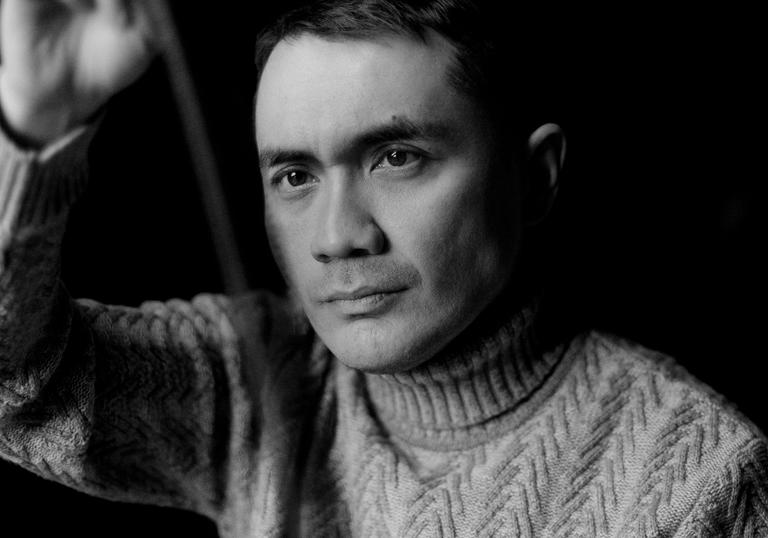
Realtor (2011)
Constructors (2013)
The Owners (2016)
The Plague at the Karatas Village (2016)
Night God (2018)
The Gentle Indifference of the World (2018)
A Dark, Dark Man (2019)
Atbai's Flight (2019)
Yellow Cat (2020)
Ulbolsyn (2020)
Herd Immunity (2021)
The Assault (2022)
Goliath (2022)
Ademoka's Education (2022)
Steppenwolf (2024)
Cadet (2024)
Moor (2024)
Turgaud (2026)
Shorts
Bakhytzhamal (2007)
Karatas (2009)
The Return of Zoya (2022)
I'm intrigued to see where this thread will go. I've only seen Yellow Cat and thought it was. . . fine, but I'm interested to hear recommendations from advocates.
Yerzhanov fascinates me. Remarkably prolific, turning out multiple movies a year, he's almost totally unrepresented in western countries. I've seen but a fraction of his films, three of them at festival screenings, three elsewhere, yet I want to know more. He has a style all his own, one you can compare to other filmmakers, but only to triangulate him, to get a descriptive handhold. His tone and style seem to be unique to him: bleak and brutal, pitiless, even feral, and yet very funny, too, in an absurdist and surreal way, mixing strains of black humour (playful, dry, absurd, grotesque). His is a cinema of the steppe: vast and open, totally entrapping, harsh and indifferent, and photographed with such a perfect eye for beauty. Repulsive and compelling. His world is very alien to my own.
Yerzhanov's style, as best I can tell with all my gaps, has been evolving over the last ten years. The Plague at the Karatas Village and Night God have an odd, formalist style, like Parajanov mixed with absurdism and surrealism, plus again the dark humour. They are impenetrable, beguiling movies. In The Plague... a functionary arrives with his wife to be mayor of a broken down village in Karatas (a recurring location in Yerzhanov's films), only to find it plague ridden with a disease more symbolic than medical, and inhabited by corrupt officials and townsfolk who enact bizarre rituals. The film is a slow, absurdist farce, where narrative is subordinate to symbolic and allegorical assemblages. Yerzhanov shoots flat compositions against walls and other surfaces, with long takes in which the rhythm of what happens on screen (movement not just of people but also objects) carries both meaning and aesthetic importance. Night God is an eschatological nightmare where the maze of Soviet bureaucracy is married to the folklore of the Steppe, all filmed in long, languorous tracking shots ala Tarkovsky, but with the flat pictorial sense of Parajanov. The camera is less static than The Plague..., but kept mainly to horizontal movements against backdrops of mud, rain, mouldering buildings, and endless night. Again, the movie is heavily symbolic and allegorical rather than narrative, and no doubt requires a lot of local Kazakhstani knowledge to unpack.
Two years later, with A Dark, Dark Man, Yerzhanov shifts his style. Gone are the heavily symbolic, surrealist narratives, and in their place genre. The movie is a murder mystery, a thriller, and a road movie, although it frustrates any attempt to appreciate them that way (the murder mystery is solved at the beginning; the road movie involves people struggling to get anywhere and mostly just waiting around). The compositions are no longer so flat, tho' they favour horizontal movements and head on framings, and pictorialism. But there are more pull-ins, there's more depth of field, more conventional film grammar. Instead of being filmed against walls or other flat surfaces, people are filmed against the vastness of the landscape, often dwarfed by it. Think Nuri Bilge Ceylan, except instead of shot from behind people are shot from the front like Wes Anderson. The steppe isn't shrouded in oppressive darkness as in the first two features, but expands into infinity around the characters. The pace is deliberate and lingering, and the humour either deadpan or bathetic as sudden violence sits next to playful, innocent humour. Yellow Cat continues this new style into what is technically a comedy. It's a road movie where a recently released prisoner and a young prostitute abscond with funds from a local gangster to set up a movie theatre in the remote steppe. The lead, an orphan, believes he looks like Alain Delon and is always reenacting scenes from Le Samourai (whose ending, tragically, he has never seen). Same deadpan black comedy mixed with surprising brutal violence, but also a streak of playfulness that suggests Godard by way of Kitano. Movie scenes are parodied, childlike play breaks out in violent or despairing circumstances, all set against the emptiness of the landscape. Yerzhanov's surrealism makes a return, with some beautiful but inexplicable scenes: a yellow sailboat in the depths of the steppe; Singing in the Rain performed against a fluttering banner; a gunman bouncing on a trampoline to shoot over a bus in front of him. It's a movie meant to provoke bitter laughter. Yerzhanov takes this style and applies it to the post-apocalyptic Mad Max style of film in Steppenwolf. The pace is no longer so languid, the compositions have even more depth, but the landscape is still horrific and beautiful. A movie whose unending brutality eventually just becomes funny, it's so absurd. Stillness and action play off each other throughout, so there's a propulsion Yerzhanov earlier avoided. Kazakh Scary Tales is his most commercial venture. More than the other five films, this is a conventional story with conventional characters. It's a detective show, but the mysteries involve the horrific folklore of the Steppe. Yerzhanov uses the bleak landscape to his advantage: there are few things more unnerving than being alone on the Steppe at night. And yet this horrific tale of devoured babies and angry succubuses is so endlessly comedic. You eventually spend more time laughing at the deadpan humour than trembling at the horrors. How else to meet such corruption and cruelty than to make fun of all your friends.
Yerzhanov's vision is bleak. Violence and corruption are so endemic, so baked into daily life, that they happen casually, normally, without much thought. As features of the world, they're engulfing. There is no recourse, no higher authority, it's there from top to bottom. His main characters simply navigate these things as best they can. They are either outsiders who cannot understand or grapple with the absurdity of the world (A Plague..., Night God), or are corrupted and consumed by it (A Dark, Dark Man, Steppenwolf), or like the main character of Yellow Cat, they have a simple, startling vision of something outside the world, tied to the imagination, and pursue it without any sense of its impracticality. These figures are often accompanied by characters in the tradition of the innocent fool, either brain damaged, neurodivergent, or just simple and carefree, and that innocence carries them through the cruelties they are subjected to. In these six movies there are characters who want out, who want more than anything to leave the stupid, degraded animal world of Karatas or Kazakhstan, yet there is no way for that to happen. These are brutally unsentimental movies. Yellow Cat, because it's a comedy, offers the freest and most explicit version of this longing, where film and play offer some kind of vision outside of animal existence, before reality crashes in so brutally. The only form of escape the films offer up is death. Otherwise there's nowhere else to go.
I don't know if I have anything of substance to add to such a strong writeup on the film, but I just watched Steppenwolf and agree with Sausage's assessment. I already want to praise Yerzhanov as an auteur because the strategy by which he reaches and sustains this somehow-pleasurable mixture of forces in repelling violence, inviting hilarity, and.. a fair amount of serene, earned drama(!) requires such a fine-tuned ear to tone in addition to form. And, perhaps divergently, both a deep understanding of its effects on the audience, and a baldfaced commitment to risk in playing with it so dynamically. That the fragmented-mood structure feels fluid is very impressive, and I'm looking forward to consuming more.
Yeah, I regret not mentioning how Yerzhanov is able to locate these humane pockets even in his most despairing films. There are moments of connection, of people wanting to help each other or do good. But the characters are so deeply compromised that all they have to offer is the barest fragment of what's left of their souls, even if they'd like to give more. That they even have a soul at that point is victory of a kind, tho'. Certainly that's what moved me most about Steppenwolf, that the main character knows there's so little left of his own humanity, yet pulls out whatever remains of it to help this one woman who may or may not be able to even recognize what's going on. There is real drama in these absurd, grotesque stories.
I've been following Yerzhanov's work for 10 years now and have seen 9 of the features listed above. Steppenwolf is not one of my favorites. Here's what I wrote in the Arrow thread:
I wrote:
"This Limited Edition release also includes Adilkhan Yerzhanov’s 2022 feature film Goliath, available for the very first time in the UK."
For me, Goliath is the superior film in this release. It does what most Yerzhanov films do - wrap nihilism and its cousin, absurdism, with art film aesthetics in some genre trappings - but does it more successfully than Steppenwolf does. The 2022 movie is the quieter one, so its ultra violence shocks by contrast. The 2024 film (bigger budget, bigger everything, non-stop violence) feels forced, and Berik Aitzhanov, who's perfectly fine in the earlier movie in which all he has to do is drag himself from place to place, can't pull off the pathos or the comedy that the more mainstream action movie requires.
Yerzhanov is one of today's top directors, iyam. He's young (42) and prolific (over a dozen features already). He's already made one great movie: A Dark, Dark Man (2019), a horrifying murder mystery played as deadpan comedy. Goliath is a slow-burning revenge story, and, though not as overtly engaging as A Dark, Dark Man, may be his next most aesthetically unified work.
These two (DDM and Goliath) are, for me, the works that make Yerzhanov "someone to watch". I also found a big dose of the Yerzhanov I like in Assault and Cadet.
It's sad no one have put out an English-friendly BD of DDM.* It was, for me, the best film of 2019.
*indeed, the only commercial release I know of is a horrible-looking French DVD!
A Dark, Dark Man is pretty good, and at first seemed much more different than Steppenwolf's structure, before I realized how similar both films actually are to one another. Steppenwolf mostly signaled what it was going to be from the beginning, and then repeated that cycle with amplification plus enhanced dramatic stakes to an increasingly apocalyptic conclusion. A Dark, Dark Man certainly blends the absurdist humor with its grisly content from the outset, but I found a lot less deadpan comedy after the first act. The film got more serious with a leisurely-paced respect for its audience, settling into a rhythm that began taking the time to flesh out the characters at around the hour mark onward. The structure felt opposed to Steppenwolf's: Instead of feeding into a theme of endless violence reflecting the limitations of personal growth, this film demonstrates how people can sober up to the morality of their situations and make a change with more inspiration. However, Steppenwolf accomplishes the latter as well. There's a similarity in how both films' antiheroes start seeking to understand rather than burying heads in the sand by stretching perceived limitations towards a compromised sense of morality, still existing within bounds of a violent world. Both films pause what they're doing about halfway through to focus on earned drama, it's just that Steppenwolf was just as egregiously violent for that first half whilst A Dark, Dark Man merely exists on a plane of anti-growth and underdevelopment up to that point, and only fulfills its moral ambitions under that necessarily violent context in its final moments.
I think I preferred Steppenwolf for its consistent and creative blending of tones throughout. It was more fun and engaging, and off-putting and horrifying. But I felt more satisfied by A Dark, Dark Man's trajectory of building upon ideas to move through tones at different points in its formation. Steppenwolf felt dense and Sisyphean while A Dark, Dark Man followed a more traditional path in evolving its narrative and characterization. That's not a knock on the earlier film - it's still perverse in its own way, partially by subverting its own genre tropes - but I guess I just didn't care very much about what was happening until Bekzat slowed down, whereas with Steppenwolf I was coerced into caring deeply about all stimuli thrown at me from the first frame.
A Dark, Dark Man seems like the inverse of Steppenwolf. In A Dark, Dark Man, the placidity and quietness is disturbed by sudden, unexpected violence; in Steppenwolf, it's the constant hammering violence that's disturbed by sudden quietness. It's a very odd effect in the latter: it's the intrusions of drama that are discomforting. The film numbs you to its brutal world before opening up these avenues for feeling or contemplation, suddenly. You're beat down only to kinda revive. Much like the lead character in a way.
Anyway, I read A Dark, Dark Man as a Kitano riff. A couple of times it even references this image from Boiling Point (which is itself a Godard reference I believe). And you can see it in the basics: a cop thriller about a quiet, compromised man who's unreactive; a gaggle of hangers on who goof off in the background; a road trip; sudden explosions of violence within placid settings; head-on compositions that mine humour from the Kuleshov effect. Yellow Cat is even more Kitano-like in its sense of game playing during a road trip within a nominal thriller. It's a tribute to Yerzhanov's auteurism that he can ape Kitano like this without losing any sense of his own style. Indeed I don't think I'd've even noticed the influence if he hadn't included that overt reference to Boiling Point. So what's the Yerzhanov difference? It's partly textural: his films are composed pictorially, but not delicately. You feel a roughness and wildness you'll never find in Kitano. Also the humour: Yerzhanov is more black and grotesque, more absurdist--a more eastern Europe style of humour--while Kitano is more childlike. And then the films are steeped in Yerzhanov's own culture while Kitano seems so Japanese (Kitano's American gangster film, Brother, doesn't seem very American). But I'd love to know why Yerzhanov traded up Tarkovsky and Parajanov in his earlier work for Kitano and Ceylan in his more recent stuff.
Yerzhanov's third film is a more realistic narrative than what immediately followed it. A destitute former criminal, his adolescent brother, and their kid sister have inherited a house following their mother's death and move in, only for the locals, backed by a corrupt sherrif's department, to use violent coercion to squeeze them out. It's a story of crushing destitution and hopelessness, bureaucratic indifference, where corruption and venality have no recourse anywhere because they are endemic and normalized. Yerzhanov's style is still in its early period, so the camera is locked down, the compositions tending to be flat, with people photographed head on. But the story telling is more conventional than The Plague at the Karatas Village and Night God, which were non-realistic stories full of symbolism and allegory. That said, while the film begins in a mainly realist mode, as the story progresses Yerzhanov's surrealist tendencies and absurdist humour (goofier here than in later films) begin to take over, so the film transforms into something more expressive. This does much to alleviate the crushing misery and hopelessness of its story, making the film into something of a dance to ward off despair. The film doesn't quite have the same power as his later work, but Yerzhanov's trademark style is here in full form, everything presaging his later mastery of an odd form of filmmaking. This is a miserable and beautiful early work.