Discussion now open! I listened to the suggestions and so the process has been tweaked since the last mini-list, but hopefully to the advantage of all.
As with every list project, I have a stack of movies I'd like to get to, but here are the films on my shortlist so far, all of which are obviously highly recommended:
A Master Builder (Jonathan Demme 2014) Ibsen adaptation by a bunch of talented performers and playwrights who freely admit they don’t quite understand all the component parts, but their game (re)interpretation leads to some dizzyingly intense moments, especially the thirty minute or so extended passage early in the film concerning Lisa Joyce’s arrival and coquettish interaction with Wallace Shawn, which is like a masterclass of tension and unease with no real narrative release.
American Buffalo (Michael Corrente 1996) / Glengarry Glen Ross (James Foley 1992) The two best screen adaptations of Mamet’s stage work, both scripted by the man himself.
American Buffalo wisely barely opens up the claustrophobia of the source and
Glengarry famously allows Mamet to expand upon some unexplored elements of the play, including a whole-cloth creation of what is widely considered to be the greatest example of Mamet’s mastery of dialog, the “ABC” sales talk from Alec Baldwin.
Baby Doll (Elia Kazan 1956) I mean, movies don’t get much better than this: three amazing performers, all trying to outdo each other, in a production so steeped in sex that the film was rated “R” on later submission to the MPAA and was of course famously condemned by the Catholic church as resulting in damnation for anyone who saw it. Have you ever heard of a better recommendation?
Butterflies Are Free (Milton Katselas 1972) Flighty Goldie Hawn begins an impulsive relationship with her blind neighbor, only to draw the ire of his overprotective mother, Eileen Heckart in her Oscar-winning perf. Some of the speechifying in the last twenty minutes are a bit thick, but for the majority of the film this is a winning and charming romantic comedy with lots of great laugh-lines, many coming from Heckart in the second half. Her role could have easily been played as the Old Witch from
Snow White as Hawn namechecks, but she shows an openness and willingness to consider her son’s best interests that make for a more interesting character than just a mere villain, and her Oscar win was definitely yet another case of the Academy rewarding a character they liked (though it was merited by her perf, at least).
Come Back, Little Sheba (Daniel Mann 1952) Shirley Booth won the Oscar for reprising her stage role as the complacent housewife to Burt Lancaster’s drunk. Some intense moments from Lancaster (including Lancaster uttering a terrifying and remarkable vulgarity for the era) and Terry Moore’s reference-level qt perf (also Oscar-nommed) make this an easy recommendation.
Days of Wine and Roses (Blake Edwards 1962) Jack Lemmon and Lee Remick comprise the perpetually drunk couple arriving at the point of no return in this superior tale of alcoholism’s all-encompassing drama.
Detective Story (William Wyler 1951) Go into this one knowing as little as possible, as this quasi-real time barnburner is a brilliant act of misdirection, completely blindsiding the viewer just like the protagonist once certain revelations come to light. Every time I teach this one, you can hear a fucking pin drop from my students due to the anxiety and stress of the last act and every laugh line and release of tension just plays beautifully with an audience. Kirk Douglas gives his greatest and most intense performance and Eleanor Parker set a record for shortest performance ever nominated for Best Actress with her memorable turn. Hard to picture anything toppling this out of the top spot for me.
Dial ‘M’ for Murder (Alfred Hitchcock 1954) Give Hitchcock a claustrophobic stageplay and 3-D technology and what does the clever bastard do? He barely opens it up and instead uses the limited space to play with relating the impact of a stage drama.
Doubt (John Patrick Shanley 2008) Amazing cast giving amazing performances of, well, pretty good material.
Dutchman (Anthony Harvey 1967) Short (it runs under an hour), unfocused but dynamite exploration of American racial politics in the sixties, this is a memorable two hander with Al Freeman Jr and Shirley Knight going through the gamut of emotional responses to racially-charged flame-throwing.
Irma La Douce (Billy Wilder 1963) / Kiss Me, Stupid (Billy Wilder 1964) With
Irma La Douce, Billy Wilder adapts a hit Broadway musical by… taking out all of the musical numbers and recasting his two stars from
the Apartment in the leads. And then for
Kiss Me, Stupid, he convinces Dean Martin to play a grotesque, amazingly vicious self-parody of himself as an unwitting third wheel in a marital spat. Both are divisive films, even for Wilder fans, but I think both are among Wilder’s best works.
Killer Joe (William Friedkin 2012) One sick fuck of a movie.
the Matchmaker (Joseph Anthony 1958) Two young up and comers, Shirley MacLaine and Anthony Perkins, and two veterans of stage adaptations this decade, Shirley Booth and Paul Ford, lend their talents to this hilarious and superior adaptation of the play later used to form
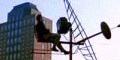
Hello, Dolly. It goes without saying but let me stress to not hold that film against this one. Besides, don’t you want to know what’s happening in this screenshot?
 Miss Julie (Alf Sjöberg 1951)
 This play has been filmed several times (and I have the recent one with Jessica Chastain on the docket for viewing this round), but this bite at the apple is a beautifully visual journey through a story that loses none of its impact with each new adaptation.
Pygmalion (Anthony Asquith and Leslie Howard 1938) Pretty garn good adaptation of the Shaw play, with memorable turns by the two leads.
the Night of the Iguana (John Huston 1964) / Suddenly, Last Summer (Joseph L Mankiewicz 1959) / Sweet Bird of Youth (Richard Brooks 1962) Tennessee Williams was a popular adaptation choice in the wake of
A Streetcar Named Desire’s massive success, but of course many of his adaptations suffer from censorship choices (most notably
Cat on a Hot Tin Roof, which is rendered meaningless with the homosexuality removed), but these (with
Baby Doll) are the strongest of the classic wave of adaptations, which live and breathe on their own two legs apart from the albatross of the plays around their necks.
Sleuth (Joseph L Mankiewicz 1972) The ultimate two-hander (even if technically it’s a third with that detective poking around in the second half). Few directors from the classic era were allowed to go out on such a high note.
the Teahouse of the August Moon (Daniel Mann 1956) Always a list bridesmaid, never a bride. One of the most important works of fifties cinema in terms of impact and cultural importance. The inability of some to see how progressive the film is due to Brando’s casting is a nightmare of improper (lack of) context run amok.
Wait Until Dark (Terence Young 1967) Audrey Hepburn is a blind woman tormented for nearly two hours by a group of jewel thieves, who enter into her home and toy with the poor woman until she figures out what’s going on and flips the tables. Even if the rest of the film were bunk, which it isn’t, it would still be worth recommending for
the most famous jump-scare in history. When the film was originally released theatres turned out all of the lights, even those dimly-lit ones guiding patrons to their seats, and refused to let anyone in or out of the auditorium for the last twenty minutes, and if you have a spare afternoon some rainy afternoon, you should do a Google search for blog entries and comments from those who saw this on first run about the audience’s reaction to
that moment.
Who’s Afraid of Virginia Woolf? (Mike Nichols 1966) I mean, is it an obvious choice? Well, yeah, but for a reason. Four incredible performances, led by Richard Burton giving the perf of his career.