1283 A History of Violence
-
domino harvey

- Dot Com Dom
- Joined: Wed Jan 11, 2006 6:42 pm


-
Cold Bishop

- Joined: Wed May 31, 2006 1:45 am
- Location: Portland, OR
*yawn*Naked Lunch*yawn*
Anyone else gets the feeling David Cronenberg is trying to prove he's more than just "body horror" with this recent string of films? Not that I'm arguing... He's one of the few currently working "North American" directors who never fails to make a worthwhile film, even if not always satisfying (I'm staring at you eXistenZ)
Anyone else gets the feeling David Cronenberg is trying to prove he's more than just "body horror" with this recent string of films? Not that I'm arguing... He's one of the few currently working "North American" directors who never fails to make a worthwhile film, even if not always satisfying (I'm staring at you eXistenZ)
-
Poncho Punch

- Joined: Tue Nov 02, 2004 6:07 pm
- Location: the emerald empire
I think A History Of Violence is a fine film, but I wouldn't say it's his best, and certainly not the most Cronenbergian (not to slight what Matt was getting at in regards to the behind-the-scene method). There's something very uncharacteristic about the end of that film, as despite the change/evolution/metamorphosis/revelation that Tom (and the rest of his family) have experienced, they return to something resembling their initial status quo. Of course, the power relationships have shifted all over the place, and I think this could be evidence of a maturation of ideas on Cronenberg's part, but I generally find it unconvincing and problematic. I simply don't buy that the family can keep up the facade after what they've been through.
Well, there's that, and the fact that I think Cronenberg is best exemplified by Vaughn's line in Crash about "the reshaping of the human body by modern technology" (even moreso than Videodrome's McLuhan aping). But I have trouble in that film deciding whether Vaughan or Ballard should be taken for David, they both fit so well on so many different levels.
Well, there's that, and the fact that I think Cronenberg is best exemplified by Vaughn's line in Crash about "the reshaping of the human body by modern technology" (even moreso than Videodrome's McLuhan aping). But I have trouble in that film deciding whether Vaughan or Ballard should be taken for David, they both fit so well on so many different levels.
-
Galen Young

- Joined: Sat Nov 13, 2004 12:46 am
In this interview with Josh Olson, he gets a hint of this from his first meeting with Cronenberg:Cold Bishop wrote:Anyone else gets the feeling David Cronenberg is trying to prove he's more than just "body horror" with this recent string of films?
I'm hoping he still makes Maps to the Stars with Bruce Wagner -- gotta wonder what a Cronenberg version of Sunset Blvd. might be like.Cold Bishop wrote:...when I first met him, because I had heard about about Painkillers too -- I'm a really big fan, and I had heard about this thing and I'm meeting him and I said, so what about Painkillers? And he starts to describe the plot to me and its sort of got all these kind of familiar Cronenberg elements, and he goes: (with a big sigh) "I'm just so bored with myself."
-
Fletch F. Fletch

- Joined: Tue Nov 02, 2004 7:54 pm
- Location: Provo, Utah
-
flyonthewall2983

- Joined: Mon Jun 27, 2005 7:31 pm
- Location: Indiana
- Contact:
From my perspective, I always thought Ballard seemed more like David. Spader referred to the character as a voyeur of sorts through the film, "a participatory one". I definitely think the same can be said for David, who shot some of the sex scenes in the film as a sort of "participatory voyeur". That's just my view.Poncho Punch wrote:Well, there's that, and the fact that I think Cronenberg is best exemplified by Vaughn's line in Crash about "the reshaping of the human body by modern technology" (even moreso than Videodrome's McLuhan aping). But I have trouble in that film deciding whether Vaughan or Ballard should be taken for David, they both fit so well on so many different levels.
-
scalesojustice
- Joined: Tue Jul 25, 2006 3:25 pm
- Contact:
I think that history of violence transcends the "thriller" genre through its thematic qualities. forgive me if i'm vague it's been over a year since i've seen this one. To me, it's more "successful" than his previous work because he had a larger viewing audience, yet didn't compromise his own integrity. all the parts are still there, the connection of sex and violence, the commentary or the "perfect american family," the absurdity of the "mob life," which might be ridiculous, but it's violence is nonetheless affecting.Gropius wrote:Why should the fact that he wrapped it in a 'digestible mainstream package' make it his most successful work? I know there was a lot of enthusiasm for History of Violence, but it's easily my least favourite Cronenberg film (even the shaky M. Butterfly was more interesting). For a crime thriller it's a superior work, but surely there are enough thriller directors as it is?
it's a rare event when an artist strikes produces work that is both artistically satisfying and able to reach a wider audience. even with his star cast, cronenberg never loses his potency.
even if they watched it just for viggo.exte wrote:Even if they watched it just for Viggo?
Last edited by scalesojustice on Thu Mar 22, 2007 1:44 pm, edited 1 time in total.
-
sevenarts

- Joined: Tue May 09, 2006 11:22 pm
- Contact:
I don't know. The film certainly questions violence in the sense that it doesn't present it quite as uncritically as other films in this genre. But I wouldn't say it's a particularly effective exploration of violence -- or a particularly deep one. What exactly does the film have to say about violence, when you get right down to it? It marks a person for life? That violence as a solution to problems is a dangerous path? That sexuality and violence are linked? Unusually for Cronenberg, he doesn't seem to have much to say in this film that isn't pat and obvious. The subplot with the son could've come right out of an after-school special for all the depth of its "commentary" on violence. The film really feels like Cronenberg was reaching to make an "issue" film that would resonate with mainstream audiences more than his usual themes, but I would say it's an almost unmitigated failure. It doesn't even work that well as a thriller in the way his other mainstream films like The Dead Zone or The Fly do. If this new one is more of the same, I'll definitely take a pass.Greathinker wrote:A History of Violence is one of my favorite of Cronenberg's and I tend to think that those of his following that don't like it are that way because it doesn't deal with the kind of esoteric topics/themes he's known for, and instead tackles that broad topic of violence-- it's ironic to me that people call it a mainstream film when there are so very few that make an attempt to question violence at this scope, particularly on-screen violence, let alone do it effectively.
-
Mr Sausage

- Has Risen from the Grave
- Joined: Thu Nov 04, 2004 1:02 am
- Location: Canada
There was ample discussion on this topic here, if you could move the more in depth discussion to that thread.sevenarts wrote:I don't know. The film certainly questions violence in the sense that it doesn't present it quite as uncritically as other films in this genre. But I wouldn't say it's a particularly effective exploration of violence -- or a particularly deep one. What exactly does the film have to say about violence, when you get right down to it? It marks a person for life? That violence as a solution to problems is a dangerous path? That sexuality and violence are linked? Unusually for Cronenberg, he doesn't seem to have much to say in this film that isn't pat and obvious. The subplot with the son could've come right out of an after-school special for all the depth of its "commentary" on violence. The film really feels like Cronenberg was reaching to make an "issue" film that would resonate with mainstream audiences more than his usual themes, but I would say it's an almost unmitigated failure. It doesn't even work that well as a thriller in the way his other mainstream films like The Dead Zone or The Fly do. If this new one is more of the same, I'll definitely take a pass.Greathinker wrote:A History of Violence is one of my favorite of Cronenberg's and I tend to think that those of his following that don't like it are that way because it doesn't deal with the kind of esoteric topics/themes he's known for, and instead tackles that broad topic of violence-- it's ironic to me that people call it a mainstream film when there are so very few that make an attempt to question violence at this scope, particularly on-screen violence, let alone do it effectively.
-
shaky
- Joined: Mon Jul 29, 2013 6:52 pm
Re: A History of Violence (Cronenberg, 2005)
Some thoughts on Cronenberg’s A HISTORY OF VIOLENCE:
A medium shot of the side of a building, presumably a motel, begins to track rightward along that side before stopping at a single door. Through the sound design and the natural lighting, one can sense the heat, the vacancy, and the quietness of the surroundings. Two men walk out the door(very Fordian) in a slow, leisurely pace. The camera tracks backwards as the men move toward a convertible car which fills up the foreground of the composition. One senses that perhaps these men are dangerous, perhaps not. But there is an unspoken hostility which permeates the atmosphere of these moments, affecting the calmness of the surroundings. One man moves ahead, out of frame, to pay for their motel room, while the camera remains fixed on the second man, the younger one, who is sitting lazily in the car smoking a cigarette. The man then starts the car and drives to where the lobby of the motel is, the camera following right along with him. The other man walks vertically out the lobby door in the background toward the convertible, settles into the driver’s seat where the second man was just sitting, before telling that man to go into the lobby and fill up the water bottle.
Cronenberg establishes a strong sense of ambiguity in this opening sequence in order to better juxtapose it with the rest of the film which is riddled with genre types, figures, archetypes, and clichés. This is not unintentional. We are implicated in these kinds of stereotypes and then forced to question their innate meanings AND what they mean in relation to the characters’ psychologies. Every shot of this film is, in some way, an assessment of American mythology. And the music constantly brings to mind the westerns of John Ford. Actually, I think John Ford was constantly on Cronenberg’s mind throughout the making of this film. Ford’s work is always about man’s complicated relationship with societal traditions, with the social types by which man is always defined. Cronenberg’s Tom Stahl(and, to a certain degree, his wife) consciously buys into a specific societal type and a specific kind of American mythology only to have the reality of a past mythology(and psychology) reassert itself into his life. There is also a surprising use of expressionist lighting and framing, and an equally surprising use of symbolic color coordinations. And I don’t know of any film which better understands the complex relationship between dominance and subservience(both physical and psychological) and violence. My God, the violence. Cronenberg is intensely interested in how violence affects the human body, in how intimate violence can be. The viewer will witness an antagonist get killed only for Cronenberg to immediately show, in extreme detail, the physical consequences of that killing. It's an extremely ethical position for the filmmaker to take.
The opening shot also sets up, through a single take, how Cronenberg will later depict space through camera coverage and editing(there’s a clear network of strong vertical and horizontal movements). My relationship with A HISTORY OF VIOLENCE is not intimate enough for me to clearly express exactly what Cronenberg is doing with analytical editing but it’s pretty damn masterful to my eyes, and I’m sure, if one looks close enough, it will, over time, reveal itself to be quite meaningful and representative of broader thematic elements. This is an aspect of the film with which I’m still grappling. But again like the opening of the film, many shots of A HISTORY OF VIOLENCE are used to further depict the textures of a specific milieu(mid-west small town). This is one of the film’s supreme achievements: its way of so accurately representing an area, its temperature, its layout(to a certain degree), its inhabitants‘ relation to it.
But these are just brief observations that only begin to scratch at some of the complex issues and aesthetics being represented in this film. I think it’s a masterpiece(as many of Cronenberg’s late films are) and I cannot wait to revisit it in the near future.
A medium shot of the side of a building, presumably a motel, begins to track rightward along that side before stopping at a single door. Through the sound design and the natural lighting, one can sense the heat, the vacancy, and the quietness of the surroundings. Two men walk out the door(very Fordian) in a slow, leisurely pace. The camera tracks backwards as the men move toward a convertible car which fills up the foreground of the composition. One senses that perhaps these men are dangerous, perhaps not. But there is an unspoken hostility which permeates the atmosphere of these moments, affecting the calmness of the surroundings. One man moves ahead, out of frame, to pay for their motel room, while the camera remains fixed on the second man, the younger one, who is sitting lazily in the car smoking a cigarette. The man then starts the car and drives to where the lobby of the motel is, the camera following right along with him. The other man walks vertically out the lobby door in the background toward the convertible, settles into the driver’s seat where the second man was just sitting, before telling that man to go into the lobby and fill up the water bottle.
Cronenberg establishes a strong sense of ambiguity in this opening sequence in order to better juxtapose it with the rest of the film which is riddled with genre types, figures, archetypes, and clichés. This is not unintentional. We are implicated in these kinds of stereotypes and then forced to question their innate meanings AND what they mean in relation to the characters’ psychologies. Every shot of this film is, in some way, an assessment of American mythology. And the music constantly brings to mind the westerns of John Ford. Actually, I think John Ford was constantly on Cronenberg’s mind throughout the making of this film. Ford’s work is always about man’s complicated relationship with societal traditions, with the social types by which man is always defined. Cronenberg’s Tom Stahl(and, to a certain degree, his wife) consciously buys into a specific societal type and a specific kind of American mythology only to have the reality of a past mythology(and psychology) reassert itself into his life. There is also a surprising use of expressionist lighting and framing, and an equally surprising use of symbolic color coordinations. And I don’t know of any film which better understands the complex relationship between dominance and subservience(both physical and psychological) and violence. My God, the violence. Cronenberg is intensely interested in how violence affects the human body, in how intimate violence can be. The viewer will witness an antagonist get killed only for Cronenberg to immediately show, in extreme detail, the physical consequences of that killing. It's an extremely ethical position for the filmmaker to take.
The opening shot also sets up, through a single take, how Cronenberg will later depict space through camera coverage and editing(there’s a clear network of strong vertical and horizontal movements). My relationship with A HISTORY OF VIOLENCE is not intimate enough for me to clearly express exactly what Cronenberg is doing with analytical editing but it’s pretty damn masterful to my eyes, and I’m sure, if one looks close enough, it will, over time, reveal itself to be quite meaningful and representative of broader thematic elements. This is an aspect of the film with which I’m still grappling. But again like the opening of the film, many shots of A HISTORY OF VIOLENCE are used to further depict the textures of a specific milieu(mid-west small town). This is one of the film’s supreme achievements: its way of so accurately representing an area, its temperature, its layout(to a certain degree), its inhabitants‘ relation to it.
But these are just brief observations that only begin to scratch at some of the complex issues and aesthetics being represented in this film. I think it’s a masterpiece(as many of Cronenberg’s late films are) and I cannot wait to revisit it in the near future.
-
chatterjees

- Joined: Tue Apr 02, 2013 10:08 pm
- Location: Pittsburgh, PA
Re: A History of Violence (Cronenberg, 2005)
I didn't know about the existence of this tread. I saw this film when it came out in 2005. I think I like this film. This film always reminded me of an Indian "Bollywood" film, which came out in 1991. Its a very popular film called HUM directed by Mukul Anand. I don't want to say that Cronenberg's film was directly influenced by this story, but there is an amazing similarity between the two story lines. I know the story of A History of Violence was based on graphic novel, but am not sure when was this graphic novel written. There are several instances where you could find heavy influences of Hollywood stories on Bollywood Hindi films. For example, the greatest Indian blockbuster Sholay (1975) was a result of fusion between the stories of The Magnificent Seven (or Seven Samurai) and Once Upon a Time in the West. A History of Violence is such a rare example, where is see something in reverse. What I am trying to say is that a Hollywood film being influenced by an Bollywood film.
If you find some spare time, you can definitely watch this film Hum. but I am not encouraging you guys to do so. Its a Bollywood film packed with ultra pure melodrama and bunch of time consuming songs.
http://www.imdb.com/title/tt0102071/
If you find some spare time, you can definitely watch this film Hum. but I am not encouraging you guys to do so. Its a Bollywood film packed with ultra pure melodrama and bunch of time consuming songs.
http://www.imdb.com/title/tt0102071/
-
knives

- Joined: Sat Sep 06, 2008 10:49 pm
Re: A History of Violence (David Cronenberg, 2005)
Technically this is a Canadian film, not Hollywood. The comic was made in '97 by the by.
-
chatterjees
- Joined: Tue Apr 02, 2013 10:08 pm
- Location: Pittsburgh, PA
Re: A History of Violence (David Cronenberg, 2005)
Sorry, I didn't know it was a Canadian film.knives wrote:Technically this is a Canadian film, not Hollywood. The comic was made in '97 by the by.
-
knives
- Joined: Sat Sep 06, 2008 10:49 pm
Re: A History of Violence (David Cronenberg, 2005)
No big, it is American enough to count as Hollywood I suppose.
-
Mr Sausage
- Has Risen from the Grave
- Joined: Thu Nov 04, 2004 1:02 am
- Location: Canada
Re: A History of Violence (David Cronenberg, 2005)
Maria Bello discussion moved here.
-
willoneill

- Joined: Wed Mar 18, 2009 2:10 pm
- Location: Ottawa, Ontario, Canada
Re: A History of Violence (David Cronenberg, 2005)
I don't think you can really consider A History of Violence a Canadian film ... I don't know many people who do. There's not much Canadian about it, other than the director and the shooting location. By that standard, you'd say Juno was Canadian, or even Titanic, to a certain extent.
-
knives
- Joined: Sat Sep 06, 2008 10:49 pm
Re: A History of Violence (David Cronenberg, 2005)
In the interviews I've seen Cronenberg has been pretty adamant about considering most of his films as Canadian, though at this point in history country of origin is getting muddier and muddier to tie to any one film.willoneill wrote:I don't think you can really consider A History of Violence a Canadian film ... I don't know many people who do. There's not much Canadian about it, other than the director and the shooting location. By that standard, you'd say Juno was Canadian, or even Titanic, to a certain extent.
-
Finch

- Joined: Mon Jul 07, 2008 9:09 pm
- Location: United States
1283 A History Of Violence
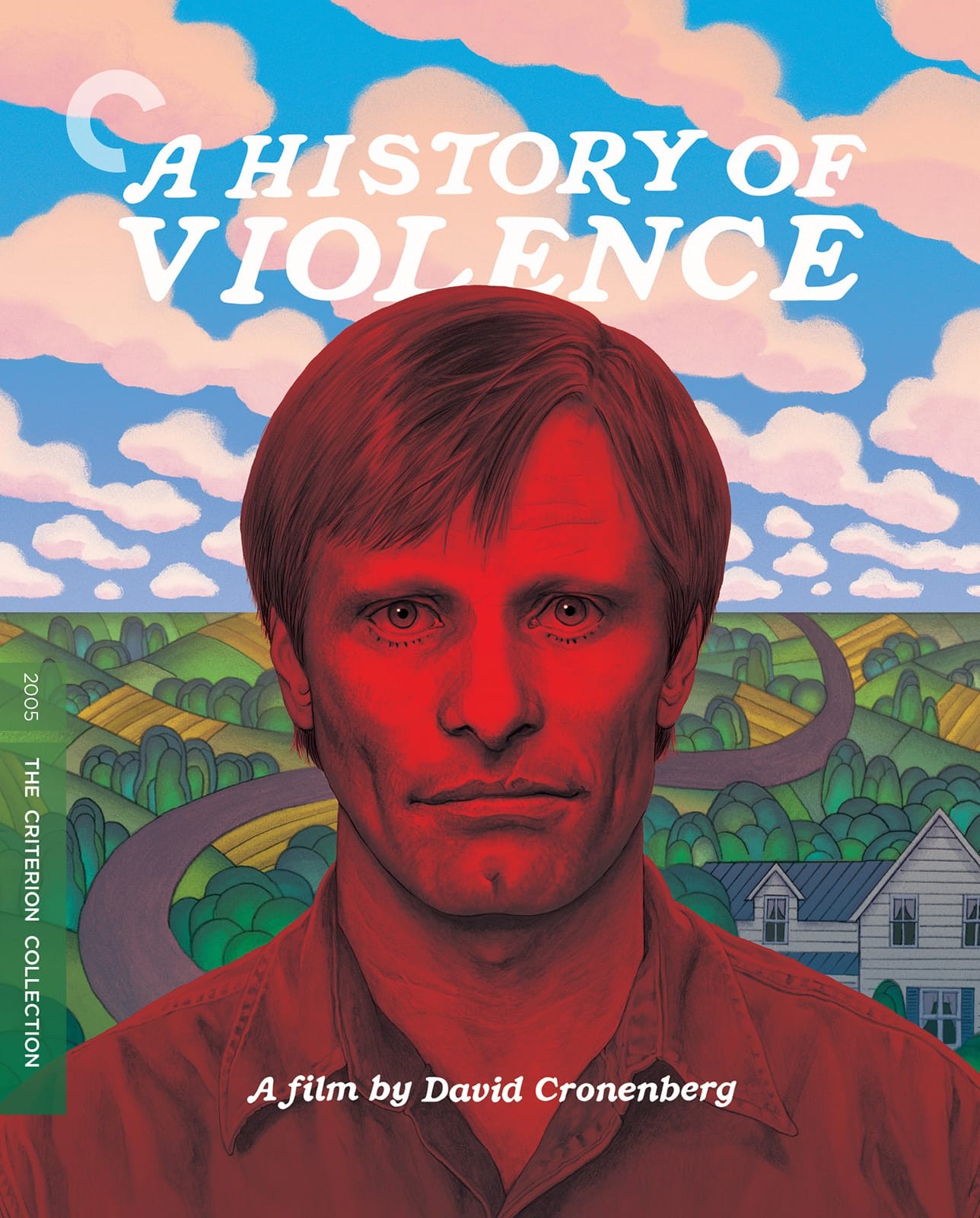
In David Cronenberg’s subtly provocative film, one of his most celebrated, all is not as it initially seems. In his first of many collaborations with the director, Viggo Mortensen delivers a highly nuanced performance as Tom Stall, a small-town husband and father who is hailed as a hero when he kills the would-be perpetrators of a violent robbery. But how did this ordinary family man dispatch them with such skill? Working with an exceptional cast that also includes Maria Bello, Ed Harris, and William Hurt, Cronenberg slyly deconstructs the mythos of the American action hero, posing elemental questions about identity, human nature, and the violence that we both abhor and can’t look away from.
Film Info
United States, Canada
2005
96 minutes
Color
1.85:1
English
Spine #1283
DIRECTOR-APPROVED 4K UHD + BLU-RAY SPECIAL EDITION FEATURES
New 4K digital restoration, supervised by director of photography Peter Suschitzky and approved by director David Cronenberg, with 5.1 surround DTS-HD Master Audio soundtrack
One 4K UHD disc of the film presented in Dolby Vision HDR and one Blu-ray with the film and special features
Audio commentary featuring Cronenberg
New interview with screenwriter Josh Olson, conducted by writer-producer Tom Bernardo
Excerpts of Cronenberg and actor Viggo Mortensen in conversation at the 2014 Toronto International Film Festival
Acts of Violence, a documentary on the making of the film, featuring behind-the-scenes footage
Three featurettes
Deleted scene with commentary by Cronenberg
Trailer
English subtitles for the deaf and hard of hearing
PLUS: An essay by critic Nathan Lee
New cover by Connor Willumsen
-
flyonthewall2983
- Joined: Mon Jun 27, 2005 7:31 pm
- Location: Indiana
- Contact:
Re: 1283 A History of Violence
This, and two Wes Anderson movies are maybe the only films in the collection I have seen on original theatrical release, in theaters. I remember liking it very much but never really bothered to rewatch, preferring to take my Cronenbergs a bit more one at a time.
-
Beloved Aunt

- Joined: Tue Dec 14, 2021 7:28 pm
Re: 1283 A History of Violence
Finally, Maria Bello finds a "much-deserved" place in the collection! Haha. I like this movie though.
-
PfR73

- Joined: Sun Mar 27, 2005 10:07 pm
Re: 1283 A History of Violence
Doesn't say whether it is the censored R-rated version or uncensored International verison.
-
hearthesilence

- Joined: Fri Mar 04, 2005 8:22 am
- Location: NYC
Re: 1283 A History of Violence
I got to say, the aesthetic of drenching an entire person in one primary color is rarely a good choice, not unless they're cartoon characters or an uncontacted indigenous tribe.
I hope it's the uncensored version. I'll probably get this anyway as it's one of Cronenberg's masterpieces IMHO.
I hope it's the uncensored version. I'll probably get this anyway as it's one of Cronenberg's masterpieces IMHO.
-
Matt

- Joined: Tue Nov 02, 2004 4:58 pm
Re: 1283 A History of Violence
Okay, I’ll bite. What’s your beef with Maria Bello? I think she’s exceptionally good in this and elsewhere as well, including Coyote Ugly if that’s what you’re gonna snark about.Randall Maysin Again wrote:Finally, Maria Bello finds a "much-deserved" place in the collection! Haha. I like this movie though.