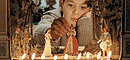
I watched the Tartan Video boxset of this a couple of months ago (which was a port of the Electric Parc Danish set) and I found that the extra features on the Element of Crime disc really helped me to enjoy this film. I can't remember exactly Narshty's previous post on the film which described it's golden brown sepia look as being covered with excrement, but I found his reaction to the film to be rather similar to mine the first time I watched it. I was really impressed by the visuals, but found the plot wilfully obtuse and so preoccupied with the image that it made the characters do stupid things in a bizarrely constructed world.
That was my first viewing when I really wasn't sure how to watch the film, I tried again a couple more times trying to figure out whether I should concentrate on trying to follow the plot, which gave me a headache; or whether I should just let the visuals and slow, measured pacing flow over me, whereupon I usually fell asleep!
I knew it wasn't really too important to be able to follow every twist and turn of the plot as it seems to me most of Von Trier's films seem to use the plot as it progresses from moment to moment as a way of confusing an audience. The more intricate it gets the more the viewer concentrates to figure out whats going on, when in a strange way the viewer needs to draw back and distance themselves to see the wood rather than the trees! I think this is the theme that goes through most of Von Trier's work in that in plots such as Dancer In The Dark, Dogville, The Idiots etc you get caught up in the currency of the events. Each time the women in Dogville or Breaking the Waves demean themselves you are struck by the immediacy of that particular event. Dancer in the Dark and The Idiots have protagonists dealing with the moment rather than think of the future or their long term prospects, people in The Kingdom get caught up in mini-quests or pointless diversions. Or rather the diversions are not pointless since they
are the film. They are the incidents that provide the drama or comedy in the situation. Dogville could last three hours or longer or shorter because it is an accumulation of incidents, the same with Breaking the Waves - it is a judging of how the audience reacts to these incidents, whether the tension builds as they see each humiliation of Grace until they're put in the uncomfortable position of being ready to cheer when she turns on the town.
Von Trier's films all seem to use this psychological attack on the audience, testing their boundaries, whether they're willing to see more indignities, go through another diversion (I think The Kingdom was a great inheritor of Twin Peak's mantle in that regard, a self concious TV series in that it acknowledged the way televsion never answers any questions, except with more questions designed to keep you tuning in next week), or follow a slow paced film to its bitter end. This seems to be the constant in his work, however else his style has changed (even The Five Obstructions is a test to see how far Jorgen Leth can be pushed, and what he does in response), and it's probably why some get really upset at his work and even Von Trier himself- perhaps like Michael Haneke he can come under the 'life's too short' or ' teaching obvious lessons' banner when critics are faced with another of his films. I think that's an understandable response, but I can't really think of any other films that are like Von Trier's (even among those who follow his 'style') and I think that is probably the best commendation there is.
Anyway back to The Element of Crime. I wasn't sure how to appreciate the film when I first saw it, even the beautifully composed visuals became tiring on the eyes after half an hour or so, and since I wasn't sure how to take it I gave up on it. I think I probably gave it more of a chance than most casual viewers since I watched it through twice. Unfortunately I think this was a film that needed a lot of explanation, which the Tranceformer documentary, while a very good overview of Von Trier's career, did not do.
My suspicions that this was a film that
needed discussion were confirmed when I got the Tartan boxset, especially with the commentary by Stig Bjorkman and Peter Schepelern. I would really recommend anyone to rewatch Element of Crime with this commentary, even if they hated the film when they previously saw it.
The commentary really increased my knowledge about the film, the reasons why certain shots were created the way they were, as well as relating the film to the Europe trilogy in particular, but also the rest of Von Trier's work.
The commentators also don't shy away from discussing why the film doesn't really work - unlikeable, sketchy characters and that with literally every shot composed and managed to within an inch of its life how that can get exhausting for the viewer. I agree with that - the film looks great in small doses but over 100 minutes can just turn into looking like it has been smeared in excrement (to quote Narshty!)
However while the film itself is not enjoyable over a sustained period, the commentators are. I never realised that Esmond Knight, who plays Osborne, was blind at the time the film was made, had fooled everyone at his audition, and had to be led around the shadowy sets in order to hit his precise marks! It will also be interesting when I get A Canterbury Tale to see Esmond Knight when he was younger!
I loved the discussion that begins when Me Me Lai's character appears. It triggers a discussion of how feminists have been unhappy about Von Trier's portrayal of women both in this and the later films, and ends with this very entertaining dissection of the character:
"But all she has to offer is the classic comfort for the hero, the warrior's rest."
"And at the same time she is bordering on being a traitor. Even though it seems to be his insanity it's still the idea of the woman as a potential treacherous threat"
"But who isn't a traitor in this film? You can't really trust anyone."
"But she's the only one who's going to be fucked back into the stone age."
There is a lot of discussion in the commentary about how the film, as well as having shots influenced by Tarkovsky, is also influenced by Welles. Mr Arkadin is mentioned as having particularly strong connections, and it is this long discussion as well as Esmond Knight being in Canterbury Tale, which led me to decide to post on this film at this moment in time.
The commentary was also worthwhile in pointing out the small glass horse head on which mistaken identity rests, which I had completely missed on previous viewings. That did a lot to clarify the major twist for me!
The other reason I thought I'd post on the Element of Crime is that the commentators mention that a couple of films came out that tried to follow the style of the film - "Mornten Arnfed's adaptation of Kristen Thorup's novel "Heaven and Hell"...an attempt to bring some of the visual ideas into the Danish mainstream. The other film was "The Man In The Moon" by Erik Clausen whose universe is very far from Von Trier's. He is a comedian and it was a film about a man released from prison who comes out to a strange and incomprehensible world."
I was wondering if anyone had any information on these films and what they thought of them. I imdb'd
Heaven and Hell and was interested to see Harriet Andersson was in it.
My thoughts on this film have changed since watching the commentaries on the Tartan disc. I was irritated with the film in that I couldn't find a way to understand it properly. The commentary (as well as the Von Trier commentary where even
he is bored by it!) allowed me to let go of searching for comprehensibility in every moment. Some things happen just because they look good, but the commentary points out some allusions to art or literature as well as keeping the pace of their conversation up so you don't notice the long slow passages! It really is the best way to see the film and while it doesn't make it possible to for the film to be able to stand up on its own without explanation (therefore making it a failure I guess), the commentary makes viewing it much more entertaining.
I think the lack of any extra material on the Criterion disc really harmed my initial understanding of what Element of Crime had to offer and I wouldn't have gone out of my way to get the Tartan edition of the film if I hadn't wanted Europa and the documentaries on the fourth disc of the boxset. There are some films which stand up on their own and don't need any explanation, which can be released bare bones or with a documentary about the director rather than the film itself. Unfortunately this film wasn't one of them. It's great to have what will probably be the only Von Trier film in the collection, but I worry that the lack of explication could have turned people off to his work altogether.