The Animation List Discussion & Suggestions (Genre Project)
-
knives

- Joined: Sat Sep 06, 2008 10:49 pm
Re: The Animation List Discussion & Suggestions (Genre Proje
Yeah the youtube link is absolutely disgusting, but I don't have an infinite amount of cash so completely terrible purchases like the Jack Lemmon set go before genius.
-
FerdinandGriffon

- Joined: Wed Nov 26, 2008 3:16 pm
Re: The Animation List Discussion & Suggestions (Genre Proje
Re: Recent discussion of White Calligraphy: There is a program of Iimura shorts playing at MoMA Saturday and Sunday, with Iimura in person. Part of the ATG and Japanese Underground retro the museum's been putting on and that I'm slavishly devoted to. New Yorkers also participating in the 60's list should note that Susumu Hani will also be making an appearance as part of the retro in February.
-
Gregory

- Joined: Tue Nov 02, 2004 8:07 pm
Re: The Animation List Discussion & Suggestions (Genre Proje
Link to the DVD works fine. Beckett was great. Aside from the work that brought him recognition, he had so much potential in his personal work. Even just looking at his drawings, I could see how skilled he was with those kinds of fundamentals. Really original work that also occupies a space in the middle ground between influences of Belson, Fischinger, McLaren, and others.knives wrote:...Adam Beckett, an ingenious abstract animator who died just as he was beginning to gain fame (he was the rotoscope artist for the original Star Wars). Here's a clip (not the whole thing) of one of his films which have been collected by his mother on disc. The link for the DVD seems dead right now, but if I find a new link I'll post.
Here is a clip from one of his major unfinished projects that he worked on for years.
-
knives
- Joined: Sat Sep 06, 2008 10:49 pm
Re: The Animation List Discussion & Suggestions (Genre Proje
Thanks, my bookmark had gone dead for some odd reason.
-
colinr0380

- Joined: Mon Nov 08, 2004 8:30 pm
- Location: Chapel-en-le-Frith, Derbyshire, UK
Re: The Animation List Discussion & Suggestions (Genre Proje
Apologies for a couple more YouTube links but I'd like to draw attention to the Alison Snowden and David Fine animations, which are both sweet and amusingl! They're involved with the pre-school Shaun The Sheep series at the moment but their earlier shorts deal with more grown up themes of disappointment and fears of rejection.
George and Rosemary is a cute short about an elderly gentleman working up the courage to talk to the lady across the road. And Bob's Birthday is a comedy of embarrassment about the worst possible thing that could happen during a surprise birthday party! Bob's Birthday was so successful it went on to a TV show, Bob and Margaret, that lasted for a couple of series. Both of these shorts show that animation doesn't have to show fantastical worlds. Rather it can help emphasise the mundane details of life!
George and Rosemary is a cute short about an elderly gentleman working up the courage to talk to the lady across the road. And Bob's Birthday is a comedy of embarrassment about the worst possible thing that could happen during a surprise birthday party! Bob's Birthday was so successful it went on to a TV show, Bob and Margaret, that lasted for a couple of series. Both of these shorts show that animation doesn't have to show fantastical worlds. Rather it can help emphasise the mundane details of life!
-
terabin
- Joined: Wed Oct 18, 2006 7:43 pm
- Contact:
Re: The Animation List Discussion & Suggestions (Genre Proje
Trying to hit two birds with one stone here:
Is anyone considering any of their animated favorites from the '60s for inclusion in their '60s decade list? In other words, do any of your favorite '60s animated films stand with the best films of the 1960s in your estimation? I'd like to see those films as I try to participate in both lists!
Is anyone considering any of their animated favorites from the '60s for inclusion in their '60s decade list? In other words, do any of your favorite '60s animated films stand with the best films of the 1960s in your estimation? I'd like to see those films as I try to participate in both lists!
-
knives
- Joined: Sat Sep 06, 2008 10:49 pm
Re: The Animation List Discussion & Suggestions (Genre Proje
Several of Svankmajer's and McLaren's films of course are under consideration by me. In addition to that John Hubley's film The Hole (which is available in one of those Image sets) is a magnificent act of animation which also manages to top Godard at one of his games essentially acting as A Film Like the Others for nuclear war and race relations in America. Khitruk's films are also very great and important with the creepy and funny Man in the Frame being my personal favorite. The Dot and the Line gets a lot of love in terms of Jones' work from the '60s but I'm actually more partial to his Sam and Ralph shorts which play as a Roadrunner short by Pirandello. High Note though is the (pardon the pun) high note for me. I'd also like to give in a good word for Gene Dietch who used to work with/for Hubley before moving to Czechoslovakia where he made some of the weirder cartoons out there. Of particular interest from him is Munro which functions like a lost UPA cartoon as a young boy is drafted into the army. Finally I want to compliment Walerian Borowczyk who I believe is most famous for his work with Chris Marker but is an amazing artist on his own. The Games of Angels is rightly or wrongly his most popular from the period and is a must see for fans of Rene Laloux.
-
swo17

- Bloodthirsty Butcher
- Joined: Tue Apr 15, 2008 2:25 pm
- Location: SLC, UT
-
Gregory
- Joined: Tue Nov 02, 2004 8:07 pm
Re: The Animation List Discussion & Suggestions (Genre Proje
I'm participating in both, and apart from a McLaren and a couple more experimental works, no animation is likely to get into my top 50 films of the 1960s. There are hundreds and hundreds of animated films I adore, but a whole lot of it peaked in the 1940s and 1950s, with a sharp decline into the 1960s and 70s and beyond, with some wonderful exceptions and more fringe works since then. Look through the list of all the feature films (released in the United States, at least) in the 1960s — what I see is a huge decline in the quality of virtually everything that made animation great. Really a sad lot, for what it represents. (Jiri Trnka's A Midsummer Night's Dream was from 1959 but is listed as 1961 on that list because that's when it premiered in the United States.) Again, there were some great animated films produced in the 1960s, but I feel a tragic downward spiral in the quality of animation took place starting in that decade.
With Chuck Jones, I'll take his wonderful peak 1940s work, and some truly great moments from the 1950s, any day over his increasingly cool, distant, stylized, and cute works progressing through the 1960s.
With Chuck Jones, I'll take his wonderful peak 1940s work, and some truly great moments from the 1950s, any day over his increasingly cool, distant, stylized, and cute works progressing through the 1960s.
-
matrixschmatrix

- Joined: Wed May 26, 2010 3:26 am
Re: The Animation List Discussion & Suggestions (Genre Proje
This is an obvious one, but Yellow Submarine is a strong contender for both.terabin wrote:Trying to hit two birds with one stone here:
Is anyone considering any of their animated favorites from the '60s for inclusion in their '60s decade list? In other words, do any of your favorite '60s animated films stand with the best films of the 1960s in your estimation? I'd like to see those films as I try to participate in both lists!
-
swo17
- Bloodthirsty Butcher
- Joined: Tue Apr 15, 2008 2:25 pm
- Location: SLC, UT
Re: The Animation List Discussion & Suggestions (Genre Proje
Oh, and A Charlie Brown Christmas of course.
-
karmajuice
- Joined: Tue Jun 10, 2008 2:02 pm
Re: The Animation List Discussion & Suggestions (Genre Proje
As I understand it, the film he made with Chris Marker, Les Astronautes, was made by Borowczyk in France, but because of legal issues he couldn't release the film on his own, so Marker contributed his name to the film to get it released.Finally I want to compliment Walerian Borowczyk who I believe is most famous for his work with Chris Marker but is an amazing artist on his own.
It's a great film, incidentally, and well worthy of consideration for this project. Mysterious, surreal, silly, and absurd: it manages to strike an array of tones while maintaining a strong sense of consistency throughout. Les Jeux des anges is a grim and impenetrable work -- a great one mind you, but I recommend seeing both, because they provide very different pleasures.
-
MichaelB

- Joined: Fri Aug 11, 2006 10:20 pm
- Location: Worthing
- Contact:
Re: The Animation List Discussion & Suggestions (Genre Proje
Borowczyk's most important animation collaborator was Jan Lenica, a highly distinguished animator (and poster artist) in his own right.
-
Dansu Dansu Dansu

- Joined: Sat Feb 18, 2012 8:14 pm
- Location: California
Re: The Animation List Discussion & Suggestions (Genre Proje
The American Cinematheque is hosting another Ghibli retrospective starting January 25th. I had a great experience watching Ocean Waves with an enthusiastic audience during last year's retrospective and hope to catch at least one of these screenings, though admittedly I'm already suffering from Ghibli fatigue after recently revisiting their work for my Ghibli guide.
-
colinr0380
- Joined: Mon Nov 08, 2004 8:30 pm
- Location: Chapel-en-le-Frith, Derbyshire, UK
Re: The Animation List Discussion & Suggestions (Genre Proje
I'll try and see about working up an Anime guide focusing on some more obscure titles but in the meantime, though I'm sure many on the forum don't need it, I thought it would be worth linking to the anime primer programme presented by Jonathan Ross that aired on the BBC back in 1994 before the premiere of Akira.
It is a little dated now (as any guide I produce will likely be as I will probably be mostly drawing from my mid-90s collection of tapes!), being just prior to the first Ghost In The Shell, but it covers most bases and interviews a number of major figures including Katsuhiro Otomo, Hayao Miyazaki and author of the Anime Movie Guide Helen McCarthy.
It is a little dated now (as any guide I produce will likely be as I will probably be mostly drawing from my mid-90s collection of tapes!), being just prior to the first Ghost In The Shell, but it covers most bases and interviews a number of major figures including Katsuhiro Otomo, Hayao Miyazaki and author of the Anime Movie Guide Helen McCarthy.
-
Gregory
- Joined: Tue Nov 02, 2004 8:07 pm
Re: The Animation List Discussion & Suggestions (Genre Proje
I finally watched Tale of Tales. Having loved Hedgehog in the Fog, I don't know why it took me this long to get Masters of Russian Animation Vol. 3 and see Tale of Tales. (I believe there's only one inexpensive new copy of that DVD left at Amazon, in case someone wants to pounce on it. It's been OOP for a while.) I can't really say anything about the film yet, though. I need to watch it at least once more, and I'll definitely get the book about it that Calvin mentioned. To see what Yuri "The Golden Snail" Norstein has been up to the past few decades, I started at his Wikipedia page, which says he's spent the last 30-plus years gradually completing the first 25 minutes of a planned 65-minute film, The Overcoat. And he's 71 years old now. I'm already bracing myself for the disappointment of never seeing another completed film by this master.
So what has everyone else been watching?
So what has everyone else been watching?
-
swo17
- Bloodthirsty Butcher
- Joined: Tue Apr 15, 2008 2:25 pm
- Location: SLC, UT
Re: The Animation List Discussion & Suggestions (Genre Proje
I need to get around to watching some Norstein at some point too. Can anyone vouch for this DVD?
-
MichaelB
- Joined: Fri Aug 11, 2006 10:20 pm
- Location: Worthing
- Contact:
Re: The Animation List Discussion & Suggestions (Genre Proje
They're the same transfers as featured on the Masters of Russian Animation compilation - in other words, broadly OK, but marred by unremovable subtitles (whose placement is disastrously misjudged in The Fox and the Hare, since virtually the entire action of the film occupies the bottom quarter of the screen).
But I'm not aware of any viable alternative.
But I'm not aware of any viable alternative.
-
matrixschmatrix
- Joined: Wed May 26, 2010 3:26 am
Re: The Animation List Discussion & Suggestions (Genre Proje
Ok, I went back through and put all the guides I spotted into the OP, but if someone's posted one that isn't in there or has a spotlight I missed, please tell me.
-
Dansu Dansu Dansu
- Joined: Sat Feb 18, 2012 8:14 pm
- Location: California
Re: The Animation List Discussion & Suggestions (Genre Proje
Studio Ghibli Guide – Part One:
Isao Takahata
The Little Norse Prince
Chie the Brat
Gauche the Cellist
Grave of the Fireflies
Only Yesterday
Pom Poko
My Neighbors, the Yamadas
Almost twenty years before the creation of Studio Ghibli, Isao Takahata helmed his debut feature The Little Norse Prince, which featured animation by future Ghibli director Hayao Miyazaki. Despite whatever it represents historically, I find the film virtually unwatchable. This simplistic fable features one-dimensional characters that merely advance the spartan plot, arguably unappealing character designs, and animation that is inconsistent, awkward, and mechanical. Still, it’s better than Tales from Earthsea! Chie the Brat is certainly a film of its time, with its Tezuka-influenced character designs and limited animation. It's such a perfect snapshot of its era, though, that its dated aesthetic is also the film's charm. The last act is entirely obsessed with testicles, which seems to be a favorite joke of Takahata's. You think I'm joking, but I'm not. The final act of this film is about two cats fighting for the honor of a dead cat's testicle, and no, the film isn't about cats. The slight Gauche the Cellist starts with a riff on Disney’s The Old Mill, as animals scurry about in a storm as Beethoven plays on the soundtrack, only to find the music is diegetic, created by the titular cellist and his practicing orchestra. Still, animals appear at his door and, fittingly, teach him to "feel" the Pastoral by making him less insensitive to nature. This atmospheric, charming film features terrific animation, and is perhaps the least strained of Takahata's ecological messages.
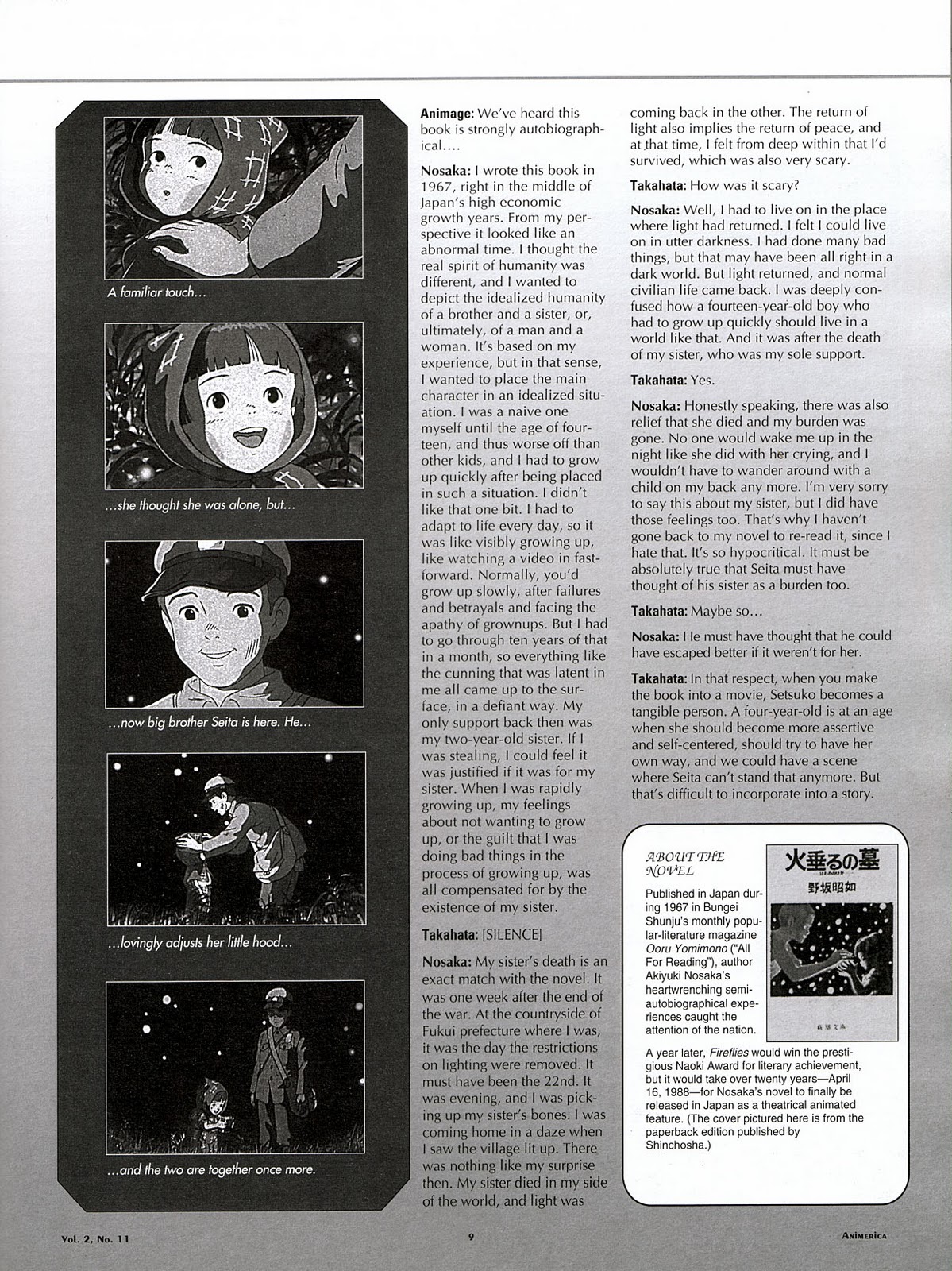
Then, out of nowhere, comes Grave of the Fireflies, Takahata’s first with Studio Ghibli and one of the most emotionally brutal films ever made about the Pacific War. Firebombing is freed from its historical context and is recreated, along with its aftermath, as a subjectively unprovoked, mystifying horror for two adolescent siblings. Fireflies also addresses Japan’s own responsibility for their notoriously unsympathetic response towards war orphans, though I’m not sure if this is intentional or not (see interview below). From personal experience, I know this film is capable of changing minds about the so-called necessary evils of war, as political rhetoric can’t help but buckle before such a clear offense against humanity. Takahata continues his roll with Only Yesterday, in which a Tokyoite in her late twenties travels to “organic farming” country and reflects on her life, as well as organic produce, class distinctions, and the vanishing natural world. As she remembers past memories, equally hilarious as painful, and reevaluates decisions made versus decisions made by her environment, she confronts the limitations of her youthful persona and redefines personal happiness despite all expectations, including her own. I recently went through a similar experience in my late twenties, which leads me to believe this is a “thing.”
I never went through the shape-shifting raccoon obsession phase, though, which is possibly why I’m indifferent to Pom Poko, a faux documentary in the spirit of the student protest movements of the 60s except featuring mythological raccoons with the ability to transmogrify into other Japanese mythologies for the sole purpose of fighting Tokyo’s sprawl. In all of Studio Ghibli’s many ecological films, never has the message been so forcefully obvious, right down to breaking the forth wall to deliver a direct plea, in case you somehow missed one of the many meetings in which raccoons concretely discussed these topical issues. I’m as troubled as anyone about the loss of the natural world, but unless you were a Japanese urban developer in the theater back in 1994, chances are you merely enjoyed the raccoons with giant testicles and suffered through Takahata’s occasionally cruel and manipulative reprimand for being too mediated and western to fathom the magic that was replaced with your apartment complex. After a lengthy hiatus, Takahata returned to direct My Neighbors, the Yamadas. With a minimalist style, as if the comics section suddenly came to life, this episodic film observes the dynamics and imperfections of a multigenerational, lower-middle class Japanese family. As a clever stylistic twist, striking, full-bodied animation is used for the fantasy segments of the film, usually the visualizations of someone’s imaginings of what life should be, which is in contrast to the uncertainty of the incomplete images from the daily life segments. It is probably Takahata’s most laid back and purely enjoyable film, and certainly his funniest.
Interview with Isao Takahata and Akiyuki Nosaka from Animerica Magizine, originally featured in Animage, as posted on Ghibli Blog: Page 1 2 3 4 5 6
Isao Takahata
The Little Norse Prince
Chie the Brat
Gauche the Cellist
Grave of the Fireflies
Only Yesterday
Pom Poko
My Neighbors, the Yamadas
Almost twenty years before the creation of Studio Ghibli, Isao Takahata helmed his debut feature The Little Norse Prince, which featured animation by future Ghibli director Hayao Miyazaki. Despite whatever it represents historically, I find the film virtually unwatchable. This simplistic fable features one-dimensional characters that merely advance the spartan plot, arguably unappealing character designs, and animation that is inconsistent, awkward, and mechanical. Still, it’s better than Tales from Earthsea! Chie the Brat is certainly a film of its time, with its Tezuka-influenced character designs and limited animation. It's such a perfect snapshot of its era, though, that its dated aesthetic is also the film's charm. The last act is entirely obsessed with testicles, which seems to be a favorite joke of Takahata's. You think I'm joking, but I'm not. The final act of this film is about two cats fighting for the honor of a dead cat's testicle, and no, the film isn't about cats. The slight Gauche the Cellist starts with a riff on Disney’s The Old Mill, as animals scurry about in a storm as Beethoven plays on the soundtrack, only to find the music is diegetic, created by the titular cellist and his practicing orchestra. Still, animals appear at his door and, fittingly, teach him to "feel" the Pastoral by making him less insensitive to nature. This atmospheric, charming film features terrific animation, and is perhaps the least strained of Takahata's ecological messages.
Then, out of nowhere, comes Grave of the Fireflies, Takahata’s first with Studio Ghibli and one of the most emotionally brutal films ever made about the Pacific War. Firebombing is freed from its historical context and is recreated, along with its aftermath, as a subjectively unprovoked, mystifying horror for two adolescent siblings. Fireflies also addresses Japan’s own responsibility for their notoriously unsympathetic response towards war orphans, though I’m not sure if this is intentional or not (see interview below). From personal experience, I know this film is capable of changing minds about the so-called necessary evils of war, as political rhetoric can’t help but buckle before such a clear offense against humanity. Takahata continues his roll with Only Yesterday, in which a Tokyoite in her late twenties travels to “organic farming” country and reflects on her life, as well as organic produce, class distinctions, and the vanishing natural world. As she remembers past memories, equally hilarious as painful, and reevaluates decisions made versus decisions made by her environment, she confronts the limitations of her youthful persona and redefines personal happiness despite all expectations, including her own. I recently went through a similar experience in my late twenties, which leads me to believe this is a “thing.”
I never went through the shape-shifting raccoon obsession phase, though, which is possibly why I’m indifferent to Pom Poko, a faux documentary in the spirit of the student protest movements of the 60s except featuring mythological raccoons with the ability to transmogrify into other Japanese mythologies for the sole purpose of fighting Tokyo’s sprawl. In all of Studio Ghibli’s many ecological films, never has the message been so forcefully obvious, right down to breaking the forth wall to deliver a direct plea, in case you somehow missed one of the many meetings in which raccoons concretely discussed these topical issues. I’m as troubled as anyone about the loss of the natural world, but unless you were a Japanese urban developer in the theater back in 1994, chances are you merely enjoyed the raccoons with giant testicles and suffered through Takahata’s occasionally cruel and manipulative reprimand for being too mediated and western to fathom the magic that was replaced with your apartment complex. After a lengthy hiatus, Takahata returned to direct My Neighbors, the Yamadas. With a minimalist style, as if the comics section suddenly came to life, this episodic film observes the dynamics and imperfections of a multigenerational, lower-middle class Japanese family. As a clever stylistic twist, striking, full-bodied animation is used for the fantasy segments of the film, usually the visualizations of someone’s imaginings of what life should be, which is in contrast to the uncertainty of the incomplete images from the daily life segments. It is probably Takahata’s most laid back and purely enjoyable film, and certainly his funniest.
Interview with Isao Takahata and Akiyuki Nosaka from Animerica Magizine, originally featured in Animage, as posted on Ghibli Blog: Page 1 2 3 4 5 6




-
Dansu Dansu Dansu
- Joined: Sat Feb 18, 2012 8:14 pm
- Location: California
Re: The Animation List Discussion & Suggestions (Genre Proje
Studio Ghibli Guide: Part Two
Hayao Miyazaki
The Castle of Cagliostro
Nausicaa of the Valley of the Wind
Castle in the Sky
My Neighbor Totoro
Kiki’s Delivery Service
Porco Rosso
On Your Mark
Princess Mononoke
Spirited Away
Howl’s Moving Castle
Ponyo
The entertaining and amiable The Castle of Cagliostro, Miyazaki’s first feature, exhibits the characteristics of a fully-formed Miyazaki adventure film while still existing in a trial run form. This film is just as packed with ancient civilizations, three-way power struggles, royal bloodlines, ancient incantations, and childhood flashbacks of orphaned princesses as his next two films, though Cagliostro’s scope and tone is limited by the Lupin the Third characters. Still, he reshapes the Lupin gang to resemble his usual optimistic archetypes with social consciences, going as far to have Lupin chastise himself for how he behaved in the TV series. Miyazaki even bestowed Lupin with his own real-life car, a beloved yet broken down Citroen, possibly a mirror of his own love/hate relationship with the character. Nausicaa of the Valley of the Wind finds a sweet spot in Miyazaki’s work where his fantasy world is still naively warm and inviting, yet grounded in dread. Ecological issues make their first appearance in a Miyazaki film, in this case, a post-apocalyptic toxic wasteland in which humanity struggles to survive. Nausicaa is the first of his many empathetic heroines, showcasing open communication and compassion as an effective counterpoint against the belligerence of militarists who act from defensive, short-sided perspectives. It’s genuinely exciting and astonishingly imaginative (the man created an entire ecosystem for this film!). Castle in the Sky completes this unofficial adventure trilogy with a step back towards the conventions of the cartoon medium. Miyazaki wanted to create a traditional adventure film with a fantasy setting, and that’s what we get. Many aspects are identical to Cagliostro and yet it feels wholly original. Castle in the Sky is among his most charming films, and features a spectacular third act in another incredibly realized environment.
My Neighbor Totoro is Miyazaki’s best known work, as its titular neighbor is practically as ubiquitous to Japanese childhoods as Mickey Mouse. The film juxtaposes wish fulfillment with the weight of reality, which is possibly the most innate conflict in animation. The result isn’t patronizing; instead, it’s somehow ennobling. Not only is it unique to the sensibilities of its creator, it is a unique work in cinema. While Kiki’s Delivery Service follows a more conventional narrative than Totoro, essentially observing a young witch’s identity vs. role confusion developmental stage, I consider it one of his most perfect creations. Along with Spirited Away and Castle of Cagliostro, Kiki features one of Miyazaki’s most impressive environments, explored through a character-based story which is arced to follow Kiki’s emotional maturation. It’s also arguably his best-animated film, as the degree of realism, especially considering the fluidity of the film, from the crowded cityscape to its reliance on flight and physics, is without blemish, a boast that even the early Walt Disney features can’t make--and they used rotoscoping!
Unfortunately, Miyazaki finally falters with an improbably personal film about those Halcyon days when pigs could fly called Porco Rosso. Here’s a revelatory excerpt from a memo written by Miyazaki during the film’s production: “Porco Rosso is designed to be a work that businessmen exhausted from international flights can enjoy even if their minds have been dulled from lack of oxygen. It must also be a work that boys and girls, as well as aunties, can enjoy, but we must never forget that first of all it is a cartoon movie for tired, middle-aged men whose brain cells have turned to tofu.” Of course, considering the film’s interests mirror his own and its protagonist is middle-aged, it’s not hard to guess who that businessman might be. It’s an enjoyable take on Bogart cool and the allure of the period, but I check-out whenever the seaplane pirates appear. Not only do they add little humor and are boring in their cartoon brashness, they’re also poor antagonists. Basically, we’re not watching a story of deepening complications, we’re watching Porco decide to do stuff and then do it. Guilt from surviving a war versus American obliviousness to reality seems to be the film’s most compelling conflict. Ultimately, it’s still imaginative and entertaining but significantly less accomplished than virtually all of his other features. His next project, On Your Mark, is an oddity. More bizarre than Miyazaki directing a J-Pop music video is the video’s content, an Orwellian sci-fi story about cults, police shootouts, and angels. Despite enjoying the quality of the animation and the cheesiness of the song (which sounds like some Christian-contemporary take on "Holy, Holy, Holy" performed by a Japanese Peter Cetera), I don’t have a strong opinion about it one way or the other. In an interview at its release, Miyazaki states he believes the world will one day serve under an authoritative government in the wake of nuclear fallout, and people might use music as a form of uncensored communication. He subversively appropriated the song’s lyrics to fit his story in order to emphasize that point. Here’s a telling quote about Miyazaki’s work from that interview: “Even in a chaotic, ruined world, there will always be good things and exciting things. As in Nausicaa, ‘We are like birds, forever going beyond that morning, spitting out blood as we fly.’”
What a perfect way to segue into Princess Mononoke, a film which, even in its trailers, surprised Japanese audiences with its violence. In a way, Mononoke is an update to the themes of Nausicaa, as if his frustration with the world had festered beyond repair, and in turn drained the joy from his fantasy world. Where Nausicaa uplifts her film, both the hero and heroine of Mononoke are cursed out of the gate, creating an elegiac struggle to preserve the natural world in the face of industrialization, militarism, and modernity. In this ecological conflict, there is no clear goal or hope for cohabitation among its characters. Princess Mononoke is about toeing the line from humans at the mercy of nature to nature at the mercy of humans; it looks unflinchingly at the damage to the natural order, but accepts it, and asks for you to accept your role in the world as it is.
I procrastinated until the end to write about Spirited Away because honestly, it’s such a complex film that I have no idea what to say about it. This film alone would cement his place in cinema’s history as one of the great fantasists. Essentially, it contrasts the spirits of traditional Japan against the monster of western-influenced capitalism through a girl’s journey towards self-reliance, in an environment of near-unprecedented scope, filled with his most imaginative characters this side of Totoro. More than any other film, Spirited Away shows it isn’t just that Miyazaki’s imagination is staggering, which is true, but his films are infused with authenticity, so that like the early films of Walt Disney or Pixar, Miyazaki creates for his own gratification, beliefs, and need, as well as to progress the medium of animation, which fortifies his films with dozens of unique qualities and layers.
Perhaps because the story’s exposition is absorbed more than revealed through a straightforward narrative, Howl’s Moving Castle split its audience down the middle, leaving many to complain it was the first time Miyazaki had let them down. Also working against it, I suspect, is its gravitation towards the surreal and grotesque. Howl’s is about knowledge which damages, the kind we shoulder alone, whether it’s from the weight of keeping a family together or living with a personal understanding of the darkness of humanity. Where Howl protects his inner child, Sophie has emotionally aged due to the burden of her mother’s childishness. Age and appearance are visual motifs, extending to the castle itself, which is a mix of architecture from different eras and for different purposes (war and peace). Also, each member of Howl’s makeshift family has two visages: the one they show under pretense, and what they truly are. On the flipside, Howl’s is arguably the funniest of Miyazaki’s films, is effortlessly likable and heartfelt yet never saccharine, which Spirited Away is occasionally guilty of, and moves at a ridiculously brisk pace, at times to a fault, which is highly unusual for the director. Finally, it features one of Joe Hisaishi’s best scores, built around a Viennese-styled waltz suggesting opulence with an undercurrent of terror, equally a character as his more melodic work but also working with the ensemble, so to speak. Though not without its flaws, it is still one of my favorite Ghibli films.
And this leads us to Miyazaki’s preschool and nursing home apocalypse flick called Ponyo. This is Studio Ghibli’s most childlike film, tonally reassuring to the point of being condescending, and yet it’s possibly Miyazaki’s most opaque film. Despite having seen it several times, I still don’t have a beat on the material. The film’s ecological collapse is more of a reset to the dawn of life, caused by the headstrong Ponyo getting into her father’s cauldron of genetic somethingerother. Ponyo loves Sosuke, a boy who saved her from a jar, almost as much as she loves ham, and her willful evolution to land-dwelling carnivore has somehow caused ocean levels to rise. Now, the Queen of the Ocean, who fluctuates between the size of Hokkaido and Kareem Abdul-Jabbar, will restore the balance, but only if the five-year old Sosuke can prove his survival skills in the primeval ocean, as if some sort of nauseating test of humanity’s evolutionary merit. If nothing else, the film’s insistence that I don’t question whether Ponyo caused the second Great Flood is what makes this film broken, because what’s up with the childlike aesthetic and cutesy optimism if millions of people have drowned? Still, the animation is spectacular, the atmospheric setting is terrific, and children are adorable and occasionally funny.
(Just to somewhat cite my sources, all the interviews and Cagliostro factoids came from Starting Point, a collection of interviews with Miyazaki from 1979-1996. Also, I’m sure this goes without saying, but the original Japanese tracks are the only way to go. Howl’s Moving Castle and Kiki’s Delivery Service are my favorite English dubs, but even these, especially the latter, change the film tonally, with Kiki going so far as adding dialogue and changing the music.)
Hayao Miyazaki
The Castle of Cagliostro
Nausicaa of the Valley of the Wind
Castle in the Sky
My Neighbor Totoro
Kiki’s Delivery Service
Porco Rosso
On Your Mark
Princess Mononoke
Spirited Away
Howl’s Moving Castle
Ponyo
The entertaining and amiable The Castle of Cagliostro, Miyazaki’s first feature, exhibits the characteristics of a fully-formed Miyazaki adventure film while still existing in a trial run form. This film is just as packed with ancient civilizations, three-way power struggles, royal bloodlines, ancient incantations, and childhood flashbacks of orphaned princesses as his next two films, though Cagliostro’s scope and tone is limited by the Lupin the Third characters. Still, he reshapes the Lupin gang to resemble his usual optimistic archetypes with social consciences, going as far to have Lupin chastise himself for how he behaved in the TV series. Miyazaki even bestowed Lupin with his own real-life car, a beloved yet broken down Citroen, possibly a mirror of his own love/hate relationship with the character. Nausicaa of the Valley of the Wind finds a sweet spot in Miyazaki’s work where his fantasy world is still naively warm and inviting, yet grounded in dread. Ecological issues make their first appearance in a Miyazaki film, in this case, a post-apocalyptic toxic wasteland in which humanity struggles to survive. Nausicaa is the first of his many empathetic heroines, showcasing open communication and compassion as an effective counterpoint against the belligerence of militarists who act from defensive, short-sided perspectives. It’s genuinely exciting and astonishingly imaginative (the man created an entire ecosystem for this film!). Castle in the Sky completes this unofficial adventure trilogy with a step back towards the conventions of the cartoon medium. Miyazaki wanted to create a traditional adventure film with a fantasy setting, and that’s what we get. Many aspects are identical to Cagliostro and yet it feels wholly original. Castle in the Sky is among his most charming films, and features a spectacular third act in another incredibly realized environment.
My Neighbor Totoro is Miyazaki’s best known work, as its titular neighbor is practically as ubiquitous to Japanese childhoods as Mickey Mouse. The film juxtaposes wish fulfillment with the weight of reality, which is possibly the most innate conflict in animation. The result isn’t patronizing; instead, it’s somehow ennobling. Not only is it unique to the sensibilities of its creator, it is a unique work in cinema. While Kiki’s Delivery Service follows a more conventional narrative than Totoro, essentially observing a young witch’s identity vs. role confusion developmental stage, I consider it one of his most perfect creations. Along with Spirited Away and Castle of Cagliostro, Kiki features one of Miyazaki’s most impressive environments, explored through a character-based story which is arced to follow Kiki’s emotional maturation. It’s also arguably his best-animated film, as the degree of realism, especially considering the fluidity of the film, from the crowded cityscape to its reliance on flight and physics, is without blemish, a boast that even the early Walt Disney features can’t make--and they used rotoscoping!
Unfortunately, Miyazaki finally falters with an improbably personal film about those Halcyon days when pigs could fly called Porco Rosso. Here’s a revelatory excerpt from a memo written by Miyazaki during the film’s production: “Porco Rosso is designed to be a work that businessmen exhausted from international flights can enjoy even if their minds have been dulled from lack of oxygen. It must also be a work that boys and girls, as well as aunties, can enjoy, but we must never forget that first of all it is a cartoon movie for tired, middle-aged men whose brain cells have turned to tofu.” Of course, considering the film’s interests mirror his own and its protagonist is middle-aged, it’s not hard to guess who that businessman might be. It’s an enjoyable take on Bogart cool and the allure of the period, but I check-out whenever the seaplane pirates appear. Not only do they add little humor and are boring in their cartoon brashness, they’re also poor antagonists. Basically, we’re not watching a story of deepening complications, we’re watching Porco decide to do stuff and then do it. Guilt from surviving a war versus American obliviousness to reality seems to be the film’s most compelling conflict. Ultimately, it’s still imaginative and entertaining but significantly less accomplished than virtually all of his other features. His next project, On Your Mark, is an oddity. More bizarre than Miyazaki directing a J-Pop music video is the video’s content, an Orwellian sci-fi story about cults, police shootouts, and angels. Despite enjoying the quality of the animation and the cheesiness of the song (which sounds like some Christian-contemporary take on "Holy, Holy, Holy" performed by a Japanese Peter Cetera), I don’t have a strong opinion about it one way or the other. In an interview at its release, Miyazaki states he believes the world will one day serve under an authoritative government in the wake of nuclear fallout, and people might use music as a form of uncensored communication. He subversively appropriated the song’s lyrics to fit his story in order to emphasize that point. Here’s a telling quote about Miyazaki’s work from that interview: “Even in a chaotic, ruined world, there will always be good things and exciting things. As in Nausicaa, ‘We are like birds, forever going beyond that morning, spitting out blood as we fly.’”
What a perfect way to segue into Princess Mononoke, a film which, even in its trailers, surprised Japanese audiences with its violence. In a way, Mononoke is an update to the themes of Nausicaa, as if his frustration with the world had festered beyond repair, and in turn drained the joy from his fantasy world. Where Nausicaa uplifts her film, both the hero and heroine of Mononoke are cursed out of the gate, creating an elegiac struggle to preserve the natural world in the face of industrialization, militarism, and modernity. In this ecological conflict, there is no clear goal or hope for cohabitation among its characters. Princess Mononoke is about toeing the line from humans at the mercy of nature to nature at the mercy of humans; it looks unflinchingly at the damage to the natural order, but accepts it, and asks for you to accept your role in the world as it is.
I procrastinated until the end to write about Spirited Away because honestly, it’s such a complex film that I have no idea what to say about it. This film alone would cement his place in cinema’s history as one of the great fantasists. Essentially, it contrasts the spirits of traditional Japan against the monster of western-influenced capitalism through a girl’s journey towards self-reliance, in an environment of near-unprecedented scope, filled with his most imaginative characters this side of Totoro. More than any other film, Spirited Away shows it isn’t just that Miyazaki’s imagination is staggering, which is true, but his films are infused with authenticity, so that like the early films of Walt Disney or Pixar, Miyazaki creates for his own gratification, beliefs, and need, as well as to progress the medium of animation, which fortifies his films with dozens of unique qualities and layers.
Perhaps because the story’s exposition is absorbed more than revealed through a straightforward narrative, Howl’s Moving Castle split its audience down the middle, leaving many to complain it was the first time Miyazaki had let them down. Also working against it, I suspect, is its gravitation towards the surreal and grotesque. Howl’s is about knowledge which damages, the kind we shoulder alone, whether it’s from the weight of keeping a family together or living with a personal understanding of the darkness of humanity. Where Howl protects his inner child, Sophie has emotionally aged due to the burden of her mother’s childishness. Age and appearance are visual motifs, extending to the castle itself, which is a mix of architecture from different eras and for different purposes (war and peace). Also, each member of Howl’s makeshift family has two visages: the one they show under pretense, and what they truly are. On the flipside, Howl’s is arguably the funniest of Miyazaki’s films, is effortlessly likable and heartfelt yet never saccharine, which Spirited Away is occasionally guilty of, and moves at a ridiculously brisk pace, at times to a fault, which is highly unusual for the director. Finally, it features one of Joe Hisaishi’s best scores, built around a Viennese-styled waltz suggesting opulence with an undercurrent of terror, equally a character as his more melodic work but also working with the ensemble, so to speak. Though not without its flaws, it is still one of my favorite Ghibli films.
And this leads us to Miyazaki’s preschool and nursing home apocalypse flick called Ponyo. This is Studio Ghibli’s most childlike film, tonally reassuring to the point of being condescending, and yet it’s possibly Miyazaki’s most opaque film. Despite having seen it several times, I still don’t have a beat on the material. The film’s ecological collapse is more of a reset to the dawn of life, caused by the headstrong Ponyo getting into her father’s cauldron of genetic somethingerother. Ponyo loves Sosuke, a boy who saved her from a jar, almost as much as she loves ham, and her willful evolution to land-dwelling carnivore has somehow caused ocean levels to rise. Now, the Queen of the Ocean, who fluctuates between the size of Hokkaido and Kareem Abdul-Jabbar, will restore the balance, but only if the five-year old Sosuke can prove his survival skills in the primeval ocean, as if some sort of nauseating test of humanity’s evolutionary merit. If nothing else, the film’s insistence that I don’t question whether Ponyo caused the second Great Flood is what makes this film broken, because what’s up with the childlike aesthetic and cutesy optimism if millions of people have drowned? Still, the animation is spectacular, the atmospheric setting is terrific, and children are adorable and occasionally funny.
(Just to somewhat cite my sources, all the interviews and Cagliostro factoids came from Starting Point, a collection of interviews with Miyazaki from 1979-1996. Also, I’m sure this goes without saying, but the original Japanese tracks are the only way to go. Howl’s Moving Castle and Kiki’s Delivery Service are my favorite English dubs, but even these, especially the latter, change the film tonally, with Kiki going so far as adding dialogue and changing the music.)
-
Michael Kerpan

- Spelling Bee Champeen
- Joined: Wed Nov 03, 2004 5:20 pm
- Location: New England
- Contact:
Re: The Animation List Discussion & Suggestions (Genre Proje
dansu -- thanks for the run-down on the Ghibli (and pre-Ghibli) films of Takahata and Miyazaki. Except -- where's Panda kopanda? ;-}
Was Chie (the movie) just assembled from the animated series (which I've always wanted to check out). Then there are the important Ann of Green Gables (Takahata , with lots of help from KOndo) and Future Boy Conan (Miyazaki) to be considered.
I must say I really did not care for On Your Mark.
Was Chie (the movie) just assembled from the animated series (which I've always wanted to check out). Then there are the important Ann of Green Gables (Takahata , with lots of help from KOndo) and Future Boy Conan (Miyazaki) to be considered.
I must say I really did not care for On Your Mark.
-
Dansu Dansu Dansu
- Joined: Sat Feb 18, 2012 8:14 pm
- Location: California
Re: The Animation List Discussion & Suggestions (Genre Proje
Studio Ghibli Guilde - Part Three
Other People
Ocean Waves
Whisper of the Heart
The Ghiblies
The Cat Returns
Dore Dore no Uta
Tales of Earthsea
Iblard Jikan
The Secret World of Arrietty
As for less famous directors messing around with the Ghibli heritage, it’s clearly a mixed bag though mostly positive, especially when Miyazaki “helps.” Ocean Waves is a relatively slight but endearing coming of age story centered on a boy’s love/hate relationship with a headstrong girl. On paper, it’s rather generic, but in actuality, Waves is a notch above other wistful school-based anime. The central female character is especially memorable, a youthful jumble of strength, obstinacy, manipulation, and vulnerability. Whisper of the Heart needs no praise from me, but I’ll give it anyway. It is actually a closet Miyazaki film in that he wrote the script and created the storyboards, but let a fledgling director make all the unpleasant, stressful decisions. Joking aside, Kondo did a wonderful job with his debut, and it’s truly our loss that he passed away before making a second feature. In a way, Whisper is in the same family as Kiki’s Delivery Service, featuring a young girl discovering her talents while exploring a city and projecting her insecurity towards her male admirer, except that the fantasy elements are mostly grounded as fictional within the story, the sole exception being a subway-riding white cat, an apparent relative of the White Rabbit. Also, this film features my favorite Ghibli family, a believable mix of irritability and support.
The Ghiblies is some strange interoffice joke, I guess? I watched it years ago and barely remember it, other than it featured fusion jazz and lots of zooms. The Cat Returns without much to say for himself, I’m afraid. Something of a sequel to Whisper of the Heart’s Baron character, Cat has a promising beginning, as like its predecessor, it observes an ordinary girl’s day at school, with the same mix of scholastic woes, closet crushes, and afterschool chats with friends. Once again, a white cat leads her down the rabbit hole, except this time the film dissolves into a mess of ill-conceived fantasy, awkward parody, and fish-out-of-water clichés. Dore Dore no Uta is another J-Pop video, disgustingly adorable and embarrassingly likable. An animated Meiko Haigo strums her guitar while singing to a bustling bugtropolis, which keeps pace with her sway. Actually, her song seems to be their sole life-force, so it’s lucky they’ve worked out this symbiotic relationship.
Then there’s Tales from Earthsea, directed by Hayao’s son, Goro Miyazaki, but, as an act of protest, without his father’s help (which he has subsequently received with his newest film, From Up on Poppy Hill, which has been released in Japan and Europe and will receive a U.S. release this spring). On a visual level alone, Earthsea doesn’t read, period. He creates space but doesn’t explore it. There is no dramatic tension or actual characterizations, just exposition with changing background art. From the disjointed level at which Goro tells his story, we see it as a blueprint of a film, leaving us consciously awaiting plot points, inciting actions, and resolutions, though we are never engrossed in the narrative or its painfully drawn-out conclusion. It’s the only Ghibli film I consider entirely irredeemable. Iblard Jikan, on the other hand, doesn’t even attempt a narrative. Closer to animation from a video installation than anything, Iblard features beautiful impressionistic landscapes which are subtly animated. Built around separate set pieces with music and environmental sounds, this ambient film observes the mundane actions of a fantastic sci-fi world, and in turn, we experience a unique environment through immersion. I’ve fallen asleep to it more than once, which I’d like to think is a good thing.
Finally, The Secret World of Arrietty is another feature heavily planned by Miyazaki, though at least this time its director, Yonebayashi, was allowed to create his own storyboards. Based on The Borrowers, it recreates familiar environments into potentially menacing ones, making its audience aware of survival in contrast to the way a rural home encourages one to forget it. It emphasizes the precariousness of life in the always irrational world, questioning the concept of ownership in the light of our own ephemeral nature and through revealing abuses of hierarchical power, perhaps out of fear of the former. It’s a much stronger film than Ponyo, at the core of Miyazaki’s repeated theme of hopelessness temporarily alleviated through two characters’ vulnerability and trust. Out of all the “other people,” Yonebayashi is so far the most natural fit for the eventual second generation of Ghibli.
Other People
Ocean Waves
Whisper of the Heart
The Ghiblies
The Cat Returns
Dore Dore no Uta
Tales of Earthsea
Iblard Jikan
The Secret World of Arrietty
As for less famous directors messing around with the Ghibli heritage, it’s clearly a mixed bag though mostly positive, especially when Miyazaki “helps.” Ocean Waves is a relatively slight but endearing coming of age story centered on a boy’s love/hate relationship with a headstrong girl. On paper, it’s rather generic, but in actuality, Waves is a notch above other wistful school-based anime. The central female character is especially memorable, a youthful jumble of strength, obstinacy, manipulation, and vulnerability. Whisper of the Heart needs no praise from me, but I’ll give it anyway. It is actually a closet Miyazaki film in that he wrote the script and created the storyboards, but let a fledgling director make all the unpleasant, stressful decisions. Joking aside, Kondo did a wonderful job with his debut, and it’s truly our loss that he passed away before making a second feature. In a way, Whisper is in the same family as Kiki’s Delivery Service, featuring a young girl discovering her talents while exploring a city and projecting her insecurity towards her male admirer, except that the fantasy elements are mostly grounded as fictional within the story, the sole exception being a subway-riding white cat, an apparent relative of the White Rabbit. Also, this film features my favorite Ghibli family, a believable mix of irritability and support.
The Ghiblies is some strange interoffice joke, I guess? I watched it years ago and barely remember it, other than it featured fusion jazz and lots of zooms. The Cat Returns without much to say for himself, I’m afraid. Something of a sequel to Whisper of the Heart’s Baron character, Cat has a promising beginning, as like its predecessor, it observes an ordinary girl’s day at school, with the same mix of scholastic woes, closet crushes, and afterschool chats with friends. Once again, a white cat leads her down the rabbit hole, except this time the film dissolves into a mess of ill-conceived fantasy, awkward parody, and fish-out-of-water clichés. Dore Dore no Uta is another J-Pop video, disgustingly adorable and embarrassingly likable. An animated Meiko Haigo strums her guitar while singing to a bustling bugtropolis, which keeps pace with her sway. Actually, her song seems to be their sole life-force, so it’s lucky they’ve worked out this symbiotic relationship.
Then there’s Tales from Earthsea, directed by Hayao’s son, Goro Miyazaki, but, as an act of protest, without his father’s help (which he has subsequently received with his newest film, From Up on Poppy Hill, which has been released in Japan and Europe and will receive a U.S. release this spring). On a visual level alone, Earthsea doesn’t read, period. He creates space but doesn’t explore it. There is no dramatic tension or actual characterizations, just exposition with changing background art. From the disjointed level at which Goro tells his story, we see it as a blueprint of a film, leaving us consciously awaiting plot points, inciting actions, and resolutions, though we are never engrossed in the narrative or its painfully drawn-out conclusion. It’s the only Ghibli film I consider entirely irredeemable. Iblard Jikan, on the other hand, doesn’t even attempt a narrative. Closer to animation from a video installation than anything, Iblard features beautiful impressionistic landscapes which are subtly animated. Built around separate set pieces with music and environmental sounds, this ambient film observes the mundane actions of a fantastic sci-fi world, and in turn, we experience a unique environment through immersion. I’ve fallen asleep to it more than once, which I’d like to think is a good thing.
Finally, The Secret World of Arrietty is another feature heavily planned by Miyazaki, though at least this time its director, Yonebayashi, was allowed to create his own storyboards. Based on The Borrowers, it recreates familiar environments into potentially menacing ones, making its audience aware of survival in contrast to the way a rural home encourages one to forget it. It emphasizes the precariousness of life in the always irrational world, questioning the concept of ownership in the light of our own ephemeral nature and through revealing abuses of hierarchical power, perhaps out of fear of the former. It’s a much stronger film than Ponyo, at the core of Miyazaki’s repeated theme of hopelessness temporarily alleviated through two characters’ vulnerability and trust. Out of all the “other people,” Yonebayashi is so far the most natural fit for the eventual second generation of Ghibli.
-
Dansu Dansu Dansu
- Joined: Sat Feb 18, 2012 8:14 pm
- Location: California
Re: The Animation List Discussion & Suggestions (Genre Proje
I confess complete ignorance of Takahata's tv work. That Chie was at one point a tv show makes far more sense, considering its disjointed nature. As for Ghibli-related tv shows, I've only seen the Miyazaki episodes of Sherlock Hound, but didn't mention them since individual episodes are ineligible for the list. If you or anyone would like to pick up my slack, I'd be greatly interested in reading it!Michael Kerpan wrote:dansu -- thanks for the run-down on the Ghibli (and pre-Ghibli) films of Takahata and Miyazaki. Except -- where's Panda kopanda? ;-}
Was Chie (the movie) just assembled from the animated series (which I've always wanted to check out). Then there are the important Ann of Green Gables (Takahata , with lots of help from KOndo) and Future Boy Conan (Miyazaki) to be considered.
-
Gregory
- Joined: Tue Nov 02, 2004 8:07 pm
Re: The Animation List Discussion & Suggestions (Genre Proje
Thank you, Dansu3.
Ursula Le Guin wrote an interesting response to the Ghibli version of Earthsea. It didn't raise her hackles nearly as much as the American TV adaptation, but she makes some interesting criticisms:
Ursula Le Guin wrote an interesting response to the Ghibli version of Earthsea. It didn't raise her hackles nearly as much as the American TV adaptation, but she makes some interesting criticisms:
Both the American and the Japanese film-makers treated these books as mines for names and a few concepts, taking bits and pieces out of context, and replacing the story/ies with an entirely different plot, lacking in coherence and consistency. I wonder at the disrespect shown not only to the books but to their readers.
I think the film's "messages" seem a bit heavyhanded because, although often quoted quite closely from the books, the statements about life and death, the balance, etc., don't follow from character and action as they do in the books. However well meant, they aren't implicit in the story and the characters. They have not been "earned." So they come out as preachy. There are some sententious bits in the first three Earthsea books, but I don't think they stand out quite this baldly.
The moral sense of the books becomes confused in the film. For example: Arren's murder of his father in the film is unmotivated, arbitrary: the explanation of it as committed by a dark shadow or alter-ego comes late, and is not convincing. Why is the boy split in two? We have no clue. The idea is taken from A Wizard of Earthsea, but in that book we know how Ged came to have a shadow following him, and we know why, and in the end, we know who that shadow is. The darkness within us can't be done away with by swinging a magic sword.
But in the film, evil has been comfortably externalized in a villain, the wizard Kumo/Cob, who can simply be killed, thus solving all problems.
In modern fantasy (literary or governmental), killing people is the usual solution to the so-called war between good and evil. My books are not conceived in terms of such a war, and offer no simple answers to simplistic questions.