That's my fundamental issue with the neo-noir list. Phoenix is great, and now that you mention it, I can see how it fits the genre, but it never would have occurred to me on my own. Most of the films that do occur to me are just bad and/or obvious parodies that I feel no need to highlight.
So basically, if anyone feels they have good suggestions here, definitely bring them up (like domino already has).
The Noir List Discussion and Suggestions (Genre Project)
-
swo17

- Bloodthirsty Butcher
- Joined: Tue Apr 15, 2008 2:25 pm
- Location: SLC, UT
-
NABOB OF NOWHERE

- Joined: Thu Sep 01, 2005 4:30 pm
- Location: Brandywine River
Re: The Noir List Discussion and Suggestions (Genre Project)
Getting a bit confused here Is the neo-noir list open to films of all countries creeds and religions but the trad noir list an US only affair?
-
domino harvey

- Dot Com Dom
- Joined: Wed Jan 11, 2006 6:42 pm
Re: The Noir List Discussion and Suggestions (Genre Project)
There are no country restrictions for either list
-
zedz

- Joined: Sun Nov 07, 2004 11:24 pm
Re: The Noir List Discussion and Suggestions (Genre Project)
I limit my noir list to US films, because that's part of my definition of film noir, but I define neo-noir as any film that consciously emulates film noir, which leaves it wide open for any filmmaker anywhere.NABOB OF NOWHERE wrote:Getting a bit confused here Is the neo-noir list open to films of all countries creeds and religions but the trad noir list an US only affair?
-
domino harvey
- Dot Com Dom
- Joined: Wed Jan 11, 2006 6:42 pm
Re: The Noir List Discussion and Suggestions (Genre Project)
Breakdown (Jonathan Mostow 1997) Flawed but lean little thriller about how one's negative views of colorful hick locals is usually correct. Kurt Russell's wife Kathleen Quinlan takes a ride from friendly trucker JT Walsh when the couple's car break down, only to go missing within minutes. The resulting action hero heroics are nicely peppered with Russell being a dick and not making the best choices, and once we figure out what's going on half-way through the film, everything get markedly less interesting, but this was still an entertaining piece of worst case scenario fluff.
Experiment in Terror (Blake Edwards 1962) Bank clerk Lee Remick is threatened by a mysterious assailant who, in the film's tensest and best moment, assaults her in her garage and tells her she's going to steal $100,000 from the bank for him or else he'll kill her and her sister. The film never recovers from the effectiveness of the first ten minutes, and once Glenn Ford's side of the story as the helpful FBI agent starts taking over the narrative, the movie suffers from the familiar (and also becomes far less suspenseful, since Ford and company are so good at their job that there's never any real threat to Remick). But there's a lot to admire here, and Edwards shows a keen visual eye and attention to sound design.
Hickey & Boggs (Robert Culp 1972) I know it has its fans here and elsewhere, but this just looked like a particularly dour TV episode of any sadsack detective series. The duo here are fittingly played here by Culp and Bill Cosby of I Spy, but replacing the wisecracks with more weary remarks and lots of plot obfuscation doesn't make for much in the way of entertainment.
Laura (John Brahm 1955) Remaking Laura for TV was always going to be a losing proposition, but this Fox in-house production is clever enough to cast Clifton Webb and Dana Andrews' 1950s equivalents to play their roles: George Sanders and Robert Stack. No matter how much this remake allegedly doesn't interest you, you can't tell me you don't want to see George Sanders as Waldo Lydecker. Sanders is in on the joke (and plays up the gay subtext to the character marvelously, more so than Webb-- now there's a twist!) and Stack does his best to pretend Dana Wynter is anywhere near as enchanting as Gene Tierney.
the Lost Moment (Martin Gabel 1947) Borderline horror film that is big on gothic atmosphere and low on explanations for what exactly is happening. As best as I could suss out, Susan Hayward plays the great-niece of an old woman (an unrecognizable Agnes Moorehead) who once was involved with a famous poet. Eager to illegally obtain the private correspondence of the two lovers, publisher Robert Cummings takes on an assumed identity and rents space in their mansion. However, by the wearing of a ring and the reading of the love letters, the niece is able to become her great-aunt (or the great-aunt is able to become young again and look like Susan Hayward? The film is unclear about this) and Cummings attempts to woo Hayward in order to break the spell. Or something.
Masquerade (Bob Swaim 1988) I've seen a handful of strong performances from Meg Tilly this summer, but this isn't one of them. Tilly is frankly quite awful here as the sleepy millionaire heiress who finds herself at the center of a typically noir-ish plot of marrying into money and murder, though none of the cast is doing anything to rise above the material here. There is one decent and unexpected twist 2/3 of the way through the film, but beyond that this Hamptons-set flick is by-the-numbers and I'm not sure how screenwriter Dick Wolf managed to parlay films like this into his legacy as Law & Order czar.
Pete Kelly's Blues (Jack Webb 1955) An interesting failure. Actor Webb's directorial hand is surprisingly dynamic, with a strong sense of visual play (maybe too strong-- I quickly got over being impressed and soon became annoyed at how many of the film's long takes begin with the camera focused on some random object in the extreme foreground of the frame), but the narrative is tired and hinges on several characters making stubborn choices that are not the result of established tics but the product of screenwriting idiocy. Peggy Lee is awful here as gangster Edmond O'Brien's sot girlfriend, but she played a sad drunk so of course she got an Oscar nomination.
Red Rock West (John Dahl 1993) Broke roughneck Nicolas Cage inadvertently finds himself confused with a contract killer, takes the money anyways, and then runs afoul of the actual killer (Dennis Hopper, hilariously stealing all of his scenes) and the husband who hired him (JT Walsh). Once the plot kicks in, the film never relents, and I was enthralled by how effectively Dahl stacks complication after complication onto Cage and company-- this is a non-stop series of "Oh shit" moments, and I can't remember the last movie I saw that floated by so quickly. Stands a good chance of making my Modern Noirs list.
Sleep, My Love (Douglas Sirk 1948) The silliest psychology fear mongering noir I've seen yet, with Don Ameche deciding to trick his wife Claudette Colbert into killing herself by driving her crazy, presumably because he had the good fortune of seeing Gaslight with his mistress just prior. This is a dumb cash-in on the popularity of Cukor's film and the existent scare-tactics of other psych-baiting noirs. I like Don Ameche but between this and Slightly French he was definitely not Sirk's good luck charm.
Too Late For Tears (Byron Haskin 1949) While I don't think this a great rediscovered masterpiece of noir like some here and elsewhere (cough Eddie Muller), it is an enjoyable variation on the same ol' same ol', with Lizabeth Scott admirably despicable and Dan Duryea surprisingly sympathetic as the hood who starts threatening Scott and then realizes he's not hunting her, she's after him! I enjoyed this, but it is in no danger of making my list.
True Confessions (Ulu Grosbard 1981) Fictionalized take on the Black Dahila case, with brothers Robert Duvall (the cop) and Robert De Niro (the monsignor) butting heads and bonding over their respective interests in the case of a dismembered corpse. Co-written by Joan Didion, this film thinks it has some things to say about the power and corruption of the Catholic church in the 40s, but I'm not sure it relays them.
the Two Jakes (Jack Nicholson 1990) Taking place about ten years after the events of Chinatown, this Robert Towne-scripted sequel isn't trying to be great art and is more in the Godfather Part III mode of legacy continuation (appropriately so, since both were released in the same year). Nicholson's direction is competent and suited to the material, which is unexpectedly lackadaisical and low stakes. Features a weird "seduction" scene between Nicholson and Madeleine Stowe that seems to be transplanted from a sex farce (her whole performance is, uh, interesting). I wish there was more focus on the building of tract houses and the GI Bill instead of just transposing the water battles of the first film to oil battles here, but I like the little touches we get. Not a great film, not a disaster, but a passable way to spend 137 minutes.
Experiment in Terror (Blake Edwards 1962) Bank clerk Lee Remick is threatened by a mysterious assailant who, in the film's tensest and best moment, assaults her in her garage and tells her she's going to steal $100,000 from the bank for him or else he'll kill her and her sister. The film never recovers from the effectiveness of the first ten minutes, and once Glenn Ford's side of the story as the helpful FBI agent starts taking over the narrative, the movie suffers from the familiar (and also becomes far less suspenseful, since Ford and company are so good at their job that there's never any real threat to Remick). But there's a lot to admire here, and Edwards shows a keen visual eye and attention to sound design.
Hickey & Boggs (Robert Culp 1972) I know it has its fans here and elsewhere, but this just looked like a particularly dour TV episode of any sadsack detective series. The duo here are fittingly played here by Culp and Bill Cosby of I Spy, but replacing the wisecracks with more weary remarks and lots of plot obfuscation doesn't make for much in the way of entertainment.
Laura (John Brahm 1955) Remaking Laura for TV was always going to be a losing proposition, but this Fox in-house production is clever enough to cast Clifton Webb and Dana Andrews' 1950s equivalents to play their roles: George Sanders and Robert Stack. No matter how much this remake allegedly doesn't interest you, you can't tell me you don't want to see George Sanders as Waldo Lydecker. Sanders is in on the joke (and plays up the gay subtext to the character marvelously, more so than Webb-- now there's a twist!) and Stack does his best to pretend Dana Wynter is anywhere near as enchanting as Gene Tierney.
the Lost Moment (Martin Gabel 1947) Borderline horror film that is big on gothic atmosphere and low on explanations for what exactly is happening. As best as I could suss out, Susan Hayward plays the great-niece of an old woman (an unrecognizable Agnes Moorehead) who once was involved with a famous poet. Eager to illegally obtain the private correspondence of the two lovers, publisher Robert Cummings takes on an assumed identity and rents space in their mansion. However, by the wearing of a ring and the reading of the love letters, the niece is able to become her great-aunt (or the great-aunt is able to become young again and look like Susan Hayward? The film is unclear about this) and Cummings attempts to woo Hayward in order to break the spell. Or something.
Masquerade (Bob Swaim 1988) I've seen a handful of strong performances from Meg Tilly this summer, but this isn't one of them. Tilly is frankly quite awful here as the sleepy millionaire heiress who finds herself at the center of a typically noir-ish plot of marrying into money and murder, though none of the cast is doing anything to rise above the material here. There is one decent and unexpected twist 2/3 of the way through the film, but beyond that this Hamptons-set flick is by-the-numbers and I'm not sure how screenwriter Dick Wolf managed to parlay films like this into his legacy as Law & Order czar.
Pete Kelly's Blues (Jack Webb 1955) An interesting failure. Actor Webb's directorial hand is surprisingly dynamic, with a strong sense of visual play (maybe too strong-- I quickly got over being impressed and soon became annoyed at how many of the film's long takes begin with the camera focused on some random object in the extreme foreground of the frame), but the narrative is tired and hinges on several characters making stubborn choices that are not the result of established tics but the product of screenwriting idiocy. Peggy Lee is awful here as gangster Edmond O'Brien's sot girlfriend, but she played a sad drunk so of course she got an Oscar nomination.
Red Rock West (John Dahl 1993) Broke roughneck Nicolas Cage inadvertently finds himself confused with a contract killer, takes the money anyways, and then runs afoul of the actual killer (Dennis Hopper, hilariously stealing all of his scenes) and the husband who hired him (JT Walsh). Once the plot kicks in, the film never relents, and I was enthralled by how effectively Dahl stacks complication after complication onto Cage and company-- this is a non-stop series of "Oh shit" moments, and I can't remember the last movie I saw that floated by so quickly. Stands a good chance of making my Modern Noirs list.
Sleep, My Love (Douglas Sirk 1948) The silliest psychology fear mongering noir I've seen yet, with Don Ameche deciding to trick his wife Claudette Colbert into killing herself by driving her crazy, presumably because he had the good fortune of seeing Gaslight with his mistress just prior. This is a dumb cash-in on the popularity of Cukor's film and the existent scare-tactics of other psych-baiting noirs. I like Don Ameche but between this and Slightly French he was definitely not Sirk's good luck charm.
Too Late For Tears (Byron Haskin 1949) While I don't think this a great rediscovered masterpiece of noir like some here and elsewhere (cough Eddie Muller), it is an enjoyable variation on the same ol' same ol', with Lizabeth Scott admirably despicable and Dan Duryea surprisingly sympathetic as the hood who starts threatening Scott and then realizes he's not hunting her, she's after him!
Spoiler
The last minute reveal of Don DeFore's identity is pretty cheap and doesn't work (I thought for sure he was going to be whoever Duryea was blackmailing, which would have been at least plausible), and it's a shame to see this go off the rails in the last reel.
True Confessions (Ulu Grosbard 1981) Fictionalized take on the Black Dahila case, with brothers Robert Duvall (the cop) and Robert De Niro (the monsignor) butting heads and bonding over their respective interests in the case of a dismembered corpse. Co-written by Joan Didion, this film thinks it has some things to say about the power and corruption of the Catholic church in the 40s, but I'm not sure it relays them.
the Two Jakes (Jack Nicholson 1990) Taking place about ten years after the events of Chinatown, this Robert Towne-scripted sequel isn't trying to be great art and is more in the Godfather Part III mode of legacy continuation (appropriately so, since both were released in the same year). Nicholson's direction is competent and suited to the material, which is unexpectedly lackadaisical and low stakes. Features a weird "seduction" scene between Nicholson and Madeleine Stowe that seems to be transplanted from a sex farce (her whole performance is, uh, interesting). I wish there was more focus on the building of tract houses and the GI Bill instead of just transposing the water battles of the first film to oil battles here, but I like the little touches we get. Not a great film, not a disaster, but a passable way to spend 137 minutes.
-
YnEoS
- Joined: Fri Oct 08, 2010 2:30 pm
Re: The Noir List Discussion and Suggestions (Genre Project)
Well, glad that at least you enjoyed Lizabeth Scott's and Dan Duryea's characters. Admittedly I may have been a bit too taken with their characters' interaction to be too critical of the plot but...domino harvey wrote: Too Late For Tears (Byron Haskin 1949) While I don't think this a great rediscovered masterpiece of noir like some here and elsewhere (cough Eddie Muller), it is an enjoyable variation on the same ol' same ol', with Lizabeth Scott admirably despicable and Dan Duryea surprisingly sympathetic as the hood who starts threatening Scott and then realizes he's not hunting her, she's after him!I enjoyed this, but it is in no danger of making my list.Spoiler
The last minute reveal of Don DeFore's identity is pretty cheap and doesn't work (I thought for sure he was going to be whoever Duryea was blackmailing, which would have been at least plausible), and it's a shame to see this go off the rails in the last reel.
Spoiler
regarding the Don DeFore reveal, I enjoyed that we were seeing the story mostly from Lizabeth Scott's perspective but we knew very little about her background and got bits and pieces about her as the film went along. So the revelation that she had a past history of this kind of behavior just felt like it fit in with the progression of realizing how much further her character was willing to go.
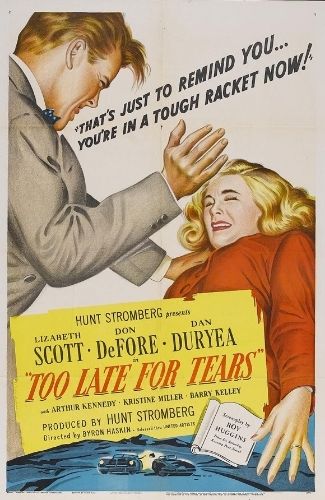
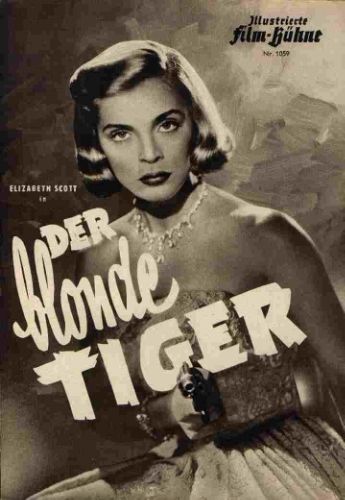
I've also been enjoying the different titles and marketing it has in different countries, the french title La tigresse and the german title Der blonde Tiger have a very difference emphasis than the American marketing while both being quite true to the film.
-
essrog

- Joined: Tue Nov 02, 2004 11:24 pm
- Location: Minneapolis, Minn.
Re: The Noir List Discussion and Suggestions (Genre Project)
This discussion reminds me that I'd like to have Too Late for Tears be my spotlight title. I gave it the briefest of write-ups here. I'm looking forward to revisiting it -- I'm pedantically going through the TCM's Summer of Darkness lineup on my DVR in order of airing. I'm generally only watching the ones I haven't seen before, but am making an exception for this because a) I've spotlighted it and I should probably see if I still like it that much; and b) the print I saw the first time was dreadful.
-
Lemmy Caution

- Joined: Wed Mar 29, 2006 7:26 am
- Location: East of Shanghai
Tune Up or Tune Out
I thought Drive a Crooked Road was a dud.
The screenplay by Blake Edwards certainly needed a tune up.
The whole film is premised on needing a getaway car to get from Point A to B in a certain amount of time, before police roadblocks get set up. So they dupe a race car driver into participating. Rather silly and contrived. The drive is all planned out to the last second, but everything else about the heist is rather shoddy.
For example, the bank manager surely got a very good look at one of the robbers. And the highly modified car wouldn't be hard to trace, unless you believe the 'we'll hide it in an abandoned mine, and push big rocks to cover the entrance' nonsense. While it would have been rather easy to concoct a story why the girl was packing up and leaving the same night as the robbery (see you in NY, honey, or whatever), rather than leaving that giant loose end.
I got that it was more interested in the characters and relationships than the crime (which isn't shown).
About the only thing I liked in the film was the cars themselves. Though the very 50's-ness of the whole proceedings was mildly diverting. I guess there was a small twist on the usual femme fatale. She feels bad, has a bit of a change of heart and decides to be honest -- though her boyfriend explains that would cruel and pointless -- and her honesty dooms our hero.
The screenplay by Blake Edwards certainly needed a tune up.
The whole film is premised on needing a getaway car to get from Point A to B in a certain amount of time, before police roadblocks get set up. So they dupe a race car driver into participating. Rather silly and contrived. The drive is all planned out to the last second, but everything else about the heist is rather shoddy.
For example, the bank manager surely got a very good look at one of the robbers. And the highly modified car wouldn't be hard to trace, unless you believe the 'we'll hide it in an abandoned mine, and push big rocks to cover the entrance' nonsense. While it would have been rather easy to concoct a story why the girl was packing up and leaving the same night as the robbery (see you in NY, honey, or whatever), rather than leaving that giant loose end.
I got that it was more interested in the characters and relationships than the crime (which isn't shown).
About the only thing I liked in the film was the cars themselves. Though the very 50's-ness of the whole proceedings was mildly diverting. I guess there was a small twist on the usual femme fatale. She feels bad, has a bit of a change of heart and decides to be honest -- though her boyfriend explains that would cruel and pointless -- and her honesty dooms our hero.
-
mistakaninja

- Joined: Thu Aug 15, 2013 9:15 pm
Re: The Noir List Discussion and Suggestions (Genre Project)
A terribly minor thing I always found fascinating about this picture, and it in no way makes up for its ordinariness, is the casual (i.e. unremarked upon) use of the testing of LA's civil defence sirens. I suppose that would have been a monthly event during those Cold War years, but it's not something I remember other pictures using. It's what I always think of first when recalling the film.domino harvey wrote:Hickey & Boggs (Robert Culp 1972)...
-
YnEoS
- Joined: Fri Oct 08, 2010 2:30 pm
Re: The Noir List Discussion and Suggestions (Genre Project)
Been in a bit of a noir rut recently, so apologies for not being as analytical with all my write ups as I'd like to be. I'm going to largely blame the large number of police procedural noirs I’ve been watching lately, which I have trouble getting interested in. It’s actually been raising my opinion of The Tattooed Stranger a bit. I previously dismissed it as light entertainment, but so far it’s been by far the most fun of the forensic science flavored police procedural. I'll probably throw it on the to rewatch if if I have time pile. I wrote up a preliminary list sometime a little while after TCM’s Summer of Darkness and I came up with 38 essential films I felt had to be on my list. Hopefully there are some more masterpieces I have left to watch, but at the moment more of the minor films I've watched are looking like more appealing candidates.
Fallen Angel (Otto Preminger, 1945) – I enjoyed the story overall when this was all over, but I’m not sure this was the ideal way to tell it. I think leaving everything for a twist at the end may have caused me to lose some interest around the middle. This one might play better on a second viewing, but at the moment I didn’t think much of it.
T-Men (Anthony Mann, 1947) - This was well put together and interesting enough, but I never really got immersed in the tension of being undercover. I think I would’ve enjoyed this more if it was just a straight documentary rather than trying to be informative and blend it with a narrative.
He Walked By Night (Alfred L. Werker & Anthony Mann, 1948) - Some really impressive set pieces, but similarly with T-men I just couldn’t get into this one. Don’t have too much insight into what in particular didn't work so well for me, so this one probably deserves another shot at some point when I'm less burned out on this type of material.
Union Station (Rudolph Maté, 1950) – I wasn’t crazy about the overall story here, but a lot of the non-flashy finesse on display kept my interest a lot better than some other police procedural noirs. Stuff like catching the guy stealing the suitcase from the kissing couple and the couple not noticing the whole exchange are a whole lot more interesting to me than any flashy Altman lighting. The many different character relationships here were all interesting enough, but I think my experiences was lessened a bit by the film not focusing in on any of them. I enjoyed the film overall and if I felt the need to include one police procedural noir on my list this would certainly be a good candidate, but I feel much more strongly about other noir sub-genres.
The Naked City (Jules Dassin, 1948) – The city life tourism aspect of this film was surprisingly entertaining. I can’t really say I thought the story was anything special, but the film’s dedication to exploring new locations and lifestyles for helped quite a bit.
Thieves' Highway (Jules Dassin, 1949) – By far the standout of this batch of viewings viewings. I didn’t know driving a delivery of apples could be so riveting, but this film was pretty damn tense. I thought all the characters here were really well written and very memorable.
Crime Wave (André De Toth, 1954) – I enjoyed this quite a bit, but I can’t say it really stood out as anything particularly special. Eddie Muller commentary track claims that this is an example of a very generic story done really well. It might be a bit too early in my noir appreciation for me to have the same amount of affection for its subtleties but I did enjoy it more than most.
Decoy (Jack Bernhard, 1946) – Another one of those noirs with a really zany plot line. Apparently remembered for its completely ruthless and unsympathetic femme fatale who narrates the film and for the level of violence. This was an interesting curiosity but I can’t say I loved it.
Spotlights
I’m not sure how much time I’ll have for venturing out on my own and exploring any new under appreciated noirs. So of the TCM Summer of Darkness films I watched that haven’t received a lot of discussion yet, my two favorites were The Gangster (Gordon Wiles, 1947), which I wrote up back here, and Cause for Alarm (Tay Garnett, 1951), which I wrote up here, and which Truffaut wrote positively about as well.
Fallen Angel (Otto Preminger, 1945) – I enjoyed the story overall when this was all over, but I’m not sure this was the ideal way to tell it. I think leaving everything for a twist at the end may have caused me to lose some interest around the middle. This one might play better on a second viewing, but at the moment I didn’t think much of it.
T-Men (Anthony Mann, 1947) - This was well put together and interesting enough, but I never really got immersed in the tension of being undercover. I think I would’ve enjoyed this more if it was just a straight documentary rather than trying to be informative and blend it with a narrative.
He Walked By Night (Alfred L. Werker & Anthony Mann, 1948) - Some really impressive set pieces, but similarly with T-men I just couldn’t get into this one. Don’t have too much insight into what in particular didn't work so well for me, so this one probably deserves another shot at some point when I'm less burned out on this type of material.
Union Station (Rudolph Maté, 1950) – I wasn’t crazy about the overall story here, but a lot of the non-flashy finesse on display kept my interest a lot better than some other police procedural noirs. Stuff like catching the guy stealing the suitcase from the kissing couple and the couple not noticing the whole exchange are a whole lot more interesting to me than any flashy Altman lighting. The many different character relationships here were all interesting enough, but I think my experiences was lessened a bit by the film not focusing in on any of them. I enjoyed the film overall and if I felt the need to include one police procedural noir on my list this would certainly be a good candidate, but I feel much more strongly about other noir sub-genres.
The Naked City (Jules Dassin, 1948) – The city life tourism aspect of this film was surprisingly entertaining. I can’t really say I thought the story was anything special, but the film’s dedication to exploring new locations and lifestyles for helped quite a bit.
Thieves' Highway (Jules Dassin, 1949) – By far the standout of this batch of viewings viewings. I didn’t know driving a delivery of apples could be so riveting, but this film was pretty damn tense. I thought all the characters here were really well written and very memorable.
Crime Wave (André De Toth, 1954) – I enjoyed this quite a bit, but I can’t say it really stood out as anything particularly special. Eddie Muller commentary track claims that this is an example of a very generic story done really well. It might be a bit too early in my noir appreciation for me to have the same amount of affection for its subtleties but I did enjoy it more than most.
Decoy (Jack Bernhard, 1946) – Another one of those noirs with a really zany plot line. Apparently remembered for its completely ruthless and unsympathetic femme fatale who narrates the film and for the level of violence. This was an interesting curiosity but I can’t say I loved it.
Spotlights
I’m not sure how much time I’ll have for venturing out on my own and exploring any new under appreciated noirs. So of the TCM Summer of Darkness films I watched that haven’t received a lot of discussion yet, my two favorites were The Gangster (Gordon Wiles, 1947), which I wrote up back here, and Cause for Alarm (Tay Garnett, 1951), which I wrote up here, and which Truffaut wrote positively about as well.
-
life_boy

- Joined: Sat Apr 15, 2006 3:51 am
- Location: Mississippi
Re: The Noir List Discussion and Suggestions (Genre Project)
I started this project on vacation so my time for decent write-ups have been limited since then. Here are a few capsules.
Detective Story (William Wyler, 1950)
William Wyler is one of the unsung heroes of classic Hollywood auteurship. A master of blocking, staging and the long take, Wyler brings the same engaging and richly textured sensibility he displayed in The Best Years of Our Lives to this exploration of male aggression, unrepentant sin and abuses of police power. Kirk Douglas gives what has to be one of his greatest ever performances. It is a portrait full of empathy, pity and an undercurrent of unchecked rage. It only felt like a play in the fact that it was basically all one setting but the drama was engaging enough that it never mattered. A lock to make my list, likely top 10.
Lady in the Lake (Robert Montgomery, 1947)
Talk about a novel premise running thin quickly, I was tired of this about 10 minutes in. Overlooking the POV, all you're left with is the convolution of the narrative and the clunky performances.
Gangster Squad (Ruben Fleischer, 2013)
Set in 1950's Los Angeles, which was the primary attraction for me, but don't expect anything engaging. It felt like it was trying to remind me of several other better movies with better plots and more exciting characters. Penn has fun chewing up the scenery but that's about it. A well-dressed mess.
Gun Crazy (Joseph H. Lewis, 1950)
I know this movie has some major supporters around here and I can see why some might go for it. For me, despite some expert shots and some nice live-action car photography, this really felt pretty middling. Dall and Cummins were great too but it all felt a bit artificial -- as in, once we started along the robbery path all that was left to enjoy was the artifice because everything else was inevitable. The emotion was determined, the narrative set and the tension relieved. Gun Crazy does a lot of things right but it still never felt like anything particularly special. The first 15 minutes were probably the most intriguing of all, but then it never seemed to payoff on that promise. Disappointing.
Tomorrow is Another Day (Felix E. Feist, 1951)
The most striking thing about Tomorrow is Another Day is the feeling of spontaneity imbued in the storyline. The story of an ex-con who finds himself in a world 18 years older than when he went in, hopelessly out-of-touch with the city, with fashion, with women is interesting enough on its own. But when he finds himself accidentally responsible (or at least thinking he is responsible) for the murder of a police officer through some strange circumstances, he and the woman also implicated strike out across the country to escape interrogation and implication. Despite his advances, she is cold on him throughout the early stages of the trip, mostly because of his seeming lust and desperation. But they do end up marrying and eventually traveling with some migrant laborers out to California. The scenes out on the farm are played with warmth and observation, as his paranoia sometimes gets the best of him and they come to the realization that if they are going to begin a new life together it might as well be here and now.
It really is the story of an unlucky guy who, despite his efforts to avoid going back, really found a certain degree of comfort in the stability of institutional life. He struggles with paranoia and fear, never able to completely trust anyone around him (even though, in some ways, his suspicion is justified). One of the most fascinating scenes is between an older couple who are neighbors to the newlyweds and have just seen his wanted ad in a magazine. They wrestle with turning him in for a $1000 reward or to remain friends. It is an honest moment that paints these people as human beings, poor and desperate, but desiring to do right by those whom they know.
It is hard for him to accept the expectations and realities of carving out a new life, committing to hard labor and learning to love the person he's given his life to. All of these scenes are really fantastic and very unexpected. What holds the film back are the final 10 minutes or so that show him spiraling deeper into paranoia while a rather forced set of circumstances brings about the resolution. I was much more interested to see this one play out like it had unfolded but it all wrapped itself up a little too neatly in the end.
==========
In response to YnEoS's viewing of Union Station:
I loved the little moments like that couple too. I hope it does end up making your list. Still one of my favorites.
I had not planned on either of those films you are spotlighting (honestly, had never heard of either before your post) but I will hopefully be able to squeeze at least one of them in before the deadline.
Detective Story (William Wyler, 1950)
William Wyler is one of the unsung heroes of classic Hollywood auteurship. A master of blocking, staging and the long take, Wyler brings the same engaging and richly textured sensibility he displayed in The Best Years of Our Lives to this exploration of male aggression, unrepentant sin and abuses of police power. Kirk Douglas gives what has to be one of his greatest ever performances. It is a portrait full of empathy, pity and an undercurrent of unchecked rage. It only felt like a play in the fact that it was basically all one setting but the drama was engaging enough that it never mattered. A lock to make my list, likely top 10.
Lady in the Lake (Robert Montgomery, 1947)
Talk about a novel premise running thin quickly, I was tired of this about 10 minutes in. Overlooking the POV, all you're left with is the convolution of the narrative and the clunky performances.
Gangster Squad (Ruben Fleischer, 2013)
Set in 1950's Los Angeles, which was the primary attraction for me, but don't expect anything engaging. It felt like it was trying to remind me of several other better movies with better plots and more exciting characters. Penn has fun chewing up the scenery but that's about it. A well-dressed mess.
Gun Crazy (Joseph H. Lewis, 1950)
I know this movie has some major supporters around here and I can see why some might go for it. For me, despite some expert shots and some nice live-action car photography, this really felt pretty middling. Dall and Cummins were great too but it all felt a bit artificial -- as in, once we started along the robbery path all that was left to enjoy was the artifice because everything else was inevitable. The emotion was determined, the narrative set and the tension relieved. Gun Crazy does a lot of things right but it still never felt like anything particularly special. The first 15 minutes were probably the most intriguing of all, but then it never seemed to payoff on that promise. Disappointing.
Tomorrow is Another Day (Felix E. Feist, 1951)
The most striking thing about Tomorrow is Another Day is the feeling of spontaneity imbued in the storyline. The story of an ex-con who finds himself in a world 18 years older than when he went in, hopelessly out-of-touch with the city, with fashion, with women is interesting enough on its own. But when he finds himself accidentally responsible (or at least thinking he is responsible) for the murder of a police officer through some strange circumstances, he and the woman also implicated strike out across the country to escape interrogation and implication. Despite his advances, she is cold on him throughout the early stages of the trip, mostly because of his seeming lust and desperation. But they do end up marrying and eventually traveling with some migrant laborers out to California. The scenes out on the farm are played with warmth and observation, as his paranoia sometimes gets the best of him and they come to the realization that if they are going to begin a new life together it might as well be here and now.
It really is the story of an unlucky guy who, despite his efforts to avoid going back, really found a certain degree of comfort in the stability of institutional life. He struggles with paranoia and fear, never able to completely trust anyone around him (even though, in some ways, his suspicion is justified). One of the most fascinating scenes is between an older couple who are neighbors to the newlyweds and have just seen his wanted ad in a magazine. They wrestle with turning him in for a $1000 reward or to remain friends. It is an honest moment that paints these people as human beings, poor and desperate, but desiring to do right by those whom they know.
It is hard for him to accept the expectations and realities of carving out a new life, committing to hard labor and learning to love the person he's given his life to. All of these scenes are really fantastic and very unexpected. What holds the film back are the final 10 minutes or so that show him spiraling deeper into paranoia while a rather forced set of circumstances brings about the resolution. I was much more interested to see this one play out like it had unfolded but it all wrapped itself up a little too neatly in the end.
==========
In response to YnEoS's viewing of Union Station:
I loved the little moments like that couple too. I hope it does end up making your list. Still one of my favorites.
I had not planned on either of those films you are spotlighting (honestly, had never heard of either before your post) but I will hopefully be able to squeeze at least one of them in before the deadline.
-
Lemmy Caution
- Joined: Wed Mar 29, 2006 7:26 am
- Location: East of Shanghai
Re: The Noir List Discussion and Suggestions (Genre Project)
In the Columbia noir set vol. 3:
I really liked The Burglar (1957), shot with a lot of verve. It's a pretty clever film and the director and cinematographer constantly try out ideas, and most of them work. Dan Duryea has kind of aged into his baby face, and has a good weary presence. For most of the film I thought he looked like William H Macy. I liked his restraint among the directorial flourishes.
This is Jayne Mansfield's first significant part, but she became a star before it was released, so Columbia sat on this this little B pic for two years in order to cash in on her peak popularity. She's good, especially in the early scenes when she has more to do. I really enjoyed the pace and characters. I guess the sneering murderous cop is perhaps a bit much, but it works within the film. I liked how bad guys and good guys are flipped. Dan Duryea might be a thief, but he's holding up the family business and honoring his promise to protect and care for his half-sister.
It's fun to see some of Atlantic City in it's peak beach resort/pre-gambling days. The Steel Pier: The Nation's Show Place one banner proclaims, as various people and a horse dive into the Atlantic Ocean.
The Mob was also very good, with Broderick Crawford infiltrating the goons who have infiltrated the dock workers. It's kind of amusing that this version of going undercover is to get as noticed as can be. Crawford loudmouths and wisecracks his way into various encounters with the crime bosses, which makes for a fairly lively, entertaining film. I especially liked the way Crawford and the mob outsmart each other during their first encounter. That was good script-writing. The one twist at the end isn't the most plausible, but ties up the film fairly well, and explains the mystery of the Big Crime Boss. Ernest Borgnine has a small role as a crime boss. Charles Bronson even pops up briefly as a jaded dock worker. Recommended.
I thought Tight Spot was rather clunky. Ginger Rogers stars as a tough wisecracking gal in prison. She gets furloughed to a nice hotel room while prosecutor Edward G. tries to convince her to testify against a mob boss (Lorne Green). Brian Keith is the primary policeman in charge of her safety. The last surprise witness, Rogers' friend, was recently gunned down on the courthouse steps. Actually that's the opening scene and pretty dramatic. But whatever happened to using the back or side entrance, and going right from a vehicle into the court building?
Anyway, the premise is fine. Good actors in key roles. And then ... it's a rather cliche-fest talkie, contrived and boring. Rather obviously adapted from a play, and in the film the dialogue and the turn-taking interactions come across as stiff. Primarily the screenplay lets the whole production down. But Ginger Rogers, unaided by the phony dialogue, doesn't really cut it as a tough dame and can't carry the film. Brian Keith is interesting but almost seems to be involved in a different more gritty film. There is one late twist, which has potential and involves Keith's character, but that gets snuffed out in uninspired fashion. And even the final scene is rather cheesy.
I really liked The Burglar (1957), shot with a lot of verve. It's a pretty clever film and the director and cinematographer constantly try out ideas, and most of them work. Dan Duryea has kind of aged into his baby face, and has a good weary presence. For most of the film I thought he looked like William H Macy. I liked his restraint among the directorial flourishes.
This is Jayne Mansfield's first significant part, but she became a star before it was released, so Columbia sat on this this little B pic for two years in order to cash in on her peak popularity. She's good, especially in the early scenes when she has more to do. I really enjoyed the pace and characters. I guess the sneering murderous cop is perhaps a bit much, but it works within the film. I liked how bad guys and good guys are flipped. Dan Duryea might be a thief, but he's holding up the family business and honoring his promise to protect and care for his half-sister.
It's fun to see some of Atlantic City in it's peak beach resort/pre-gambling days. The Steel Pier: The Nation's Show Place one banner proclaims, as various people and a horse dive into the Atlantic Ocean.
The Mob was also very good, with Broderick Crawford infiltrating the goons who have infiltrated the dock workers. It's kind of amusing that this version of going undercover is to get as noticed as can be. Crawford loudmouths and wisecracks his way into various encounters with the crime bosses, which makes for a fairly lively, entertaining film. I especially liked the way Crawford and the mob outsmart each other during their first encounter. That was good script-writing. The one twist at the end isn't the most plausible, but ties up the film fairly well, and explains the mystery of the Big Crime Boss. Ernest Borgnine has a small role as a crime boss. Charles Bronson even pops up briefly as a jaded dock worker. Recommended.
I thought Tight Spot was rather clunky. Ginger Rogers stars as a tough wisecracking gal in prison. She gets furloughed to a nice hotel room while prosecutor Edward G. tries to convince her to testify against a mob boss (Lorne Green). Brian Keith is the primary policeman in charge of her safety. The last surprise witness, Rogers' friend, was recently gunned down on the courthouse steps. Actually that's the opening scene and pretty dramatic. But whatever happened to using the back or side entrance, and going right from a vehicle into the court building?
Anyway, the premise is fine. Good actors in key roles. And then ... it's a rather cliche-fest talkie, contrived and boring. Rather obviously adapted from a play, and in the film the dialogue and the turn-taking interactions come across as stiff. Primarily the screenplay lets the whole production down. But Ginger Rogers, unaided by the phony dialogue, doesn't really cut it as a tough dame and can't carry the film. Brian Keith is interesting but almost seems to be involved in a different more gritty film. There is one late twist, which has potential and involves Keith's character, but that gets snuffed out in uninspired fashion. And even the final scene is rather cheesy.
-
swo17
- Bloodthirsty Butcher
- Joined: Tue Apr 15, 2008 2:25 pm
- Location: SLC, UT
Re: The Noir List Discussion and Suggestions (Genre Project)
Just to be difficult...I feel like Le Samouraï (1967) really belongs on a neo-noir list (there are clear noir elements to the film and it's obviously very highly regarded, but note that it didn't receive a single vote during the prior round) but it seems like the rules as currently written don't allow for this? I wonder if the rules might be slightly tweaked to better recognize the transitional period of the sixties, either a) allowing any film released during the sixties to be placed on either the noir or neo-noir list, or b) moving the cutoff from 1970 back to, say, 1964. (Is anyone considering listing anything as a noir that came out after The Naked Kiss?)
Point Blank (1967) seems like another film in the same boat, too modern to be a true noir but clearly heavily influenced by the genre. This too is a highly regarded film, and yet was orphaned on the last list.
Otherwise, the rules are awesome and everything you do domino is wonderful.
Point Blank (1967) seems like another film in the same boat, too modern to be a true noir but clearly heavily influenced by the genre. This too is a highly regarded film, and yet was orphaned on the last list.
Otherwise, the rules are awesome and everything you do domino is wonderful.
-
domino harvey
- Dot Com Dom
- Joined: Wed Jan 11, 2006 6:42 pm
Re: The Noir List Discussion and Suggestions (Genre Project)
Pretty Poison is for sure making my list, and it's '68. However, yes, unlike me, the eligibility perimeters are imperfect. But any exceptions beyond setting an arbitrary date-based cut-off are too heavily predicated on individual desires for Film X, Y, or Z. So, no, I'm not doing that, but I recognize where you're coming from and don't disagree that the current boundaries are flawed. But that'd be true of any boundaries I set, so here we are regardless.
-
swo17
- Bloodthirsty Butcher
- Joined: Tue Apr 15, 2008 2:25 pm
- Location: SLC, UT
Re: The Noir List Discussion and Suggestions (Genre Project)
OK. I guess my option A was intended to remove the arbitrariness of a single year cutoff, essentially replacing it with a "vote for it" style exercise where the spirit of "noir" vs. "neo-noir" was the main concern. If the real distinction between the two is going to be the year of release, then I would just urge that people not leave any sixties films off of their noir lists purely on the grounds that they feel more like neo-noir than true noir.
-
zedz
- Joined: Sun Nov 07, 2004 11:24 pm
Re: The Noir List Discussion and Suggestions (Genre Project)
I think neo-noir isn't really as time-proscribed as noir itself. Any sixties examples of noir proper are going to be outliers - last gasps of a waning genre - but self-conscious appropriations of the genre could - and did - happen as soon as the genre itself was acknowledged, and I think Le Samourai and Point Blank (and Pretty Poison) definitely fall into that category, even though they'd be very odd fits in a strictly film noir list. I definitely don't consider neo-noir to be defined as "film noir made after year X," even though some films in that category might look a lot like that.
-
Noiradelic
- Joined: Sun Jul 19, 2009 4:45 am
Re: The Noir List Discussion and Suggestions (Genre Project)
Agree wholeheartedly with all of this (including the last).swo17 wrote:Just to be difficult...I feel like Le Samouraï (1967) really belongs on a neo-noir list (there are clear noir elements to the film and it's obviously very highly regarded, but note that it didn't receive a single vote during the prior round) but it seems like the rules as currently written don't allow for this? I wonder if the rules might be slightly tweaked to better recognize the transitional period of the sixties, either a) allowing any film released during the sixties to be placed on either the noir or neo-noir list, or b) moving the cutoff from 1970 back to, say, 1964. (Is anyone considering listing anything as a noir that came out after The Naked Kiss?)
Point Blank (1967) seems like another film in the same boat, too modern to be a true noir but clearly heavily influenced by the genre. This too is a highly regarded film, and yet was orphaned on the last list.
Otherwise, the rules are awesome and everything you do domino is wonderful.
Why not have the cutoff for neo-noir be 1960? It really is a mixed decade. I think swo's suggestions would be self-policing, because nobody is going to want to label their favorite pre-1965 noirs as "neo-noir" because of the mildly negative connotation -- self-consciousness or lacking authenticity -- it has for films of that vintage. Underworld USA and The Naked Kiss are the only sixties films to make the first list and the neo-noir list is only 10 films, so we're really only talking about a handful of films that are likely to make the cut.swo17 wrote:OK. I guess my option A was intended to remove the arbitrariness of a single year cutoff, essentially replacing it with a "vote for it" style exercise where the spirit of "noir" vs. "neo-noir" was the main concern.
Personally, I'd rather the noir list's cutoff be 1960 than the neo-noir list's cutoff be 1970, because The Manchurian Candidate is probably the only sixties film that will make my noir list and I can live with that being classified as neo-noir, but I want to vote for multiple sixties films for the neo-noir one. I'm not advocating the former -- people should have the right to vote for pre-1965 films -- just stressing my feelings about changing the latter.
-
YnEoS
- Joined: Fri Oct 08, 2010 2:30 pm
Re: The Noir List Discussion and Suggestions (Genre Project)
Two of a Kind (Henry Levin, 1951) – Well this was just delightfully fun. I like the way the film just drops you in without really explaining what’s going on. It did a good enough job of setting up questions so I was always interested to see where it was going and the story has a lot of momentum behind it. I was a little worried that it was going to lose some steam once the whole scheme was finally revealed, but the film just gets even goofier and charges on. Definitely one of my favorite fun takes on the noir genre.
Sweet Smell of Success (Alexander Mackendrick, 1957) – Not much to add other than this film really lives up to its reputation. Does a great job of following characters doing completely distasteful things and being endlessly fascinating to watch.
Shockproof (Douglas Sirk, 1949) – I was enjoying this, but the storyline kind of lost some steam for me part of the way through. Can’t put my finger on exactly what it was, but either the characters or the storyline or both didn’t seem to have enough depth behind them to stay interesting throughout the whole film. Glad I watched it to see where the final act of Tomorrow is Another Day came from.
Ride the Pink Horse (Robert Montgomery, 1947) – Really well made film, glad Criterion released something like this. I was so taken in right from the beginning I didn’t notice some of the bravura long takes until they were pointed out on the commentary track.
Human Desire (Fritz Lang, 1954) – This is a really well constructed film. There’s really great union of cinematography, blocking and acting here with lots of information being conveyed by character posture and the way they’re placed in the frame. Gloria Grahame gets to do some really great eyebrow acting throughout. I can’t say I always pay attention to these small details so I don’t know how exemplary this film is, but it really stood out to me when watching the film. Definitely thought there was some high craftsmanship at work here.
Where I got thrown off was the inconsistent tone of the film. It seemed like a lot of effort went into building sympathy and motivation for Gloria Grahame’s character to the extent that she could probably be the protagonist of the film. But then all the scenes where Glenn Ford is torn between his feelings for his friend’s wife and his other friend’s daughter felt like they were from a different movie. It was played like the typical good girl/bad girl dichotomy, but Gloria Grahame’s character isn't exactly Barbara Stanwyck from Double Indemnity, so it felt odd to have her characterized that way in these scenes. Those two plotlines aren’t necessarily incompatible, but I felt like the film made no effort to reconcile the discrepancy between what we saw of Gloria Grahame’s character and how the rest of the characters thought of her. It didn’t really feel like it was setting it up as a tragic misunderstanding or that her character was being harshly judged by people who couldn’t understand her circumstances. Its been a long time since I’ve watched La Bête Humaine and I haven’t read the Émile Zola novel, so I can’t say how this compares to the source material and other adaptations. But the way it was presented here really perplexed me. Maybe I missed something or was coming at this from the wrong angle.
The Lineup (Don Siegel, 1958) – Interesting setup and Eli Wallach is really captivating in all of his scenes. However I’m gonna have to be a little crabby about this one and say that once again the police procedural plotline didn’t really do a lot for me. I wish I could approach this subgenre more on its own terms since there seems to be a good amount of enthusiasm for these films, and definitely some good craftsmanship behind them. But so far they’ve all felt like more of a chore to watch than other noirs.
Murder by Contract (Irving Lerner, 1958) – Well this was really fascinating. I don’t think I’ve ever seen anything quite like this from this era of filmmaking. It really does an outstanding job of creating a unique atmosphere and tone without making any sacrifices to the basic tension of its storyline which is handled pretty perfectly.
Spoiler
The beginning was so filled with attractive people being jealous of each other, that I was wondering the whole time if any of them were even interested in the supposed crime they were committing. So I nearly applauded when Lizbeth Scott and Edmund O’Brien ended up getting together. So many noirs dictate that when the protagonist starts down the wrong path they’ve got to keep pushing it to see how far they’ll go before their downfall. I found it very refreshing to see a film where we have two protagonists with a line they won’t cross, and they get off the hook because of their refusal to cross it. Wouldn’t mind watching more romantic comedies by way of film noir.
Sweet Smell of Success (Alexander Mackendrick, 1957) – Not much to add other than this film really lives up to its reputation. Does a great job of following characters doing completely distasteful things and being endlessly fascinating to watch.
Shockproof (Douglas Sirk, 1949) – I was enjoying this, but the storyline kind of lost some steam for me part of the way through. Can’t put my finger on exactly what it was, but either the characters or the storyline or both didn’t seem to have enough depth behind them to stay interesting throughout the whole film. Glad I watched it to see where the final act of Tomorrow is Another Day came from.
Ride the Pink Horse (Robert Montgomery, 1947) – Really well made film, glad Criterion released something like this. I was so taken in right from the beginning I didn’t notice some of the bravura long takes until they were pointed out on the commentary track.
Human Desire (Fritz Lang, 1954) – This is a really well constructed film. There’s really great union of cinematography, blocking and acting here with lots of information being conveyed by character posture and the way they’re placed in the frame. Gloria Grahame gets to do some really great eyebrow acting throughout. I can’t say I always pay attention to these small details so I don’t know how exemplary this film is, but it really stood out to me when watching the film. Definitely thought there was some high craftsmanship at work here.
Where I got thrown off was the inconsistent tone of the film. It seemed like a lot of effort went into building sympathy and motivation for Gloria Grahame’s character to the extent that she could probably be the protagonist of the film. But then all the scenes where Glenn Ford is torn between his feelings for his friend’s wife and his other friend’s daughter felt like they were from a different movie. It was played like the typical good girl/bad girl dichotomy, but Gloria Grahame’s character isn't exactly Barbara Stanwyck from Double Indemnity, so it felt odd to have her characterized that way in these scenes. Those two plotlines aren’t necessarily incompatible, but I felt like the film made no effort to reconcile the discrepancy between what we saw of Gloria Grahame’s character and how the rest of the characters thought of her. It didn’t really feel like it was setting it up as a tragic misunderstanding or that her character was being harshly judged by people who couldn’t understand her circumstances. Its been a long time since I’ve watched La Bête Humaine and I haven’t read the Émile Zola novel, so I can’t say how this compares to the source material and other adaptations. But the way it was presented here really perplexed me. Maybe I missed something or was coming at this from the wrong angle.
The Lineup (Don Siegel, 1958) – Interesting setup and Eli Wallach is really captivating in all of his scenes. However I’m gonna have to be a little crabby about this one and say that once again the police procedural plotline didn’t really do a lot for me. I wish I could approach this subgenre more on its own terms since there seems to be a good amount of enthusiasm for these films, and definitely some good craftsmanship behind them. But so far they’ve all felt like more of a chore to watch than other noirs.
Murder by Contract (Irving Lerner, 1958) – Well this was really fascinating. I don’t think I’ve ever seen anything quite like this from this era of filmmaking. It really does an outstanding job of creating a unique atmosphere and tone without making any sacrifices to the basic tension of its storyline which is handled pretty perfectly.
-
life_boy
- Joined: Sat Apr 15, 2006 3:51 am
- Location: Mississippi
Re: The Noir List Discussion and Suggestions (Genre Project)
The Big Knife (Robert Aldrich, 1955)
I'll quickly admit that I probably need to rewatch this to get the full impact but first impressions were fairly disappointing. I was not expecting what this movie turned out to be, to the point that I found myself pretty distracted overall. An Odets play makes its way to the screen, skewering Hollywood in big sweeping gestures. There are multiple power dynamics, each vying for ultimate control. It's pretty clear from the top who holds the trump cards but exactly how those will get played is why there's a story at all. Palance in profile looks like a skeleton with skin stretched over, an effect that points to his indecision and spiritual doom. Put him in contrast to Ida Lupino's tender face, full of warmth and resilience, and its like night and day.
It's a noir with even lighting, taking the crime briefly out of the shadows and back alleys and placing it in the lavish, well-lit living rooms and sunny backyards of Bel Air millionaires. It's not a great script, but Aldrich does a lot with his deep spatial blocking and long takes. Rod Steiger steals the show.
Gilda (Charles Vidor, 1946)
This movie's at its razor-sharp best when its deconstructing interpersonal power dynamics in a weird love triangle full of half-truths and veiled threats; it's pretty mediocre when it slows down to get carried away with a second-rate thriller plot about tungsten patents and murder investigations. Still, there's Rita Hayworth in THE defining role of the decade and she nailed it. Glenn Ford wasn't bad either. If this movie continued to be as sharp and spunky as its first hour, this would be a hands down masterpiece.
The Hitch-Hiker (Ida Lupino, 1953)
Small, taut, intense and bleak. Sorely underseen and undervalued, The Hitch-Hiker is about as simple as it gets and yet absolutely ferocious. Emmett Myers is one of the more frightening villains in all of film noir; yes, even right up there with Tommy Udo. What makes him so frightening is he has a restraint to him that somehow makes him feel more volatile. His violence is as much or more psychological as it is physical. He also has a paranoid commitment to pointing a gun at these guys. He doesn't ever get chummy or let down his guard. He never trusts his hostages and makes no secret of the fact that they have a limited life span. Lupino shoots the desert as well as anybody and though she doesn't have time for deep characterization, she also doesn't treat her limited cast as stock. Hard to beat. Definitely making my list.
Kansas City Confidential (Phil Karlson, 1952)
Very solid noir with a pretty bleak view of law enforcement. The movie appears to be a heist film but soon proves to be an aftermath film, this time featuring a guy who unwittingly played the patsy just by showing up to work one morning. After being beaten by the authorities hoping to get a confession out of him, they find evidence that seems to indicate he's not the guy and likely innocent. They're sorry. He's using every ounce of self-restraint to keep from burning down the station.
A good noir begins when someone should have just walked away and let injustice happen, and by that metric, this is definitely a good noir. Dynamic characters and great interactions while the truth slowly works its way out enough to be seen by the players. It may find its way into the nether regions of my list.
Nightmare Alley (Edmund Goulding, 1947)
A nasty bit of business that packs quite a punch as it slowly unravels. It starts so anonymously, so accidentally - just a guy trying to make something of himself through hard work in the carnival racket. But he wants more. What this movie nails is not just the rise and fall of a con man but the fact that the con man buys into his own act more than anyone. He knows the score but he relishes in it to the point of feeling invincible. Self-deception is a killer and the superstitious among us have a way of fulfilling their own doomed prophecies. Words fail me because this feels like an out-and-out masterpiece.
T-Men (Anthony Mann, 1947) [REWATCH]
A more than serviceable thriller with undercover treasury officers trying to work their way in and through the underworld to get their way to the head of a counterfeiting ring. A seal of authenticity from the U.S. Treasury Department marks the opening card and a dry, objective narration follows (appearing consistently yet sporadically throughout the runtime), an aspect some viewers are annoyed by but I find kind of charming and brilliant. It's almost like a lost Pare Lorentz documentary, with Mann's stylistic flourishes and characteristic compositional brilliance. His violence here is not as sharp and cutting as it often is, which may be part of why this plays as a bit of a b-side in Mann's repertoire.
It's too bad I've never been able to catch this on anything other than a rudimentary film-to-video transfer because Alton is all guns blazing here, pushing his shadows about as far into abstraction as they can go. And though nobody cares, Dennis O'Keefe puts together a great little performance here. He plays O'Brien/Harrigan with enough ambiguity and nonchalance that it seems he almost prefers the blurred edges and clear politics of the underworld to the teams of experts and countless policies that govern the overworld. That's not a clear point, but it plays out in many of O'Keefe's daring responses when challenged. I like it but I prefer Raw Deal.
I'll quickly admit that I probably need to rewatch this to get the full impact but first impressions were fairly disappointing. I was not expecting what this movie turned out to be, to the point that I found myself pretty distracted overall. An Odets play makes its way to the screen, skewering Hollywood in big sweeping gestures. There are multiple power dynamics, each vying for ultimate control. It's pretty clear from the top who holds the trump cards but exactly how those will get played is why there's a story at all. Palance in profile looks like a skeleton with skin stretched over, an effect that points to his indecision and spiritual doom. Put him in contrast to Ida Lupino's tender face, full of warmth and resilience, and its like night and day.
It's a noir with even lighting, taking the crime briefly out of the shadows and back alleys and placing it in the lavish, well-lit living rooms and sunny backyards of Bel Air millionaires. It's not a great script, but Aldrich does a lot with his deep spatial blocking and long takes. Rod Steiger steals the show.
Gilda (Charles Vidor, 1946)
This movie's at its razor-sharp best when its deconstructing interpersonal power dynamics in a weird love triangle full of half-truths and veiled threats; it's pretty mediocre when it slows down to get carried away with a second-rate thriller plot about tungsten patents and murder investigations. Still, there's Rita Hayworth in THE defining role of the decade and she nailed it. Glenn Ford wasn't bad either. If this movie continued to be as sharp and spunky as its first hour, this would be a hands down masterpiece.
The Hitch-Hiker (Ida Lupino, 1953)
Small, taut, intense and bleak. Sorely underseen and undervalued, The Hitch-Hiker is about as simple as it gets and yet absolutely ferocious. Emmett Myers is one of the more frightening villains in all of film noir; yes, even right up there with Tommy Udo. What makes him so frightening is he has a restraint to him that somehow makes him feel more volatile. His violence is as much or more psychological as it is physical. He also has a paranoid commitment to pointing a gun at these guys. He doesn't ever get chummy or let down his guard. He never trusts his hostages and makes no secret of the fact that they have a limited life span. Lupino shoots the desert as well as anybody and though she doesn't have time for deep characterization, she also doesn't treat her limited cast as stock. Hard to beat. Definitely making my list.
Kansas City Confidential (Phil Karlson, 1952)
Very solid noir with a pretty bleak view of law enforcement. The movie appears to be a heist film but soon proves to be an aftermath film, this time featuring a guy who unwittingly played the patsy just by showing up to work one morning. After being beaten by the authorities hoping to get a confession out of him, they find evidence that seems to indicate he's not the guy and likely innocent. They're sorry. He's using every ounce of self-restraint to keep from burning down the station.
A good noir begins when someone should have just walked away and let injustice happen, and by that metric, this is definitely a good noir. Dynamic characters and great interactions while the truth slowly works its way out enough to be seen by the players. It may find its way into the nether regions of my list.
Nightmare Alley (Edmund Goulding, 1947)
A nasty bit of business that packs quite a punch as it slowly unravels. It starts so anonymously, so accidentally - just a guy trying to make something of himself through hard work in the carnival racket. But he wants more. What this movie nails is not just the rise and fall of a con man but the fact that the con man buys into his own act more than anyone. He knows the score but he relishes in it to the point of feeling invincible. Self-deception is a killer and the superstitious among us have a way of fulfilling their own doomed prophecies. Words fail me because this feels like an out-and-out masterpiece.
T-Men (Anthony Mann, 1947) [REWATCH]
A more than serviceable thriller with undercover treasury officers trying to work their way in and through the underworld to get their way to the head of a counterfeiting ring. A seal of authenticity from the U.S. Treasury Department marks the opening card and a dry, objective narration follows (appearing consistently yet sporadically throughout the runtime), an aspect some viewers are annoyed by but I find kind of charming and brilliant. It's almost like a lost Pare Lorentz documentary, with Mann's stylistic flourishes and characteristic compositional brilliance. His violence here is not as sharp and cutting as it often is, which may be part of why this plays as a bit of a b-side in Mann's repertoire.
It's too bad I've never been able to catch this on anything other than a rudimentary film-to-video transfer because Alton is all guns blazing here, pushing his shadows about as far into abstraction as they can go. And though nobody cares, Dennis O'Keefe puts together a great little performance here. He plays O'Brien/Harrigan with enough ambiguity and nonchalance that it seems he almost prefers the blurred edges and clear politics of the underworld to the teams of experts and countless policies that govern the overworld. That's not a clear point, but it plays out in many of O'Keefe's daring responses when challenged. I like it but I prefer Raw Deal.
-
swo17
- Bloodthirsty Butcher
- Joined: Tue Apr 15, 2008 2:25 pm
- Location: SLC, UT
Re: The Noir List Discussion and Suggestions (Genre Project)
With the films I've been watching at least, I haven't seen a whole lot in the way of the snappy dialogue that one typically associates with this genre, though domino's recommendations of Scene of the Crime and The Web didn't disappoint in this respect. Are there any other lesser known noirs of this ilk that people would recommend?
I'd also appreciate recommendations of noirs with creatively shocking moments of violence, e.g. Brute Force, Union Station, The Big Combo, most Manns.
I'd also appreciate recommendations of noirs with creatively shocking moments of violence, e.g. Brute Force, Union Station, The Big Combo, most Manns.
-
Lemmy Caution
- Joined: Wed Mar 29, 2006 7:26 am
- Location: East of Shanghai
Re: The Noir List Discussion and Suggestions (Genre Project)
Well, two that I reviewed on this page qualify:swo17 wrote: snappy dialogue
The Mob has Broderick Crawford mouthing off and firing snappy one-liners.
That should be just what you're looking for.
In Tight Spot, Ginger Rogers stars as a tough wisecracking gal in prison.
A bit of a change with a dame getting the tough witty lines.
Though I didn't care for the film that much.
Sure there's plenty more, and I'll try to rec some, but it's easier to recall the dialogue from recently watched films. In general terms, most films featuring a private dick, such as Marlowe, or featuring Bogart tend to have snappy one-liners, and especially those with Bogart as a private investigator.
-
Noiradelic
- Joined: Sun Jul 19, 2009 4:45 am
Re: The Noir List Discussion and Suggestions (Genre Project)
This may not qualify as lesser-known anymore thanks to the Noir Foundation, but Cry Danger's first half-hour is a giddy rush of snappy patter (same screenwriter as The Mob).swo17 wrote:With the films I've been watching at least, I haven't seen a whole lot in the way of the snappy dialogue that one typically associates with this genre, though domino's recommendations of Scene of the Crime and The Web didn't disappoint in this respect. Are there any other lesser known noirs of this ilk that people would recommend?
I'd also appreciate recommendations of noirs with creatively shocking moments of violence, e.g. Brute Force, Union Station, The Big Combo, most Manns.
Shield for Murder (first to mind because the last one I saw) has a creatively directed moment of violence, with a nicely-edited series of cutaways to horrified onlookers (free with Amazon Prime or $1.99 without). Dead Reckoning (another recent watch) has a surprisingly (for a Bogie movie) brutal torture scene. Phenix City Story is known for its violence, though it's been too long for me to recall specifics.
-
Rayon Vert

- Green is the Rayest Color
- Joined: Thu Jan 09, 2014 2:52 am
- Location: Canada
- Contact:
Re: The Noir List Discussion and Suggestions (Genre Project)
I don't remember if it was "creative" but The Glass Key (Heisler, 1942) had some shockingly brutal violence. Definitely not the best of the Ladd & Lake noirs, but that element stood out.
-
YnEoS
- Joined: Fri Oct 08, 2010 2:30 pm
Re: The Noir List Discussion and Suggestions (Genre Project)
Up until now I’ve tried not to comment too much on what is classified as film noir or not, except in a few instances that seemed obvious to me. I wanted to just simply watch a number of films classified under that label without too many preconceived notions guiding me. Now I’ve read a number of film noir books to familiarize myself with some of the common arguments and to try help decide how to assemble my list. So I’m going to review each book I read for the project, but try to discuss some of the more interesting arguments I came across and finish by explaining my current perspective on the noir genre. I don't know if I'll be reading anything else before the end of the project, but I'd still enjoy any additional recommendations people have.
Also, apologies for filling the thread with lots of off the cuff generalizations about the genre. Hopefully my comments will be a bit more informed going forward.
Dark City: The Lost World of Film Noir (Eddie Muller, 1998) – Eddie Muller had lots of interesting production information on films during TCM’s summer of darkness, so I hoped his book would tie a lot of the threads together into a coherent narrative. Not so much the case, this is an enthusiastic fan tribute to film noir filled with film reviews and interesting behind the scenes stories. It’s a fun enough read but seems aimed at noir newcomers looking for film recommendations. By trying to cover all his favorite films he doesn’t really stick on any one long enough to go into as much depth as he does on his commentaries. This probably would’ve been a good read for me nearer to the beginning of the project before watching all the TCM Summer of Darkness films.
The Dark Side of the Screen: Film Noir (Foster Hirsch, 1981, 2008) – Admittedly I’m not completely familiar with the different approaches to noir, but this struck me as a lucid and insightful rendition of the classical story that I’ve heard repeated in various forms. I found his writing on the pulp authors who contributed to noir particularly helpful. He explains their place in the history of literature as well as analyzing the differences between their writing style.
More than Night: Film Noir in Its Contexts (James Naremore, 1998, 2008) – This book is purposely structured in a way that doesn’t lend itself to building a coherent single theory, but each chapter is filled with insights none the less. It does a good job of questioning some commonly held assumptions about noir and has useful information about the intellectual climate of the French critics who originally coined the term and the political and intellectual ideas of noir authors and directors. It avoids blanket statements about noir expressing some aspect of American culture and instead roots it in the actual circumstances and ideas of the people who made it. It also spends a lot of time looking at modern examples of noir using a very broad definition which is less interesting to me, but there was plenty of great information on classic noir that I didn't mind too much.
Just Tell Me When to Cry: A Memoir (Richard Fleischer, 1993) – I was hoping that Richard Fleischer’s memoir would have more information on his B noir career, but unfortunately he only spends a small amount of time talking about it. However his story about working on His Kind of Woman for Howard Hughes is invaluable. The rest of the book is similarly excellent and he does discuss many noir actors he directed in non-noir films later in their careers, but it has little bearing on this project.
Film Noir, The Directors (Edited by Alain Silver and James Ursini, 2012) – I didn’t realize that this was designed as a continuation of their Film Noir Reader series, only conceived as a series of essays focusing only on directors. There’s lots of good information scattered throughout here, but some of the essays aren't so great. I found reading through it a bit of a chore and clearly it was meant more as a reference, being arranged alphabetically. Not consistently as insightful as I would’ve hoped, but it is nice to have analyses of just the noir films in a number of director's filmographies at hand.
Blackout: World War II and the Origins of Film Noir (Sheri Chinen Biesen, 2005) – By far one of the most insightful and well researched books I read on noir. This book seeks to counter the notion started by Paul Schrader that film noir took a hiatus during the patriotic optimism of World War II, instead suggesting that origins of Film Noir can be found in the material constraints filmmakers faced during World War 2. The book examines the production history of key noir films in rigorous detail as well as some of its forerunners.
Sheri Chinen Biesen argues that the men leaving to fight in the war opened up positions in Hollywood for people who were ineligible for military service. The often cited European émigré directors were given new opportunities during WWII, more women stepped into writing and producing roles such as Joan Harrison (The Phantom Lady) and Virginia Van Upp (Gilda), and older male actors like Humphrey Bogart and Edward G. Robinson were able to step in as romantic leads and refresh their careers. Additionally many of these new creative personnel were given unprecedented creative control as Hollywood studios gave them hyphenate statuses like Writer-Director, Producer-Director, and Writer-Producer as independent contractors so that they could be paid under the 25% capital gains tax rate rather than the 90% salaried income rate from the War. There was also a shortage of story materials causing studios to draw more heavily on pulp novels, a Variety article from November 1943 writes "Shortage of story materials and writers now has film companies seriously ogling the pulp mag scripts and scriptors. It marks the first time that Hollywood has initiated a concerted drive to replenish its dwindling library supplies and it's scripted ranks from the 20 cent-a-word authors of the weird-snappy-breezy-argosy-spy-crime-detective school"
Wartime rationing also had a significant influence on the films of this time. Limits were placed on construction budget and electricity usage. Filmmakers had to re-use sets from older films and often used less light and extreme angles to hide them. Additionally the women who had entered the workforce were earning more disposable income, but had less consumer goods to spend it on so they went to cinemas. Movies were earning more money as a result and playing for longer runs. Studios began producing fewer but more high budget films and prestige B or “near A” pictures to save on film stock. The book goes on to show in detail how these production restraints linked together many of the early examples of film noir.
Le Film Noir : Vrais et faux cauchemars (Noël Simsolo, 2005) – This struck me as having more fan enthusiasm than critical insight, but damn is this book exhaustive in its examination of film noir. This book catalogs almost every possible literary and filmic pre-cursor imaginable before running through a huge number of famous and obscure noirs. Sometimes it seems to sacrifice detailed analysis for its comprehensiveness, but Noël Simsolo clearly is bursting in enthusiasm for these films and does occasionally take time to furnish extra analysis on some of his favorites. Although I’m not sure I learned much about noir films from this one, I did enjoy reading the wide web of references throughout literary and film history and was happy to see some of the less well known forum favorites get praised here. I also got a handful of noir recommendations out of it.
Le film noir : Histoire et significations d'un genre populaire subversif (Jean-Pierre Esquenazi, 2012) – Of all the books I read this seemed to be the best overall account of film noir, building off of existing research and providing many original insights. The first two chapters attempt to summarize the existing French and English literature on noir. The rest of his analysis aims to build on previous noir theories particularly those expressed by James Naremore in More Than Night and Sheri Chinen Biesen’s Blackout as well as frequently bringing in Rick Altman’s theories from Film/Genre. His overall idea is that the term “Film Noir” is the result of a strange accident of history, but none the less the films that have fallen under that label form a clear category made by a homogenous group of filmmakers under the material conditions of the Hollywood studio system at the time.
Jean-Pierre Esquenazi thinks that many American writers have misunderstood and overemphasized the two French essays that first used the term film noir and their importance in French film criticism. He claims that the two authors used the term “film noir” in different contexts, Nino Frank use the term in passing to compare the films to the Marcel Duhamel translations of American pulp novels and Jean-Pierre Chartier, as part of the old anti-american streak of French intellectuals, was using “noir” to refer to the lack of morals in the films. He goes on to point out that none of the subsequent reviews in those journals continued to use the label film noir and most French critics at the time wrote extremely negative reviews of what we now have labeled noir films in disconnect to their popularity among French amateur cinephiles. Two critics from the younger generation, Gérard Legrand and François Truffaut, wrote positive reviews of the films, but didn’t call them film noirs. The term resurfaced in 1948 when Bazin asked Pierre Kast and François Truffaut to help organize Objectif 49 and they set up the Festival du Film Noir. There’s an anecdote that Jacques Donoil Valcroze was booed by the audience when he called Gilda a "mauvais film noir", which Esquanazi points to as another sign of the disconnect between critics and the French public. The biggest usage of the term was when Raymond Bord and Étienne Chaumeton published Panorama du film noir américan in 1954. The term hasn’t been used much in France since then, and only a handful of French books have been published on Film Noir. The classification Film Noir only gained widespread usage when it was picked up by American and English writers starting in the late 1960s and really picking up in the late 70s and 80s.
Esquenazi disagrees with the argument that noir can’t be discussed as a genre because it was a term conceived by critics rather than by the studios themselves. He points to Rick Altman’s work on genre pointing out that American studios rarely tried to establish stabilized genres, but instead tried to repeat factors that made past films successful. He argues that the term that critics have passed onto us, can be used to identify a real trend in the studio system that emerged through circumstances rather than conscious planning and was repeated as studios tried to re-capture the successful elements of past films.
Esquenazi notes the unique production circumstances of 4 films that he believes jump started the original cycle of noir films, Double Indemnity, Laura, Woman in the Window, and The Phantom Lady. He claims that these films had a number of unique features in common that made them different from past films. They all are crime stories without gangsters or action, where a man follows a mysterious woman into an unknown world, taking place largely in the city at night, using cinematography effects usually reserved for fantastic films, and experimental (for Hollywood) musical scores. They were all the result of the collaborations between European Émigrés and New York intellectuals, with some involvement of a pulp novel writer, and featured new actors in leading roles, or old actors being cast against type. They all faced censorship difficulties and had new violent and erotic content that was previously unseen. They were produced simultaneously by 4 different studios, Paramount, Universal, Independent Pictures, 20th Century Fox and after the first one was released, Double Indemnity, it immediately influenced MGM and Warner Brothers to follow up with The Postman Always Rings Twice and Mildred Pierce.
Afterwards the success of these 4 films inspired many similar films with growing budgets from big studios as well as low budget imitations from smaller studios. As the war ended and the original Hollywood directors began making their own versions of film noir. Not being limited by the same material circumstances during the war the follow ups didn’t necessarily retain all the same features. He also agrees with Altman’s theories on genres that you can have a genre as both a noun and an adjective, so one can discuss the proper film noirs that fit closely to the plot type and setting, and also “women’s film noirs” “policier noirs” and “hawksian noirs”, which incorporate features of film noir but do not re-define what constitutes the pure idea of the genre. He also points out several pre-noirs made right before the emergence of the 4 noirs he chose as his template, that didn’t start the trend but helped develop it and continued to influence later film productions. For example This Gun For Hire made in 1942 shares many features with his chosen template noirs, and its pairing of Alan Ladd and Veronica Lake would repeated in subsequent noir productions. He also argues that similar genres can be absorbed into a new cycle citing as an example letters from Daryl Zanyck discussing Leave Her to Heaven and Dragonwyck in terms of repeating the success of Laura even though they don’t follow the same plot template. He also points out that many actors, directors, and producers continued to have healthy careers in what we call noir films, helping maintain continuity between the mixing and experimentation the genre underwent.
The book is immense and goes into much more detail on the political climate in America and the various narrative strategies and how they shifted in 1947, but that's my best attempt to summarize the main points that had the biggest influence on how I conceptualized film noir.
Some Preliminary Thoughts
So I've found a lot of good ideas to think about, and I'm still working out all the implications of some. I found many of the arguments of Sheri Chinen Biesen and Jean-Pierre Esquenazi very convincing, that noir is best understood in terms of the production circumstances of the American studio system, not necessarily by applying the themes or ideas across film history. At the moment I think I'm liking the idea of keeping my list more strictly to the main period of noir film production in the mid-1940s to the early-1950s. I'm not going to put any hard restrictions down, but I think I might only include late 1950s films that fit closely to the original style or have some continuity with the original cycle of filmmakers/actors. There was less writing on the 1950s noirs though, so I have to think on it more, and figure out if it makes more sense to talk about these films in terms of a later revised noir cycle or under another label.
Also, apologies for filling the thread with lots of off the cuff generalizations about the genre. Hopefully my comments will be a bit more informed going forward.
Dark City: The Lost World of Film Noir (Eddie Muller, 1998) – Eddie Muller had lots of interesting production information on films during TCM’s summer of darkness, so I hoped his book would tie a lot of the threads together into a coherent narrative. Not so much the case, this is an enthusiastic fan tribute to film noir filled with film reviews and interesting behind the scenes stories. It’s a fun enough read but seems aimed at noir newcomers looking for film recommendations. By trying to cover all his favorite films he doesn’t really stick on any one long enough to go into as much depth as he does on his commentaries. This probably would’ve been a good read for me nearer to the beginning of the project before watching all the TCM Summer of Darkness films.
The Dark Side of the Screen: Film Noir (Foster Hirsch, 1981, 2008) – Admittedly I’m not completely familiar with the different approaches to noir, but this struck me as a lucid and insightful rendition of the classical story that I’ve heard repeated in various forms. I found his writing on the pulp authors who contributed to noir particularly helpful. He explains their place in the history of literature as well as analyzing the differences between their writing style.
More than Night: Film Noir in Its Contexts (James Naremore, 1998, 2008) – This book is purposely structured in a way that doesn’t lend itself to building a coherent single theory, but each chapter is filled with insights none the less. It does a good job of questioning some commonly held assumptions about noir and has useful information about the intellectual climate of the French critics who originally coined the term and the political and intellectual ideas of noir authors and directors. It avoids blanket statements about noir expressing some aspect of American culture and instead roots it in the actual circumstances and ideas of the people who made it. It also spends a lot of time looking at modern examples of noir using a very broad definition which is less interesting to me, but there was plenty of great information on classic noir that I didn't mind too much.
Just Tell Me When to Cry: A Memoir (Richard Fleischer, 1993) – I was hoping that Richard Fleischer’s memoir would have more information on his B noir career, but unfortunately he only spends a small amount of time talking about it. However his story about working on His Kind of Woman for Howard Hughes is invaluable. The rest of the book is similarly excellent and he does discuss many noir actors he directed in non-noir films later in their careers, but it has little bearing on this project.
Film Noir, The Directors (Edited by Alain Silver and James Ursini, 2012) – I didn’t realize that this was designed as a continuation of their Film Noir Reader series, only conceived as a series of essays focusing only on directors. There’s lots of good information scattered throughout here, but some of the essays aren't so great. I found reading through it a bit of a chore and clearly it was meant more as a reference, being arranged alphabetically. Not consistently as insightful as I would’ve hoped, but it is nice to have analyses of just the noir films in a number of director's filmographies at hand.
Blackout: World War II and the Origins of Film Noir (Sheri Chinen Biesen, 2005) – By far one of the most insightful and well researched books I read on noir. This book seeks to counter the notion started by Paul Schrader that film noir took a hiatus during the patriotic optimism of World War II, instead suggesting that origins of Film Noir can be found in the material constraints filmmakers faced during World War 2. The book examines the production history of key noir films in rigorous detail as well as some of its forerunners.
Sheri Chinen Biesen argues that the men leaving to fight in the war opened up positions in Hollywood for people who were ineligible for military service. The often cited European émigré directors were given new opportunities during WWII, more women stepped into writing and producing roles such as Joan Harrison (The Phantom Lady) and Virginia Van Upp (Gilda), and older male actors like Humphrey Bogart and Edward G. Robinson were able to step in as romantic leads and refresh their careers. Additionally many of these new creative personnel were given unprecedented creative control as Hollywood studios gave them hyphenate statuses like Writer-Director, Producer-Director, and Writer-Producer as independent contractors so that they could be paid under the 25% capital gains tax rate rather than the 90% salaried income rate from the War. There was also a shortage of story materials causing studios to draw more heavily on pulp novels, a Variety article from November 1943 writes "Shortage of story materials and writers now has film companies seriously ogling the pulp mag scripts and scriptors. It marks the first time that Hollywood has initiated a concerted drive to replenish its dwindling library supplies and it's scripted ranks from the 20 cent-a-word authors of the weird-snappy-breezy-argosy-spy-crime-detective school"
Wartime rationing also had a significant influence on the films of this time. Limits were placed on construction budget and electricity usage. Filmmakers had to re-use sets from older films and often used less light and extreme angles to hide them. Additionally the women who had entered the workforce were earning more disposable income, but had less consumer goods to spend it on so they went to cinemas. Movies were earning more money as a result and playing for longer runs. Studios began producing fewer but more high budget films and prestige B or “near A” pictures to save on film stock. The book goes on to show in detail how these production restraints linked together many of the early examples of film noir.
Le Film Noir : Vrais et faux cauchemars (Noël Simsolo, 2005) – This struck me as having more fan enthusiasm than critical insight, but damn is this book exhaustive in its examination of film noir. This book catalogs almost every possible literary and filmic pre-cursor imaginable before running through a huge number of famous and obscure noirs. Sometimes it seems to sacrifice detailed analysis for its comprehensiveness, but Noël Simsolo clearly is bursting in enthusiasm for these films and does occasionally take time to furnish extra analysis on some of his favorites. Although I’m not sure I learned much about noir films from this one, I did enjoy reading the wide web of references throughout literary and film history and was happy to see some of the less well known forum favorites get praised here. I also got a handful of noir recommendations out of it.
Le film noir : Histoire et significations d'un genre populaire subversif (Jean-Pierre Esquenazi, 2012) – Of all the books I read this seemed to be the best overall account of film noir, building off of existing research and providing many original insights. The first two chapters attempt to summarize the existing French and English literature on noir. The rest of his analysis aims to build on previous noir theories particularly those expressed by James Naremore in More Than Night and Sheri Chinen Biesen’s Blackout as well as frequently bringing in Rick Altman’s theories from Film/Genre. His overall idea is that the term “Film Noir” is the result of a strange accident of history, but none the less the films that have fallen under that label form a clear category made by a homogenous group of filmmakers under the material conditions of the Hollywood studio system at the time.
Jean-Pierre Esquenazi thinks that many American writers have misunderstood and overemphasized the two French essays that first used the term film noir and their importance in French film criticism. He claims that the two authors used the term “film noir” in different contexts, Nino Frank use the term in passing to compare the films to the Marcel Duhamel translations of American pulp novels and Jean-Pierre Chartier, as part of the old anti-american streak of French intellectuals, was using “noir” to refer to the lack of morals in the films. He goes on to point out that none of the subsequent reviews in those journals continued to use the label film noir and most French critics at the time wrote extremely negative reviews of what we now have labeled noir films in disconnect to their popularity among French amateur cinephiles. Two critics from the younger generation, Gérard Legrand and François Truffaut, wrote positive reviews of the films, but didn’t call them film noirs. The term resurfaced in 1948 when Bazin asked Pierre Kast and François Truffaut to help organize Objectif 49 and they set up the Festival du Film Noir. There’s an anecdote that Jacques Donoil Valcroze was booed by the audience when he called Gilda a "mauvais film noir", which Esquanazi points to as another sign of the disconnect between critics and the French public. The biggest usage of the term was when Raymond Bord and Étienne Chaumeton published Panorama du film noir américan in 1954. The term hasn’t been used much in France since then, and only a handful of French books have been published on Film Noir. The classification Film Noir only gained widespread usage when it was picked up by American and English writers starting in the late 1960s and really picking up in the late 70s and 80s.
Esquenazi disagrees with the argument that noir can’t be discussed as a genre because it was a term conceived by critics rather than by the studios themselves. He points to Rick Altman’s work on genre pointing out that American studios rarely tried to establish stabilized genres, but instead tried to repeat factors that made past films successful. He argues that the term that critics have passed onto us, can be used to identify a real trend in the studio system that emerged through circumstances rather than conscious planning and was repeated as studios tried to re-capture the successful elements of past films.
Esquenazi notes the unique production circumstances of 4 films that he believes jump started the original cycle of noir films, Double Indemnity, Laura, Woman in the Window, and The Phantom Lady. He claims that these films had a number of unique features in common that made them different from past films. They all are crime stories without gangsters or action, where a man follows a mysterious woman into an unknown world, taking place largely in the city at night, using cinematography effects usually reserved for fantastic films, and experimental (for Hollywood) musical scores. They were all the result of the collaborations between European Émigrés and New York intellectuals, with some involvement of a pulp novel writer, and featured new actors in leading roles, or old actors being cast against type. They all faced censorship difficulties and had new violent and erotic content that was previously unseen. They were produced simultaneously by 4 different studios, Paramount, Universal, Independent Pictures, 20th Century Fox and after the first one was released, Double Indemnity, it immediately influenced MGM and Warner Brothers to follow up with The Postman Always Rings Twice and Mildred Pierce.
Afterwards the success of these 4 films inspired many similar films with growing budgets from big studios as well as low budget imitations from smaller studios. As the war ended and the original Hollywood directors began making their own versions of film noir. Not being limited by the same material circumstances during the war the follow ups didn’t necessarily retain all the same features. He also agrees with Altman’s theories on genres that you can have a genre as both a noun and an adjective, so one can discuss the proper film noirs that fit closely to the plot type and setting, and also “women’s film noirs” “policier noirs” and “hawksian noirs”, which incorporate features of film noir but do not re-define what constitutes the pure idea of the genre. He also points out several pre-noirs made right before the emergence of the 4 noirs he chose as his template, that didn’t start the trend but helped develop it and continued to influence later film productions. For example This Gun For Hire made in 1942 shares many features with his chosen template noirs, and its pairing of Alan Ladd and Veronica Lake would repeated in subsequent noir productions. He also argues that similar genres can be absorbed into a new cycle citing as an example letters from Daryl Zanyck discussing Leave Her to Heaven and Dragonwyck in terms of repeating the success of Laura even though they don’t follow the same plot template. He also points out that many actors, directors, and producers continued to have healthy careers in what we call noir films, helping maintain continuity between the mixing and experimentation the genre underwent.
The book is immense and goes into much more detail on the political climate in America and the various narrative strategies and how they shifted in 1947, but that's my best attempt to summarize the main points that had the biggest influence on how I conceptualized film noir.
Some Preliminary Thoughts
So I've found a lot of good ideas to think about, and I'm still working out all the implications of some. I found many of the arguments of Sheri Chinen Biesen and Jean-Pierre Esquenazi very convincing, that noir is best understood in terms of the production circumstances of the American studio system, not necessarily by applying the themes or ideas across film history. At the moment I think I'm liking the idea of keeping my list more strictly to the main period of noir film production in the mid-1940s to the early-1950s. I'm not going to put any hard restrictions down, but I think I might only include late 1950s films that fit closely to the original style or have some continuity with the original cycle of filmmakers/actors. There was less writing on the 1950s noirs though, so I have to think on it more, and figure out if it makes more sense to talk about these films in terms of a later revised noir cycle or under another label.
-
domino harvey
- Dot Com Dom
- Joined: Wed Jan 11, 2006 6:42 pm
Re: The Noir List Discussion and Suggestions (Genre Project)
I like Muller (and I'm seeing him speak in DC for the Noir City festival next weekend) but he makes it pretty clear in one of his books (either Dark City or Gun Crazy) that he's not interested in academic/critical discourse when it comes to these kind of films (and he regrettably looks down his nose at the practice from others), and either offers fan-servicing enthusiasm (which can be occasionally worthwhile, since he knows his stuff) or, more successfully, production histories/interviews.