I have to admit I really struggled with this. Some great fight scenes, and a cool dance number, are propping up an inpenetrable mire of scenes where people fail to have proper conversations, and instead we are forced to see a guy sloooowwwwwlllly slurp soup 6 times, or a very squeaky door being opened out of shot repeatedly.
I really don't get it.
The Assassin (Hou Hsiao-hsien, 2015)
-
domino harvey

- Dot Com Dom
- Joined: Wed Jan 11, 2006 6:42 pm
-
swo17

- Bloodthirsty Butcher
- Joined: Tue Apr 15, 2008 2:25 pm
- Location: SLC, UT
Re: The Assassin (Hou Hsiao-hsien, 2015)
For most of that review I thought he was talking about Ex Machina.
-
Orlac
- Joined: Tue Apr 14, 2009 8:29 am
Re: The Assassin (Hou Hsiao-hsien, 2015)
To be fair, I adore A Touch of Zen, so I do have some taste!domino harvey wrote:It's Art
-
domino harvey
- Dot Com Dom
- Joined: Wed Jan 11, 2006 6:42 pm
Re: The Assassin (Hou Hsiao-hsien, 2015)
I liked A Touch of Zen too and hated this, you're not alone!
-
criterion10
Re: The Assassin (Hou Hsiao-hsien, 2015)
You guys are gonna make Trees have a stroke.
-
mfunk9786

- Under Chris' Protection
- Joined: Fri May 16, 2008 8:43 pm
- Location: Miami, FL
Re: The Assassin (Hou Hsiao-hsien, 2015)
All of Trees' posts here are strokes in one sense of the word or the othercriterion10 wrote:You guys are gonna make Trees have a stroke.
-
zedz

- Joined: Sun Nov 07, 2004 11:24 pm
Re: The Assassin (Hou Hsiao-hsien, 2015)
I finally received the Taiwanese BluRay of The Assassin and while the blacks are comparatively weak, they seem to be so primarily in low contrast indoor and night time scenes. In outdoor daylit scenes, the blacks were as black as the sidebars on my screen, and in some cases in the low contrast scenes, certain details like the characters' hair were darker than the 'milky' shadows that surrounded them, so I'm not entirely sure that this low contrast look isn't deliberate. The contrast is pumped up on the trailer included on the disc, so those scenes look different, but not necessarily better. At any rate, the transfer was otherwise gorgeous.
There are two extras: the additional scene from the Japanese cut and a 20-or-so-minute making of that’s unsubbed, but has glimpses of shots and scenes that didn’t make it into the film. The Japanese scene is totally expendable but quite fascinating. It’s a scene of the very minor Mirror-Polisher character, set in the outpost to which Yinniang returns at the end of the film, but it crams his entire life into three minutes because, strikingly, he gets the privilege of a widescreen flashback, rather rapidly edited. Including these scenes in the film would certainly complicate the narrative (why is this character getting a flashback?), but in an evocative way, since it would create a mysterious link with Yinniang (which would in turn imply a much greater connection between them than the very tentative relationship we see in the film).
Narrative-wise, everything’s pretty much completely recoverable on an alert second watch (assuming you had an alert first watch). Typically for Hou, he eschews conventional exposition, but all the narrative information you need is there in some form, in some place. You need to be actively speculating about relationships and motivations throughout so that you can recognize significant information when it's thrown away in a later scene. For example, the first flashback scene, which is signalled by a shift to widescreen, is reasonably identifiable as a flashback, since we cut back to Academy Ratio Yinniang musing in her bath, but it's only much later in the film that she positively identifies the woman in the flashback as her mother, Princess Jiacheng, and explains the significance of the story of the bluebird. The second flashback is only really identified as such formally, by another shift to widescreen - so if you weren't paying attention to the aspect ratio earlier in the film, it might not register as a flashback at all. There's a third widescreen flashback, but only in the Japanese version / deleted scene.
Other important plot points, such as Tian Ji'an's wife's past and present political machinations (including the killing of a former advisor to her husband and the failed attempt to do so again) are all laid out before us, but they're laid out as inferences and actions (e.g. the method of killing links the two crimes), without being spelt out in expository dialogue.
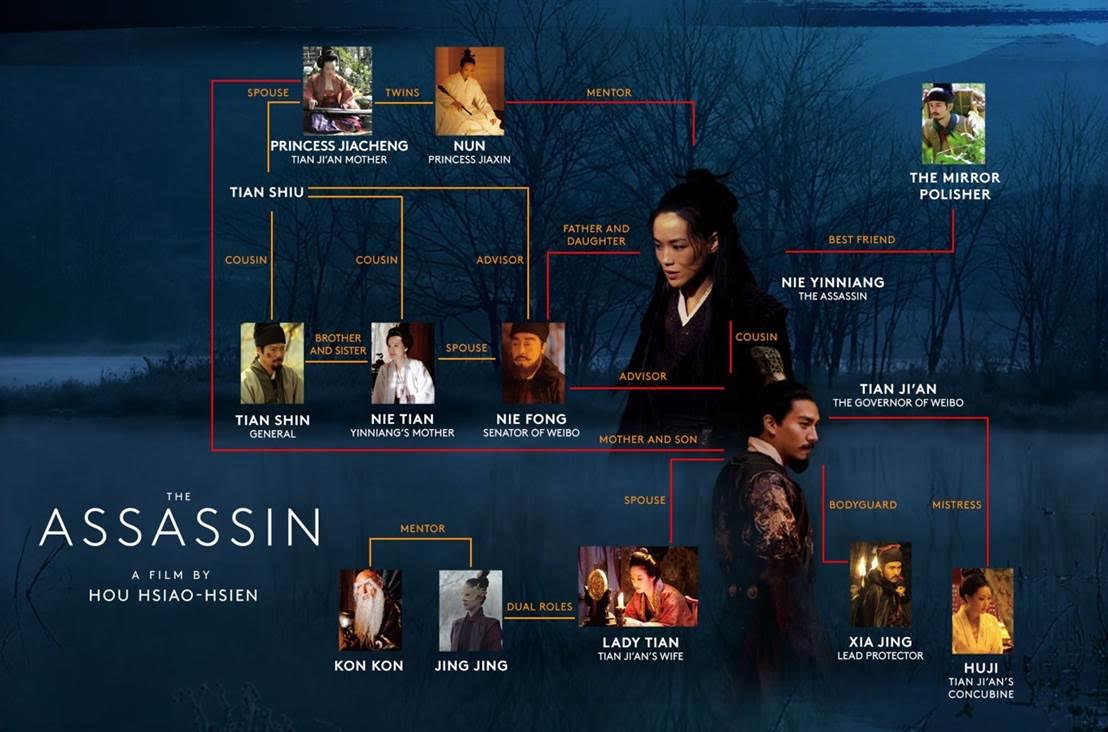
You still have to do some work to parse the relationships, but that work brings its own rewards, just like any close reading should. For instance, it’s let slip rather late in the film that Tian Ji’an isn’t Yinnniang’s cousin in an entirely straightforward way: he is the child of one of her father’s concubines, who is adopted by Yinniang’s mother and raised formally as the son and heir (presumably because Princess Jiacheng only produced a daughter: Yinniang). So this tiny scrap of information not only makes the central relationship of the film much more complex - the protagonists were raised as brother and sister and are in fact half-siblings – but it adds psychological shading to Tian Ji’an’s concern for his pregnant concubine, since she’s essentially in the (very vulnerable) position of his own mother. It also links Yinniang's specific concern about the vulnerability of children (which guides her decisive actions more than once) to the legacy of her mother (which is another primary force guiding her actions throughout the film - again, not explicitly stated, but demonstrated over and over again by her actions).
There are two extras: the additional scene from the Japanese cut and a 20-or-so-minute making of that’s unsubbed, but has glimpses of shots and scenes that didn’t make it into the film. The Japanese scene is totally expendable but quite fascinating. It’s a scene of the very minor Mirror-Polisher character, set in the outpost to which Yinniang returns at the end of the film, but it crams his entire life into three minutes because, strikingly, he gets the privilege of a widescreen flashback, rather rapidly edited. Including these scenes in the film would certainly complicate the narrative (why is this character getting a flashback?), but in an evocative way, since it would create a mysterious link with Yinniang (which would in turn imply a much greater connection between them than the very tentative relationship we see in the film).
Narrative-wise, everything’s pretty much completely recoverable on an alert second watch (assuming you had an alert first watch). Typically for Hou, he eschews conventional exposition, but all the narrative information you need is there in some form, in some place. You need to be actively speculating about relationships and motivations throughout so that you can recognize significant information when it's thrown away in a later scene. For example, the first flashback scene, which is signalled by a shift to widescreen, is reasonably identifiable as a flashback, since we cut back to Academy Ratio Yinniang musing in her bath, but it's only much later in the film that she positively identifies the woman in the flashback as her mother, Princess Jiacheng, and explains the significance of the story of the bluebird. The second flashback is only really identified as such formally, by another shift to widescreen - so if you weren't paying attention to the aspect ratio earlier in the film, it might not register as a flashback at all. There's a third widescreen flashback, but only in the Japanese version / deleted scene.
Other important plot points, such as Tian Ji'an's wife's past and present political machinations (including the killing of a former advisor to her husband and the failed attempt to do so again) are all laid out before us, but they're laid out as inferences and actions (e.g. the method of killing links the two crimes), without being spelt out in expository dialogue.
You still have to do some work to parse the relationships, but that work brings its own rewards, just like any close reading should. For instance, it’s let slip rather late in the film that Tian Ji’an isn’t Yinnniang’s cousin in an entirely straightforward way: he is the child of one of her father’s concubines, who is adopted by Yinniang’s mother and raised formally as the son and heir (presumably because Princess Jiacheng only produced a daughter: Yinniang). So this tiny scrap of information not only makes the central relationship of the film much more complex - the protagonists were raised as brother and sister and are in fact half-siblings – but it adds psychological shading to Tian Ji’an’s concern for his pregnant concubine, since she’s essentially in the (very vulnerable) position of his own mother. It also links Yinniang's specific concern about the vulnerability of children (which guides her decisive actions more than once) to the legacy of her mother (which is another primary force guiding her actions throughout the film - again, not explicitly stated, but demonstrated over and over again by her actions).
-
Trees

- Joined: Sun Sep 27, 2015 8:04 pm
Re: The Assassin (Hou Hsiao-hsien, 2015)
I saw the film projected at a theater, and the side letterboxing of the 1.85 DCP was fairly washed out (not entirely black). Maybe a crummy projector, maybe intentional. I've seen the film many, many times, and I learn something new on each viewing. The plot is fairly complex and opaque, requiring a lot from the viewer. As zedz mentions, it can be very rewarding to invest effort in the film with multiple viewings.
-
tenia

- Ask Me About My Bassoon
- Joined: Wed Apr 29, 2009 3:13 pm
Re: The Assassin (Hou Hsiao-hsien, 2015)
In this month's Positif, there is a dossier dedicated to Hou Hsiao-hsien, including an interview with Mark Lee Ping Bing, The Assassin's DoP :
Q: How did you achieve the quality of these very dense blacks ?
A: HHH and myself both love deep dense blacks which allow some details to be more visible. It's more Chinese !
Q: Were they difficult to obtain ?
A: Yes. You need to prepare very precisely the image, choose the right opening of the iris, the lighting and the distance. This isn't a documentary where we arrive and shoot straight away. Most of the young DoPs which are trying to obtain this type of picture usually only get black with no detail at all.
Q : Wasn't it even more complicated because Shu Qi is often dressed in black ? Black on black...
A: Yes indeed, especially to get the details.
Q: How did you achieve the quality of these very dense blacks ?
A: HHH and myself both love deep dense blacks which allow some details to be more visible. It's more Chinese !
Q: Were they difficult to obtain ?
A: Yes. You need to prepare very precisely the image, choose the right opening of the iris, the lighting and the distance. This isn't a documentary where we arrive and shoot straight away. Most of the young DoPs which are trying to obtain this type of picture usually only get black with no detail at all.
Q : Wasn't it even more complicated because Shu Qi is often dressed in black ? Black on black...
A: Yes indeed, especially to get the details.
-
htom

- Joined: Sun Nov 07, 2004 5:57 pm
Re: The Assassin (Hou Hsiao-hsien, 2015)
In the original story "Nie Yinniang" the mirror polisher has no back story or purpose to speak of outside of becoming Yinniang's husband by her wish. So I guess that was a bit of an expansion of the character's role, which even in the standard cut is expanded by quite a lot.zedz wrote:There are two extras: the additional scene from the Japanese cut and a 20-or-so-minute making of that’s unsubbed, but has glimpses of shots and scenes that didn’t make it into the film. The Japanese scene is totally expendable but quite fascinating. It’s a scene of the very minor Mirror-Polisher character, set in the outpost to which Yinniang returns at the end of the film, but it crams his entire life into three minutes because, strikingly, he gets the privilege of a widescreen flashback, rather rapidly edited. Including these scenes in the film would certainly complicate the narrative (why is this character getting a flashback?), but in an evocative way, since it would create a mysterious link with Yinniang (which would in turn imply a much greater connection between them than the very tentative relationship we see in the film).
-
The Fanciful Norwegian

- Joined: Tue Nov 02, 2004 6:24 pm
- Location: Teegeeack
Re: The Assassin (Hou Hsiao-hsien, 2015)
Apropos of Trees' observation about learning something new with every story, I noticed something in my most recent (third) viewing that seems to allude to the mirror polisher's backstory: the destination they're heading to at the end of the film (rendered in the English subtitles as "Xinro," a made-up name) appears to be Silla, a kingdom on the Korean peninsula. I haven't yet received my copy of the Taiwanese Blu so I don't know how this might square with the deleted flashback, but my inference is that the mirror polisher came from Silla and is returning there (accompanied by Yinniang) at the end of the film. Making the character a foreigner would also be a handy way of dealing with Tsumabuki's non-Chineseness, though his role in the film is so minor that I don't think a viewer would even guess he isn't Chinese/Taiwanese unless they already knew who he was. Does the deleted flashback scene have anything relevant to this assumption?
-
EddieLarkin

- Joined: Sat Sep 08, 2012 2:25 pm
Re: The Assassin (Hou Hsiao-hsien, 2015)
I haven't watched it yet but I just checked out my Well Go disc and it is definitely suffering from incorrectly presented blacks. Blu-ray.com's reviewer describes them as "appealingly deep and convincing" which is utterly ridiculous. A change to PC Levels solves all, as usual.tenia wrote:In this month's Positif, there is a dossier dedicated to Hou Hsiao-hsien, including an interview with Mark Lee Ping Bing, The Assassin's DoP :
Q: How did you achieve the quality of these very dense blacks ?
A: HHH and myself both love deep dense blacks which allow some details to be more visible. It's more Chinese !
Q: Were they difficult to obtain ?
A: Yes. You need to prepare very precisely the image, choose the right opening of the iris, the lighting and the distance. This isn't a documentary where we arrive and shoot straight away. Most of the young DoPs which are trying to obtain this type of picture usually only get black with no detail at all.
Q : Wasn't it even more complicated because Shu Qi is often dressed in black ? Black on black...
A: Yes indeed, especially to get the details.
-
zedz
- Joined: Sun Nov 07, 2004 11:24 pm
Re: The Assassin (Hou Hsiao-hsien, 2015)
I'd say so: the flashback is almost like the trailer for an entire film about the Mirror-Polisher, including details of his culture (a dance which isn't anything like the dance we see in the main film and which I assume is culturally specific).The Fanciful Norwegian wrote:Apropos of Trees' observation about learning something new with every story, I noticed something in my most recent (third) viewing that seems to allude to the mirror polisher's backstory: the destination they're heading to at the end of the film (rendered in the English subtitles as "Xinro," a made-up name) appears to be Silla, a kingdom on the Korean peninsula. I haven't yet received my copy of the Taiwanese Blu so I don't know how this might square with the deleted flashback, but my inference is that the mirror polisher came from Silla and is returning there (accompanied by Yinniang) at the end of the film. Making the character a foreigner would also be a handy way of dealing with Tsumabuki's non-Chineseness, though his role in the film is so minor that I don't think a viewer would even guess he isn't Chinese/Taiwanese unless they already knew who he was. Does the deleted flashback scene have anything relevant to this assumption?
-
htom
- Joined: Sun Nov 07, 2004 5:57 pm
Re: The Assassin (Hou Hsiao-hsien, 2015)
I'd assumed that the mirror polisher and Yinniang were acting as escorts/bodyguards for a client, as an indication of the way she chooses to live her life from now on. Then again, I've only watched the film once.The Fanciful Norwegian wrote:I haven't yet received my copy of the Taiwanese Blu so I don't know how this might square with the deleted flashback, but my inference is that the mirror polisher came from Silla and is returning there (accompanied by Yinniang) at the end of the film. Making the character a foreigner would also be a handy way of dealing with Tsumabuki's non-Chineseness, though his role in the film is so minor that I don't think a viewer would even guess he isn't Chinese/Taiwanese unless they already knew who he was. Does the deleted flashback scene have anything relevant to this assumption?
-
lacritfan

- Life is one big kevyip
- Joined: Wed Dec 05, 2007 10:39 pm
- Location: Los Angeles
-
Trees
- Joined: Sun Sep 27, 2015 8:04 pm
Re: The Assassin (Hou Hsiao-hsien, 2015)
Lord Tian also calls Nie Fong "Uncle".
I assume Princess Jiacheng is also Yinniang's aunt (by marriage)? Which would also make the Nun who instructs her Yinniang's aunt? If so, wouldn't the Nun be ordering Yinniang to kill her own Nephew, Lord Tian? (at least by marriage?)
I assume Princess Jiacheng is also Yinniang's aunt (by marriage)? Which would also make the Nun who instructs her Yinniang's aunt? If so, wouldn't the Nun be ordering Yinniang to kill her own Nephew, Lord Tian? (at least by marriage?)
-
Ribs

- Joined: Fri Jun 13, 2014 5:14 pm
Re: The Assassin (Hou Hsiao-hsien, 2015)
I hate to bring this thread back in fear of being crushed by someone else's genuine and unbridled enthusiasm, but this is now on Netflix US if for whatever reason anybody was still holding out on seeing this.
-
Kokomo Blues

- Joined: Tue Nov 22, 2011 5:43 pm
Re: The Assassin (Hou Hsiao-hsien, 2015)
For as little actual "action" there was in this film why use a freakin wire?
I found it extremely dull - except - the music at the final credits was amazing!
Great bagpipes by Bagad Men Ha Tan
https://www.youtube.com/watch?v=UyLo0nBpzBc" onclick="window.open(this.href);return false;
I found it extremely dull - except - the music at the final credits was amazing!
Great bagpipes by Bagad Men Ha Tan
https://www.youtube.com/watch?v=UyLo0nBpzBc" onclick="window.open(this.href);return false;
-
Luke M

- Joined: Fri Jul 13, 2007 1:21 am
Re: The Assassin (Hou Hsiao-hsien, 2015)
Amazing how much that description could fit Ex Machina.swo17 wrote:For most of that review I thought he was talking about Ex Machina.
-
knives

- Joined: Sat Sep 06, 2008 10:49 pm
Re: The Assassin (Hou Hsiao-hsien, 2015)
Unsurprisingly I didn't like this, though despite the strong language to follow I didn't hate it either. I just found it to be forgettable in its ineffectiveness. More than anything else, to illustrate a point, I wish Hou could decide what type of action movie he was making. For the longest time it seems like he's going for a minimalist sort of punishing the viewer thing with the choreography hidden by tree and a long away camera, but then he'll randomly pop in a traditionally done scene that is playing up the extra coolness of the characters. The whole film has this sloppy aesthetic inconsistency, but the action sequences are the most obvious example of that. What makes this even more frustrating is that beneath the stylistic inconsistencies and randomness the film does work and has moments which are the best I've seen from Hou such as the assassin feeding the man water after the rescue. It's moments like this which really help make this at least an okay film and certainly the best Hou I've seen after the first segment of Three Times. Unfortunately the film is also really ugly at times. The lighting is indistinguishable from an Andreas Schnaas film whenever Hou goes to exteriors with the often stiff camera work only highlighting the awkwardness. By itself it would be bad, but Hou handles himself well with interiors showing a great use of lighting and some very well considered camera work and editing. This leaves the film the jarring sense that it was made by two entirely different crews like a Godfrey Ho hatchet job. I'm mildy mad that a film can do so many things right, the dance near the end is great in a way that ZHANG Yimou would be jealous of, and suggest such a good movie and yet have so many moments so disastrously awful that it can't help but give me schlock tourettes.
Last edited by knives on Wed Aug 10, 2016 6:18 pm, edited 1 time in total.
-
Michael Kerpan

- Spelling Bee Champeen
- Joined: Wed Nov 03, 2004 5:20 pm
- Location: New England
- Contact:
Re: The Assassin (Hou Hsiao-hsien, 2015)
Yimou? Really.... (first name basis, lucky you).
Disagree with pretty much else as well -- but "de gustibus..."
Disagree with pretty much else as well -- but "de gustibus..."
-
knives
- Joined: Sat Sep 06, 2008 10:49 pm
Re: The Assassin (Hou Hsiao-hsien, 2015)
Sorry on that. My mind accidentally placed that as his last name.
-
jsteffe

- Joined: Sat Mar 31, 2007 1:00 pm
- Location: Atlanta, GA
Re: The Assassin (Hou Hsiao-hsien, 2015)
I finally looked at the Well Go Blu-ray, and the black levels are indeed as weak as everyone has said. I *never* do this normally, but I reduced the gamma a couple points on my television, and it made a huge difference - now it actually looks like a well-photographed film.
I think part of the challenge for this transfer is that Hou and his cinematographer appear to systematically manipulate the color and contrast range to achieve a particular look. It's very distinctive, but I find it hard to believe that the extreme milkiness of the blacks on the Blu-ray was something that they wanted, because makes the film almost unwatchable. It must be a technical problem.
I think part of the challenge for this transfer is that Hou and his cinematographer appear to systematically manipulate the color and contrast range to achieve a particular look. It's very distinctive, but I find it hard to believe that the extreme milkiness of the blacks on the Blu-ray was something that they wanted, because makes the film almost unwatchable. It must be a technical problem.
-
chetienne
- Joined: Sat Jan 30, 2016 8:49 pm
Re: The Assassin (Hou Hsiao-hsien, 2015)
It's not simply the blu-ray. The DCP of this film was quite poor as well. It didn't retain nearly the detail that a 35mm print would have in the highlights (noticeable particularly in Knives's reviled exteriors) and the colors often looked flat and garish. Moreover, there are problems here and there with what looked to me like sloppily executed digital reframing (e.g. the flashback, a few of the landscape shots, moments in the fight sequences), a lot of ugly digital noise popping up. Speaking as someone who admires the movie a great deal, I must admit that each time I saw it (four times in theaters, a couple times at home) I felt I had to imagine what the film would have looked like if it had been given a film out, or at the very least a higher quality post job. It's not just me though! Mark Lee Ping-bin noted Hou's dissatisfaction with the color correction process when he visited MoMA in May, and Hou himself complained about the DCP in interviews around the film's US release.