BD 245-246 Straight Shooting & Hell Bent: Two Films by John Ford

Discuss releases by Eureka and Masters of Cinema and the films on them
Post Reply
Message
Author
User avatar
Finch
Joined: Mon Jul 07, 2008 9:09 pm
Location: United States

BD 245-246 Straight Shooting & Hell Bent: Two Films by John Ford

#1 Post by Finch »

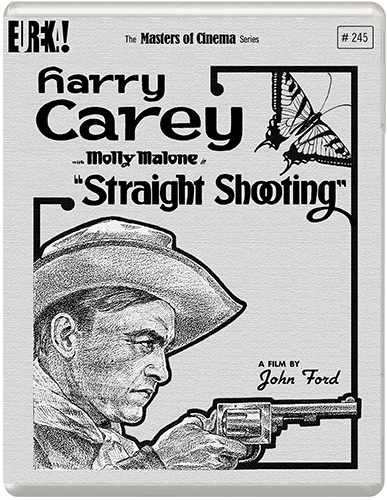
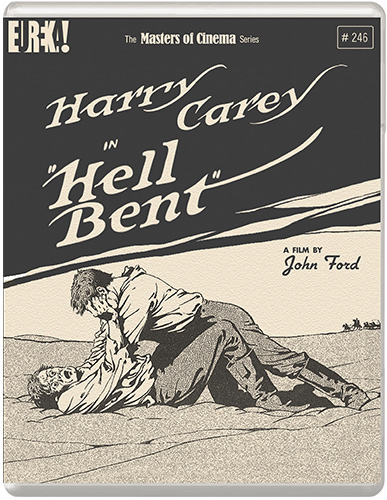
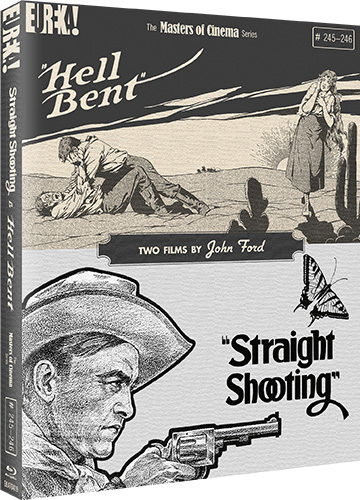
Straight Shooting & Hell Bent: Two Films by John Ford (Blu-ray)

ImageImage
Image

SYNOPSIS

The Masters of Cinema Series is proud to present two early features from John Ford (credited on both films as Jack Ford) in their UK debuts on home video, fully restored in 4K.

Straight Shooting is a landmark in the history of the Western. The first feature directed by Ford, it revived the career of Harry Carey who gives a rough and tumble performance here as a hired gun who turns on his employers to defend an innocent farmer and his family.

In Hell Bent, ‘Cheyenne Harry’ (Harry Carey playing the same character from Straight Shooting) flees the law after a poker game shootout, and arrives in the town of Rawhide, where he becomes friendly with local cowboy Cimarron Bill (Duke Lee) and dance hall girl Bess Thurston (Neva Gerber). When gang leader Beau Ross (Jospeh Harris) kidnaps Bess, Harry goes to desperate lengths travelling across the deadly desert in order to free Bess from the hard-bitten Ross.
SPECIAL FEATURES

Limited Edition O-Card slipcase and reversible sleeve artwork [2000 copies]
Both features presented in 1080p on Blu-ray from 4K restorations undertaken by Universal Pictures, available for the first time ever on home video in the UK
Straight Shooting – Score by Michael Gatt
Hell Bent – Score by Zachary Marsh
Straight Shooting – Audio commentary by film historian Joseph McBride, author of Searching for John Ford: A Life
Hell Bent – Audio commentary by film historian Joseph McBride
Brand new interview with film critic and author Kim Newman
Bull Scores a Touchdown – Video essay by Tag Gallagher
A Horse or a Mary? – Video essay by Tag Gallagher
Archival audio interview from 1970 with John Ford by Joseph McBride
A short fragment of the lost film Hitchin’ Posts (dir. John Ford, 1920) preserved by the Library of Congress
A collector’s booklet featuring writing by Richard Combs, Phil Hoad, and Tag Gallagher
User avatar
L.A.
Joined: Thu May 28, 2009 11:33 am
Location: Helsinki, Finland

Re: BD 245-246 Straight Shooting & Hell Bent: Two Films by John Ford

#2 Post by L.A. »

On Facebook they mention this:
STRAIGHT SHOOTING: the Czech version - inclusion TBC
Hopefully they can get this. Should be easier to acquire than the Champion Festival version of Mothra from Toho? 🤔
User avatar
The Fanciful Norwegian
Joined: Tue Nov 02, 2004 6:24 pm
Location: Teegeeack

Re: BD 245-246 Straight Shooting & Hell Bent: Two Films by John Ford

#3 Post by The Fanciful Norwegian »

Argh, and I just bought Straight Shooting at the last Kino Lorber sale. At least I passed on their Hell Bent since it wasn't part of the sale.

Very curious to see the Czech version if that's possible. My understanding (correct me if I'm wrong) is that it's the sole surviving print and was the basis for the restoration, so if it is included, would it be an unrestored version with Czech titles and perhaps sans tinting?
User avatar
movielocke
Joined: Fri Jan 18, 2008 4:44 am

Re: BD 245-246 Straight Shooting & Hell Bent: Two Films by John Ford

#4 Post by movielocke »

The kino releases are superb and this is better in combining them in one release, the commentaries are very good,slightly repetitive of each other.

Interesting that I listened to the interview with Ford around the same time I listened to the interview with king and McLean on the gunfighter, all done at about the same era. It’s amazing how the leading questions of McBride (talk about this film/person specifically, comment on this other persons comment) yielded non responses, but the open questions of the AFI “who were you working with on pictures back then” “what was the process” lead to fruitful informative elaborate reminiscences.
User avatar
L.A.
Joined: Thu May 28, 2009 11:33 am
Location: Helsinki, Finland

Re: BD 245-246 Straight Shooting & Hell Bent: Two Films by John Ford

#5 Post by L.A. »

User avatar
Maltic
Joined: Sat Oct 10, 2020 5:36 am

Re: BD 245-246 Straight Shooting & Hell Bent: Two Films by John Ford

#6 Post by Maltic »

A probable contender for package of the year.
movielocke wrote: Thu Jan 28, 2021 11:04 pm The kino releases are superb and this is better in combining them in one release, the commentaries are very good,slightly repetitive of each other.

Interesting that I listened to the interview with Ford around the same time I listened to the interview with king and McLean on the gunfighter, all done at about the same era. It’s amazing how the leading questions of McBride (talk about this film/person specifically, comment on this other persons comment) yielded non responses, but the open questions of the AFI “who were you working with on pictures back then” “what was the process” lead to fruitful informative elaborate reminiscences.
I count 11 McBride commentaries on various Ford DVD and BD releases.

Straight Shooting (1917)
Hell Bent (1918)
3 Bad Men (1926)
Pilgrimage (1933)
The Hurricane (1937)
Young Mr. Lincoln (1939)
The Grapes of Wrath (1940)
How Green Was My Valley (1941)
My Darling Clementine (1946)
The Quiet Man (1952)
Cheyenne Autumn (1964)

Must be a record. He's one of the best around, too, although he has a propensity for armchair psychologizing and is perhaps more of a raconteur than a reliable historian.
User avatar
Drucker
Your Future our Drucker
Joined: Wed May 18, 2011 1:37 pm

Re: BD 245-246 Straight Shooting & Hell Bent: Two Films by John Ford

#7 Post by Drucker »

I love his Orson Welles books and have seen him speak at Film Forum but he's absolutely the way Welles depicts him in The Other Side Of the Wind.
User avatar
Fred Holywell
Joined: Fri Jun 11, 2010 3:45 am

Re: BD 245-246 Straight Shooting & Hell Bent: Two Films by John Ford

#8 Post by Fred Holywell »

Always appreciate having McBride's commentaries on the Ford films. I seem to remember reading when the WB John Ford Film Collection (The Lost Patrol, The Informer, Mary of Scotland, Sergeant Rutledge, Cheyenne Autumn) came out, that he'd hoped to record commentaries for some of the other titles in the set, but only managed to do the one for Cheyenne Autumn.
User avatar
Drucker
Your Future our Drucker
Joined: Wed May 18, 2011 1:37 pm

Re: BD 245-246 Straight Shooting & Hell Bent: Two Films by John Ford

#9 Post by Drucker »

This is an enjoyable package. I particularly liked Straight Shooting but more than that, it's really fun to visit these films after I've digested so much of the rest of Ford's oeuvre. There's a comment somewhere in the booklet that Ford set out to make a different kind of Western here, more of a 'character study than a shoot-em-up' and I know it's probably obvious but I feel like next time I revisit his films it'll be something I think about. The one thing missing in these films to a degree is a real sense of community that makes Ford's sound features so wonderful. Here, Harey Carey is front and center and it's hard to keep straight the rest of the cast. The films also clearly owe a bit to Griffith at this point, but there are some lovely signs of what would come from Ford.

Regarding the McBride audio interview, I have to say it's not that great. It's fun hearing Ford be crotchety, I suppose, but as he admits in the intro, you're really encountering McBride learn to interview in real time.
User avatar
domino harvey
Dot Com Dom
Joined: Wed Jan 11, 2006 6:42 pm

Re: BD 245-246 Straight Shooting & Hell Bent: Two Films by John Ford

#10 Post by domino harvey »

Drucker wrote: Sun Apr 25, 2021 4:38 pm The films also clearly owe a bit to Griffith at this point, but there are some lovely signs of what would come from Ford.
Worked through the package and this was def my takeaway from Straight Shooting especially— it seems very silly for the extras to talk about this film in terms of Ford and not the obvious Griffith imitation. I did think Hell Bent was much more “Fordian” but at what cost, because it’s the lesser picture of the two (it’s a comedy even)!

Copious set of extras and great package for these minor works, though!
pistolwink
Joined: Thu Dec 12, 2013 7:07 am

Re: BD 245-246 Straight Shooting & Hell Bent: Two Films by John Ford

#11 Post by pistolwink »

Tag Gallagher's video essays on these films are really cringeworthy to me, since he repeatedly does that thing were he takes an absolutely typical visual strategy of the 1910s (or any other decade), like putting stuff in the foreground to give a scene a greater sense of depth, and attributes it to the genius of Ford. I would never accuse Gallagher of being ignorant of classical Hollywood cinema in general, but this is a very undergrad sort of mistake. And it's too bad, because Ford was a genius, and Straight Shooting at least seems to me almost a masterpiece—but picking out some conventional (if very well-executed) staging tricks as the reason why is not doing anybody any favors. (I recognize Gallagher is a favorite around here, and I like some stuff in his books, but many of his video essays seem impossibly pretentious to me. Pretentious in the sense of pretending to an erudition and insight they don't possess. They frequently remind me of this classic.)
User avatar
hearthesilence
Joined: Fri Mar 04, 2005 8:22 am
Location: NYC

Re: BD 245-246 Straight Shooting & Hell Bent: Two Films by John Ford

#12 Post by hearthesilence »

Finally caught up with Straight Shooting at MoMA and it’s astounding that it barely survived because it is revelatory. It really makes one wonder how much we no longer know about Ford’s development as a filmmaker when the overwhelming majority of his earliest films (as in dozens of them) are possibly lost forever.

David Bordwell and Kristin Thompson have also written at least a few posts on it, which I’ll need to revisit, but Ford does a pretty spectacular job filming horses. I have no idea how or where he learned to do that - obviously Griffith is a likely inspiration but with something this specific, it could be many things. Two things I noticed: most movement, especially group movements, travel along the y or z axis and rarely the x axis. The y axis blocking is often much more effective, especially when the horses must navigate around things like a pinball racing down a machine, but even in z axis movements, vertical elements like trees and especially sloping rocks and cliffs are all the more striking as framing elements, lending a feeling of tension, claustrophobia or isolation depending on the situation. Also contrasts in composition like a sole unmoving figure against many galloping from the horizon are all the more effective when pitted directly against each other, by now a basic concept that Ford clearly understands and knows how to exploit easily.

The elements that serve as a precursor to The Searchers have been mentioned and there are other elements that Ford would continue to revisit and refine in his later films (some still effective here and others much less so due their crude staging). Logically it’s possible these things are executed with more grace and poetry later on because Ford had to find different ways to convey the same idea when he wanted to revisit them - repeating himself without really repeating so to speak.

Beyond that, I thought it was great how the set is built outside so that they can film someone coming through the doorway without needing to adjust the aperture - the inside is clearly exposed to the outside (and therefore lit by the sun) and the giveaway is a slight breeze visible on certain objects. Houses like these would have open windows though, so a breeze wouldn’t appear strange at all.

There’s also a fun moment where someone falls off his horse while crossing a stream and it adds tension since he’s racing to get to someone - it’s likely a genuine accident because the giveaway is that it looks like they are smiling just before the cut once they reach the foreground.

Also there’s an interesting cut after we see a medium close up of Cheyenne deciding he’s not going after the settlers. It goes to a title card quoting a henchman about his decision. Then it cuts to a close up reaction shot of the boss, so we never see the henchman. In the sound era, this would likely be a voiceover of the henchman over the Cheyenne close up followed by a close up of the boss. It may have been a commonplace idea in terms of cutting between scenes at this point, but it’s interesting to see, especially in the way directors may think of title cards and how to edit with them when using them.
Post Reply