I meant a sample from the big names was included previously, not a list of every vote. So sounds like it’s a similar format in this issue?MichaelB wrote: Fri Dec 02, 2022 4:20 pmNope, a selection in both cases. I've just looked up the September 2012 edition, and they picked a sample of 100 out of 846, unsurprisingly biased towards the bigger-name contributors.Graham wrote: Fri Dec 02, 2022 1:48 pmThe individual lists aren't in the same issue? That's really irritating as I've ordered this edition of Sight & Sound mainly for that reason. I'm sure the last two lists, in 2002 and 2012, included those in the same issue.yoloswegmaster wrote: Thu Dec 01, 2022 11:09 pm Apparently the individual lists (which are infinitely more interesting than the combined lists) is going to be released next month.
The 2012 poll has double that number of contributors, so it simply wouldn't have been practical to reproduce them in print. The issue I have in front of me averages fifteen lists per page, in text that I imagine is as small as they can comfortably go, so with 1,600-plus lists this time round they'd need another hundred pages just for the text alone, never mind accompanying stills etc.
But all lists were published online back then, and this is going to happen this year too.
Sight & Sound
-
Graham

- Joined: Sat Mar 12, 2011 6:50 pm
Re: Sight & Sound
-
MV88

- Joined: Mon Jan 24, 2022 12:52 pm
Re: Sight & Sound
I just want to add regarding the topic of Jeanne Dielman and the list in general being "too inaccessible" that the results of this list represent the logical culmination of where film discourse and the cinephile community have been heading in relation to the so-called "average moviegoer," which can be approached either way, really. From one perspective -- and I'm sure there are already plenty of angry gut reactions to the list like this already out there -- this list is proof positive that critics are hopelessly out of touch with the average moviegoer. But from the other perspective, couldn't it just as easily be suggested that it's actually evidence of how cinema itself has become more of a niche interest in recent years, and this list is simply embracing that fact? For crying out loud, there are people who use the term "cult film" to refer to quite literally anything that isn't a mega-budget franchise blockbuster. Sometimes I do think we need to take a step back and realize that most of the population still views movies strictly as popular entertainment, not as an art form comparable to what one would visit a museum to see. Since that perception has only increased in recent years with the fandom-ification of the popular movie landscape, it was inevitable that cinema-as-art would eventually be relegated to a niche area of interest more akin to classical music or painting than to the culture of fandom that dominates Hollywood production now, and one could interpret this list as a mere confirmation of that.
Maybe it's time that not only do cinephiles accept that we are a pretty small niche in the grand scheme of things, but frankly, that the so-called "average moviegoer" accepts that when sources like Sight & Sound are discussing film, they're discussing a subject that they are not interested in to begin with. To use my earlier example of a theoretical list of greatest painters, that's not even a list that would garner much attention because painting isn't regarded as a form of popular entertainment in the way that movies are. Nobody would insinuate that such a list should make an effort to appeal to "casual" fans of painting, would they? That's an attitude that is more specific to movies and to a lesser extent music, although even that is more accepted as an umbrella term for a bunch of insular interests within it rather than one monolithic subject at this point. Cinema has reached the point where it really shouldn't be thought of as one all-inclusive area of interest, yet it still is in most circles. I don't fully agree with Scorsese's assertion that Marvel movies (for example) are closer to theme park rides than they are to cinema, but I would be perfectly willing to accept an adjustment of that comment that stated those movies generally appeal more to the sort of people who would rather visit an amusement park than a museum. There's nothing wrong with either preference, it's just that it's become quite apparent that there's really only a relatively small number of people who are interested in cinema as an art form rather than just as popular entertainment, and it's okay to admit that the Sight & Sound poll is really only intended to be relevant to that niche. It's only the continued perception of cinema as one all-inclusive thing rather than as an umbrella term for a set of different and sometimes even opposing interests within it that leads to the sort of bafflement and outrage that a lot of people are expressing about how "obscure" most of the choices are. It's not the job of a museum curator to build a collection based on what will appeal to the average person who has no interest in art, and it shouldn't be the job of cinephiles to make sure their discussion is accessible to the average person who is openly opposed to even watching a film in another language. And while I do think it would elitist for a cinephile to act like the average moviegoer is in any way inferior because of their preferences, I also think it would be ridiculous for the average moviegoer to suggest that cinephiles should make an active effort to ensure that all their discussions are accessible to them.
Maybe it's time that not only do cinephiles accept that we are a pretty small niche in the grand scheme of things, but frankly, that the so-called "average moviegoer" accepts that when sources like Sight & Sound are discussing film, they're discussing a subject that they are not interested in to begin with. To use my earlier example of a theoretical list of greatest painters, that's not even a list that would garner much attention because painting isn't regarded as a form of popular entertainment in the way that movies are. Nobody would insinuate that such a list should make an effort to appeal to "casual" fans of painting, would they? That's an attitude that is more specific to movies and to a lesser extent music, although even that is more accepted as an umbrella term for a bunch of insular interests within it rather than one monolithic subject at this point. Cinema has reached the point where it really shouldn't be thought of as one all-inclusive area of interest, yet it still is in most circles. I don't fully agree with Scorsese's assertion that Marvel movies (for example) are closer to theme park rides than they are to cinema, but I would be perfectly willing to accept an adjustment of that comment that stated those movies generally appeal more to the sort of people who would rather visit an amusement park than a museum. There's nothing wrong with either preference, it's just that it's become quite apparent that there's really only a relatively small number of people who are interested in cinema as an art form rather than just as popular entertainment, and it's okay to admit that the Sight & Sound poll is really only intended to be relevant to that niche. It's only the continued perception of cinema as one all-inclusive thing rather than as an umbrella term for a set of different and sometimes even opposing interests within it that leads to the sort of bafflement and outrage that a lot of people are expressing about how "obscure" most of the choices are. It's not the job of a museum curator to build a collection based on what will appeal to the average person who has no interest in art, and it shouldn't be the job of cinephiles to make sure their discussion is accessible to the average person who is openly opposed to even watching a film in another language. And while I do think it would elitist for a cinephile to act like the average moviegoer is in any way inferior because of their preferences, I also think it would be ridiculous for the average moviegoer to suggest that cinephiles should make an active effort to ensure that all their discussions are accessible to them.
-
pistolwink
- Joined: Thu Dec 12, 2013 7:07 am
Re: Sight & Sound
ha, I don't think Carpenter's favorites have changed in 40 years, God bless 'em.
-
rde
- Joined: Fri Dec 02, 2022 3:45 am
Re: Sight & Sound
Was it Martyrs?domino harvey wrote: Fri Dec 02, 2022 6:01 pm I think it might be important to note that I gave the film a lot of latitude until the ending, which completely betrayed all my good will. I had a similar reaction to a much more recent, very long two part film that similarly resorted to extreme provocateur melodramatics at the finish line (though that movie certainly had a steadier clip of absurdities on the road to the finish). I don’t think what came before merits where it goes. I don’t hate the film, I get what it’s doing and where its aims are. I think all the accusations leveled at me for what is admittedly a pretty typically colorful (read: dickish) response from me to the placement on the list miss the possibility that I am perfectly capable of understanding this film’s appeal for others and its intents but still not buying it and still unhappy by the shift of weight it now carries (and much of this is my own fault for not extrapolating further in this thread, though I already touched on this in its dedicated thread)
If you're talking about Jeanne Dielman, well, it definitely plays to a 'it makes my job easier' bias among critics. It's an easy film to write about, to say anything about with impunity, and not be 'wrong', while also seeming deep. Even among people who genuinely like it, there's a lot of after-the-fact thinking-based appreciation, which swamps accounts of in-the-cinema enjoyment.
I'd call it a weak version of the 'Last Year at Marienbad effect': it's a film to be written about, more than seen. Except Dielman is a good movie.
-
pistolwink
- Joined: Thu Dec 12, 2013 7:07 am
Re: Sight & Sound
That's not everyone's experience ("better written about than seen") with Jeanne Dielman by any means.
Our thoughts, privately felt and publicly expressed, about all films are the result of a process of sifting through, reshaping, organizing, and forgetting the moments we spent watching them — often in light of what other people have to say about them.
I tend to admire films that feel more like irreducible sensuous experiences than films that make some formal or other "point," but the films I put in the former category (like Godard's '80s work) other folks might put in the latter and vice-versa.
Our thoughts, privately felt and publicly expressed, about all films are the result of a process of sifting through, reshaping, organizing, and forgetting the moments we spent watching them — often in light of what other people have to say about them.
I tend to admire films that feel more like irreducible sensuous experiences than films that make some formal or other "point," but the films I put in the former category (like Godard's '80s work) other folks might put in the latter and vice-versa.
-
Eric
- Joined: Wed Nov 03, 2004 7:09 pm
- Location: Minneapolis
-
Maltic

- Joined: Sat Oct 10, 2020 5:36 am
Re: Sight & Sound
On the other hand, people might've been surprised in 2012 if you told them the 2022 list would have two recent Best Picture winners and one nominee.MV88 wrote: Fri Dec 02, 2022 6:12 pm I just want to add regarding the topic of Jeanne Dielman and the list in general being "too inaccessible" that the results of this list represent the logical culmination of where film discourse and the cinephile community have been heading in relation to the so-called "average moviegoer," which can be approached either way, really. From one perspective -- and I'm sure there are already plenty of angry gut reactions to the list like this already out there -- this list is proof positive that critics are hopelessly out of touch with the average moviegoer. But from the other perspective, couldn't it just as easily be suggested that it's actually evidence of how cinema itself has become more of a niche interest in recent years, and this list is simply embracing that fact?
Also, if you look at the studio era picks and the 2012>2022 changes, it would seem that in 2022 there's been a higher concentration of voters who may not have a very good grasp of classical Hollywood. Ambersons, Touch of Evil, Rio Bravo, Sunrise, The Searchers descended or were knocked off the top 100. The Wilder films, The Third Man, Casablanca, Singing in the Rain, Night of the Hunter ascended. I'm not saying one group or the other is "better", but I would argue the latter films have the more "old movies for those who don't like old movies" appeal. Though, granted, we don't have much to go on, statistically speaking.

-
hearthesilence

- Joined: Fri Mar 04, 2005 8:22 am
- Location: NYC
Re: Sight & Sound
Honestly, when you tally up all the "egregious" omissions, you'd probably get more than 100 films. I don't mean to sound flip, but at this point a list of the 100 best isn't that long.
Last edited by hearthesilence on Fri Dec 02, 2022 6:53 pm, edited 1 time in total.
-
domino harvey

- Dot Com Dom
- Joined: Wed Jan 11, 2006 6:42 pm
Re: Sight & Sound
To steal from Godard, if the best form of film criticism is another film, then I'd offer Franju's Thérèse Desqueyroux as a superior example of many of the same aims of Akerman's movie in the wind-up, only it does so much more with these component parts and hits at such a deeply felt look at depression and external/systemic oppressions (and Red Screamer, I know we can at least break bread over this film). There is no English-friendly commercial release of it (I think every film in the top 100 has an English-friendly commercial release, right?), though, so maybe in another 10 years it will find an audience after boutique labels run out of Jess Franco films (hmm, actually might take 20 years for that well to dry). Hell, if I'd been given a ballot, I might have even voted for it
-
Altair
- Joined: Wed Aug 14, 2013 4:56 pm
- Location: England
Re: Sight & Sound
I enjoy Mulvey and thinking about how representation (i.e. the prsentation of a subject in visual arts) has political ramifications and shapes, or contributes, to ideological structures through which we understand and navigate the world around us. So while I'm guessing you didn't go in to the essay with a hermenutic of genrosity or curiosity, I'm glad that at least you attempted to grapple with the origins of an idea that you initially brought up and are puzzled by.rde wrote: Fri Dec 02, 2022 5:36 pm So, what's the essay mean to you? How has it deepened your appreciation of Portrait of a Lady on Fire, or Jeanne Dielmann, or, to go in the other direction, Hitchcock?
I think there are three levels here: the male gaze in cinema, the male gaze in contemporary Western society, and feminist and female responses to both of these phenomena.
Mulvey argues that classical Hollywood filmmaking is patriarchal*. This means that narrative films are fundamentally structured around men's pleasure. This is unsurprising when directors, writers, producers, and the whole support structure around filmmaking (the novels and plays films are based on) are overwhelmingly dominated by men. We're talking well over 90% here. Men are still the vast majority of filmmaking creatives in Hollywood. Mulvey identifies a particular facet of this male desire, what she calls 'the scopophilic desire'. Men make films they themselves enjoy and want to watch. Part of the pleasure they derive from cinema is the pleasure of looking at women, in other words, objectifying women into sexual objects. A sexual object, ideally, that can be dominated by the virile man. So Hollywood films show men as active (the protagonists, the heroes or anti-heroes), while women are supporting characters, have things done to them: men identify with the male protagonist and derive pleasure from the protagonist's sexual conquestion of a woman. The James Bond films would be a great example of this; Eva Marie Saint's character in North by Northwest, to give you a Hitchcock example, also operates here. We identify with Cary Grant and are glad that the film's 'climax' shows him winning her (Hitchcock even makes a famous joke with the final shot of the film, of the train rushing into the tunnel). While Mulvey emerges out of a psychoanalytical framework, the idea of the male gaze is most heplful thought about it in structural terms - why are men the hero? Why are women suppporting characters? Why do films service male desire? The male gaze offers an answer.
The male gaze operates everywhere in contemporary society - most obviously in advertising where beautiful women are used to sell all kinds of things (cars, phone plans, films themselves), or where objects promise men that they will be more sexually attracive and thus able to live out their fantasy of sexual conquest that cinema helps to model as the kind of desire they should have (cinema is not the only agent here do this).
I'd encourage you to ask your female friends about how they feel objectified in society - how does that shape the places they go? What clothes they wear? The way they interact with men in general? I would say that the vast majority of women I know have expressed, at one point or another, a frustration with the pressure of the male gaze on their bodies, which denies them their subjectivity - their individuality - and turns them into mere sexual objects. Women can't simply exit themselves from this system: for some, they benefit from it because they have, for now, the correct form which patriarchal society finds desirable. Some women resist by choosing their own form of objectification: by wearing a Playboy t-shirt for instance. For them, it's better to have agency in their own objectification then not. Other women attempt to circumnavigate this objectification by refusing to participate in men's sexual coding of women. Usually women move through all these strategies (no doubt there are more) depending on the circumstances.
So yes, certainly, Mulvey and related writing has deepened my appreciation of cinema and how it works: it shows how powerful moving images are, in telling us what to desire. And Hitchcock's cinema, especially Vertigo, are often extensive meditations on how the male gaze propels his characters and find themselves manipulated by women they think are passive but actually turn their own sexual desire against them.
*My arguments here are all centred on American and European cinema and society and shouldn't - can't be - extrapolated to other cultures and filmmaking traditions.
-
yoloswegmaster

- Joined: Tue Nov 01, 2016 7:57 pm
Re: Sight & Sound
Another ballot list from a director, this time it's Tsai Ming-Liang:
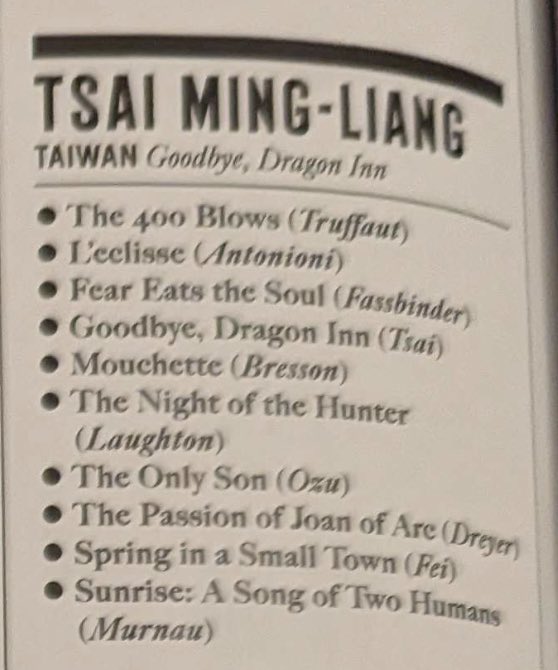 Apichatpong and NWR as well:


Spoiler
Spoiler
-
domino harvey
- Dot Com Dom
- Joined: Wed Jan 11, 2006 6:42 pm
Re: Sight & Sound
Does the order factor into the tabulation? Why do some contributors have 15 films?
-
rde
- Joined: Fri Dec 02, 2022 3:45 am
Re: Sight & Sound
I once ran into Richard Brody in New York, and complained to him about 'not getting' King Lear. (He had come up to Toronto a few months before to introduce the film. He's written that it's his favorite film. I got to go to that screening.)pistolwink wrote: Fri Dec 02, 2022 6:43 pm That's not everyone's experience ("better written about than seen") with Jeanne Dielman by any means.
Our thoughts, privately felt and publicly expressed, about all films are the result of a process of sifting through, reshaping, organizing, and forgetting the moments we spent watching them — often in light of what other people have to say about them.
I tend to admire films that feel more like irreducible sensuous experiences than films that make some formal or other "point," but the films I put in the former category (like Godard's '80s work) other folks might put in the latter and vice-versa.
He said to treat it like poetry and just let it flow. Which is the 'irreducible sensuous experience' approach. (And for Passion and Every Man for Himself? Absolutely agreed. The rest from the 80's? ...)
I personally find Dielman to be an experience in the same way. I think it's rhythmic and hypnotic like an abstract painting or, hell, knitting. I detest Marienbad but probably love Dielman, personally.
But you know what I mean? But there are people for whom that is the case. Domino was suggesting earlier that a lot of people could get as much out of Dielman from a plot summary or a formal analysis as from watching it. There's a lot of 'I was thinking about it after the fact and...' and less of 'while in the theater I felt...'
-
swo17

- Bloodthirsty Butcher
- Joined: Tue Apr 15, 2008 2:25 pm
- Location: SLC, UT
Re: Sight & Sound
Where's Paul Schrader's list?Eric wrote: Fri Dec 02, 2022 6:47 pm https://twitter.com/thejoshl/status/1598748988668317696
Now THAT'S consistency!
-
DarkImbecile

- Ask me about my visible cat breasts
- Joined: Mon Dec 09, 2013 10:24 pm
- Location: Albuquerque, NM
Re: Sight & Sound
My question is, given the much larger number of participants, why are there so many ties? Maybe there's a mathematical reason to expect it, but with 16,000+ selections, I was surprised that the first placement for which there wasn't a tie is 66th, and only one more outside the top 35.
-
beamish14
- Joined: Fri May 18, 2018 7:07 pm
Re: Sight & Sound
yoloswegmaster wrote: Fri Dec 02, 2022 6:56 pm Another ballot list from a director, this time it's Tsai Ming-Liang:
Apichatpong and NWR as well:Spoiler
Spoiler
Tsai Ming-Liang picking himself is a straight-up Jeanette Winterson move
The Brothers Quay and Fat City are excellent choices
-
swo17
- Bloodthirsty Butcher
- Joined: Tue Apr 15, 2008 2:25 pm
- Location: SLC, UT
Re: Sight & Sound
Could be wrong but I believe they only tabulate the top 10 films listed and the order within the top 10 doesn't matter.domino harvey wrote: Fri Dec 02, 2022 6:59 pm Does the order factor into the tabulation? Why do some contributors have 15 films?
This would also help explain all the ties, if every mention counts for one point as opposed to some number 1-10
-
yoloswegmaster
- Joined: Tue Nov 01, 2016 7:57 pm
Re: Sight & Sound
Speaking of Paul Schrader:
 At least we found one fan of Jordan Ruimy.
Spoiler
-
diamonds

- Joined: Sun Apr 24, 2016 6:35 pm


-
pistolwink
- Joined: Thu Dec 12, 2013 7:07 am
Re: Sight & Sound
We won't know until we see the ballots! It's possible that more people voted for more studio-era Hollywood films, and just split the votes.Maltic wrote: Fri Dec 02, 2022 6:48 pm Also, if you look at the studio era picks and the 2012>2022 changes, it would seem that in 2022 there's been a higher concentration of voters who may not have a very good grasp of classical Hollywood.
Not that it'll draw this conversation to a halt or should, but people read way too much into what's in the top 10 and 100 and etc. A lot of it is just the luck of the draw. For example, Passion of Joan and Singin' in the Rain flit in and out of the top 10. But there haven't been any sea changes in the reception of those films in many decades.
I was wondering how many ballots Fury Road would be in -- surely that's one of the few blockbusters of the past decade that film snobs can get behind? Apparently some directors agree.
-
rde
- Joined: Fri Dec 02, 2022 3:45 am
Re: Sight & Sound
Well, I appreciate that. You're more on the level than Mulvey.Altair wrote: Fri Dec 02, 2022 6:55 pmI enjoy Mulvey and thinking about how representation (i.e. the prsentation of a subject in visual arts) has political ramifications and shapes, or contributes, to ideological structures through which we understand and navigate the world around us. So while I'm guessing you didn't go in to the essay with a hermenutic of genrosity or curiosity, I'm glad that at least you attempted to grapple with the origins of an idea that you initially brought up and are puzzled by.rde wrote: Fri Dec 02, 2022 5:36 pm So, what's the essay mean to you? How has it deepened your appreciation of Portrait of a Lady on Fire, or Jeanne Dielmann, or, to go in the other direction, Hitchcock?
I think there are three levels here: the male gaze in cinema, the male gaze in contemporary Western society, and feminist and female responses to both of these phenomena.
Mulvey argues that classical Hollywood filmmaking is patriarchal*. This means that narrative films are fundamentally structured around men's pleasure. This is unsurprising when directors, writers, producers, and the whole support structure around filmmaking (the novels and plays films are based on) are overwhelmingly dominated by men. We're talking well over 90% here. Men are still the vast majority of filmmaking creatives in Hollywood. Mulvey identifies a particular facet of this male desire, what she calls 'the scopophilic desire'. Men make films they themselves enjoy and want to watch. Part of the pleasure they derive from cinema is the pleasure of looking at women, in other words, objectifying women into sexual objects. A sexual object, ideally, that can be dominated by the virile man. So Hollywood films show men as active (the protagonists, the heroes or anti-heroes), while women are supporting characters, have things done to them: men identify with the male protagonist and derive pleasure from the protagonist's sexual conquestion of a woman. The James Bond films would be a great example of this; Eva Marie Saint's character in North by Northwest, to give you a Hitchcock example, also operates here. We identify with Cary Grant and are glad that the film's 'climax' shows him winning her (Hitchcock even makes a famous joke with the final shot of the film, of the train rushing into the tunnel). While Mulvey emerges out of a psychoanalytical framework, the idea of the male gaze is most heplful thought about it in structural terms - why are men the hero? Why are women suppporting characters? Why do films service male desire? The male gaze offers an answer.
The male gaze operates everywhere in contemporary society - most obviously in advertising where beautiful women are used to sell all kinds of things (cars, phone plans, films themselves), or where objects promise men that they will be more sexually attracive and thus able to live out their fantasy of sexual conquest that cinema helps to model as the kind of desire they should have (cinema is not the only agent here do this).
I'd encourage you to ask your female friends about how they feel objectified in society - how does that shape the places they go? What clothes they wear? The way they interact with men in general? I would say that the vast majority of women I know have expressed, at one point or another, a frustration with the pressure of the male gaze on their bodies, which denies them their subjectivity - their individuality - and turns them into mere sexual objects. Women can't simply exit themselves from this system: for some, they benefit from it because they have, for now, the correct form which patriarchal society finds desirable. Some women resist by choosing their own form of objectification: by wearing a Playboy t-shirt for instance. For them, it's better to have agency in their own objectification then not. Other women attempt to circumnavigate this objectification by refusing to participate in men's sexual coding of women. Usually women move through all these strategies (no doubt there are more) depending on the circumstances.
So yes, certainly, Mulvey and related writing has deepened my appreciation of cinema and how it works: it shows how powerful moving images are, in telling us what to desire. And Hitchcock's cinema, especially Vertigo, are often extensive meditations on how the male gaze propels his characters and find themselves manipulated by women they think are passive but actually turn their own sexual desire against them.
*My arguments here are all centred on American and European cinema and society and shouldn't - can't be - extrapolated to other cultures and filmmaking traditions.
You're making a fair point about eroticism tipping over into objectification. Sure.
But we didn't need Lacan to know that. That's a commonplace point that has nothing to do with castration, or Lacan, or any of that. You know what I mean? It's a simple point wrapped up in a lot of bunk that nobody believes. Like, do you believe it? That when men look at women they see them as men sans-penis, and fear castration?
As far as I can tell, for this author, the only solution is to write men out of the picture. I find the whole thing is just so hostile to desire and normal human coupling, like how can a man look at a woman in a way that isn't concerning? Ask to see her CV? The author herself says that the essay is hostile to desire, and wants to deconstruct and destroy it. I'm not convinced she has anything to replace it with.
And I'm confused as to how it's supposed to influence my viewing of a film — am I supposed to hold myself in suspicion? I'm being serious. Like, what does it add?
Instead of seeing Jimmy Stewart as a representative of men writ large, and Kim Novac as women writ large, why not regard them both as very broken individuals? Jimmy Stewart is a sweaty, cornered mess in that film, and he's trying to recapture a part of his past, and has to hold another person hostage to do so. He knows it's impossible and we know it's impossible but he persists anyway, and there's something tragic about that. It has a lot more to do with trying to recapture a dead loved one (even if the actual reference is a woman in a painting) than with the 'patriarchy' — and everybody faces that situation eventually, man or woman. He hardly strikes me as an agent of a powerful conspiracy among men to repress women. He's a lonely, pathetic and terrified man at the end of his rope.
Last edited by rde on Fri Dec 02, 2022 8:31 pm, edited 1 time in total.
-
Maltic
- Joined: Sat Oct 10, 2020 5:36 am
Re: Sight & Sound
pistolwink wrote: Fri Dec 02, 2022 7:44 pmWe won't know until we see the ballots! It's possible that more people voted for more studio-era Hollywood films, and just split the votes.Maltic wrote: Fri Dec 02, 2022 6:48 pm Also, if you look at the studio era picks and the 2012>2022 changes, it would seem that in 2022 there's been a higher concentration of voters who may not have a very good grasp of classical Hollywood.
They didn't split the vote on Wilder and Casablanca though.
-
zedz

- Joined: Sun Nov 07, 2004 11:24 pm
Re: Sight & Sound
That seems an incredibly silly position to take. What, they suddenly stopped making great films in 2009?rde wrote: Fri Dec 02, 2022 4:07 am Re: furbicide on Portrait of a Lady on Fire being the best of the 2010's: I don't think any film from the 2010's deserves to be in the top 100 films ever made.
-
rde
- Joined: Fri Dec 02, 2022 3:45 am
Re: Sight & Sound
No, just that the films before 2009 were that much better. (Though the switch from film stock to digital as the go-to medium was a serious blow to filmmaking for me.) It's only 100 spots.zedz wrote: Fri Dec 02, 2022 8:13 pmThat seems an incredibly silly position to take. What, they suddenly stopped making great films in 2009?rde wrote: Fri Dec 02, 2022 4:07 am Re: furbicide on Portrait of a Lady on Fire being the best of the 2010's: I don't think any film from the 2010's deserves to be in the top 100 films ever made.
Which would you nominate post-2009?
-
MV88
- Joined: Mon Jan 24, 2022 12:52 pm
Re: Sight & Sound
I decided to do a makeshift aggregation of the critics' and directors' lists into one overall list to see how different the results would be. Of course it's not going to hold up as accurate once all the individual lists have been released as I know my method gives disproportionate power to the directors' choices seeing as how I weighed them evenly when in reality a lot more critics voted in the poll, but just as temporary estimation of what the overall results from everyone who voted in both polls might look like, all I did was take all the films that appeared on both lists and assign them points based on their rankings on each. Here's what the top 10 looks like using this method:
1 (tie). Citizen Kane (1941, Welles)
1 (tie). Jeanne Dielman, 23 Quai du Commerce, 1080 Bruxelles (1975, Akerman)
3. 2001: A Space Odyssey (1968, Kubrick)
4 (tie). Tokyo Story (1953, Ozu)
4 (tie). Vertigo (1958, Hitchcock)
6. In the Mood for Love (2000, Wong)
7. The Godfather (1972, Coppola)
8. Beau travail (1999, Denis)
9. Close-Up (1990, Kiarostami)
10. Persona (1966, Bergman)
The rest of the top 50 in the spoiler box:
1 (tie). Citizen Kane (1941, Welles)
1 (tie). Jeanne Dielman, 23 Quai du Commerce, 1080 Bruxelles (1975, Akerman)
3. 2001: A Space Odyssey (1968, Kubrick)
4 (tie). Tokyo Story (1953, Ozu)
4 (tie). Vertigo (1958, Hitchcock)
6. In the Mood for Love (2000, Wong)
7. The Godfather (1972, Coppola)
8. Beau travail (1999, Denis)
9. Close-Up (1990, Kiarostami)
10. Persona (1966, Bergman)
The rest of the top 50 in the spoiler box:
Spoiler
11. Mulholland Dr. (2001, Lynch)
12. Seven Samurai (1954, Kurosawa)
13 (tie). 8½ (1963, Fellini)
13 (tie). Apocalypse Now (1979, Coppola)
15 (tie). Man with a Movie Camera (1929, Vertov)
15 (tie). Mirror (1975, Tarkovsky)
17. Taxi Driver (1976, Scorsese)
18. Sunrise: A Song of Two Humans (1927, Murnau)
19 (tie). The Passion of Joan of Arc (1928, Dreyer)
19 (tie). The Rules of the Game (1939, Renoir)
21. À bout de souffle (1960, Godard)
22. Do the Right Thing (1989, Lee)
23 (tie). Barry Lyndon (1975, Kubrick)
23 (tie). Pather Panchali (1955, Ray)
23 (tie). Stalker (1979, Tarkovsky)
26 (tie). Bicycle Thieves (1948, De Sica)
26 (tie). Rashomon (1950, Kurosawa)
28. Au hasard Balthazar (1966, Bresson)
29. Singin' in the Rain (1952, Donen & Kelly)
30. Playtime (1967, Tati)
31. The Night of the Hunter (1955, Laughton)
32. Cléo from 5 to 7 (1962, Varda)
33. Psycho (1960, Hitchcock)
34 (tie). Meshes of the Afternoon (1943, Deren & Hammid)
34 (tie). Ordet (1955, Dreyer)
36. L'Atalante (1934, Vigo)
37. City Lights (1931, Chaplin)
38. Late Spring (1949, Ozu)
39. The 400 Blows (1959, Truffaut)
40. The Searchers (1956, Ford)
41. Goodfellas (1990, Scorsese)
42. Andrei Rublev (1966, Tarkovsky)
43. La Dolce Vita (1960, Fellini)
44. Shoah (1985, Lanzmann)
45 (tie). Le mépris (1963, Godard)
45 (tie). Some Like It Hot (1959, Wilder)
47. La jetée (1962, Marker)
48. The Piano (1993, Campion)
49. Ali: Fear Eats the Soul (1974, Fassbinder)
50. L'Avventura (1960, Antonioni)
12. Seven Samurai (1954, Kurosawa)
13 (tie). 8½ (1963, Fellini)
13 (tie). Apocalypse Now (1979, Coppola)
15 (tie). Man with a Movie Camera (1929, Vertov)
15 (tie). Mirror (1975, Tarkovsky)
17. Taxi Driver (1976, Scorsese)
18. Sunrise: A Song of Two Humans (1927, Murnau)
19 (tie). The Passion of Joan of Arc (1928, Dreyer)
19 (tie). The Rules of the Game (1939, Renoir)
21. À bout de souffle (1960, Godard)
22. Do the Right Thing (1989, Lee)
23 (tie). Barry Lyndon (1975, Kubrick)
23 (tie). Pather Panchali (1955, Ray)
23 (tie). Stalker (1979, Tarkovsky)
26 (tie). Bicycle Thieves (1948, De Sica)
26 (tie). Rashomon (1950, Kurosawa)
28. Au hasard Balthazar (1966, Bresson)
29. Singin' in the Rain (1952, Donen & Kelly)
30. Playtime (1967, Tati)
31. The Night of the Hunter (1955, Laughton)
32. Cléo from 5 to 7 (1962, Varda)
33. Psycho (1960, Hitchcock)
34 (tie). Meshes of the Afternoon (1943, Deren & Hammid)
34 (tie). Ordet (1955, Dreyer)
36. L'Atalante (1934, Vigo)
37. City Lights (1931, Chaplin)
38. Late Spring (1949, Ozu)
39. The 400 Blows (1959, Truffaut)
40. The Searchers (1956, Ford)
41. Goodfellas (1990, Scorsese)
42. Andrei Rublev (1966, Tarkovsky)
43. La Dolce Vita (1960, Fellini)
44. Shoah (1985, Lanzmann)
45 (tie). Le mépris (1963, Godard)
45 (tie). Some Like It Hot (1959, Wilder)
47. La jetée (1962, Marker)
48. The Piano (1993, Campion)
49. Ali: Fear Eats the Soul (1974, Fassbinder)
50. L'Avventura (1960, Antonioni)