Father Mother Sister Brother (Jim Jarmusch, 2025)
-
Finch

- Joined: Mon Jul 07, 2008 9:09 pm
- Location: United States
Re: Jim Jarmusch
Thank you cantinflas for sharing that interview. And Jarmusch should absolutely get a lifetime achievement award from someone, whether it's the Europeans or Americans.
-
hearthesilence

- Joined: Fri Mar 04, 2005 8:22 am
- Location: NYC
Re: Jim Jarmusch
I just saw Father Mother Sister Brother and liked it quite a bit, and it's a strong example of how he makes the most out of small details, which I think he's described as a maximalist effect in what's frequently described as a minimalist approach. Haven't processed it all yet, but it was wonderful watching it all unfold, albeit extremely sad. I'm not sure if anyone else has described it that way, but this is a film that looks at a hard truth about a lot of families - they permanently bind together people who would otherwise never associate with one another, and this can involve some unsettling and even toxic relationships.
Spoiler
The first third could work as a strong short film in its own right. Even though the casting involves two longtime collaborators and someone he enjoyed watching as a game show host, it's actually striking how all three of them do look like blood relations. Tom Waits in his younger days did not resemble Driver, but now with his thoroughly aged face he does come off as someone who could've resembled him in the past.
As it plays out, it feels like Waits is adrift as someone who's receding from life, society and even the present day, not unlike some people when they're running down the final years of their lives. As his children drive to his house, they go deeper and deeper into rural parts of New Jersey where people's homes are isolated in the woods. They mention how they haven't seen him in two years, that he probably looks much older, that he's still using a landline...he's not someone who uses modern day communication like FaceTime. Even his car is extremely run down, suggesting he rarely drives it if at all.
When he's cleaning up for their arrival, you can sense the anxiety on his part. As this chapter moves on, you almost feel like there's a little desperation in trying to maintain a connection to his children.
When we see the scattered photos of them and his deceased wife, they're all from many years ago - something about that left a sense that his image of his family is still frozen in the past. When they do arrive, his daughter immediately observes that his chair is faced towards a wide open view of an enormous lake. It brings to mind Ingmar Bergman, who set up his own home in the same exact way and talks about it in Bergman Island. (One wonders if that was the inspiration - both filmmakers had a mutual admiration for at least some of each other's work.) In one particular wide shot - which is all the more effective on a big screen - it comes off as a metaphor for their father's current isolated existence. It's almost completely frozen over, to the point where one suspects it's a still. (It's not - we can see the moving waves in a very small portion that hasn't frozen.) It's vast, surrounded by the woods, and the waves that once rippled across it are visibly frozen in time.
The daughter is occasionally prone to smart remarks: "That's probably why she divorced you," "(he's your only son) as far as we know." She might catch herself and apologize, but the ease and comfort with which she does this says a lot. There are families where someone who's like that would literally get struck for being insolent. (Sadly, not as rare as one would hope.) This is not how someone acts if they're worrying about losing or straining the relationships they have with someone else. That's not the case with the son or the father, and in the son's case, finding out he's divorced early on does leave a significant impression of someone who's already lost someone meaningful in his life and still feels hurt by it as some kind of failure.
So as their visit nears the end, I got the impression that it could be the last one, that in a way they're mentally preparing for the inevitable, and it's made even more sad by the fact that these people will never be particularly close because they're too dissimilar, something they all realize. It also genuinely affects them, though some more than others - the joke in the trailer "you've always been my favorite son" now looks like it was really intended as "you've always been my favorite child."
Then amusingly the film takes a turn - first, Driver spells out succinctly what the preceding 30 minutes appeared to be about, which feels too on the nose. And then it's revealed that this character played by Tom Waits is actually kind of like the Tom Waits we all imagined! It's not just a clever joke though, and it doesn't negate what we just saw so much as add another dimension to it. I was left with the impression that Waits has seen his children grow into the kind of people he never thought he'd create, people that don't have much of his personality, something he came to accept, which is a bit sad too. He still was genuinely anxious to see them, still was happy to do so even if it was partly driven by obligation, but he knows the life he's made for himself will always be worlds away from his own children. It kind of makes sense his family pictures wouldn't be recent - it's probably the only time when he felt like his children were really a part of him, before they grew into their own selves. If he ever thought about what kind of people he'd want them to become under his own parenting, it was probably something very different that reflected some part of him that isn't there in them now.
The second third is the most unsettling. This is a mother who leaves in a very intricately designed house with lots of hedges unnaturally shaped into geometrical objects. She's also a best-selling writer of melodramatic books - think about the imagination and autonomy involved in doing that for your life. All of this sets up the kind of presence Rampling is in her children's lives. There's almost never a moment where her eyes aren't looking at her children, and if you can imagine what a parent is like when they feel like they can control or discipline their children with their own gaze, Rampling's performance conveys that. Both children are grown now, but Rampling's eyes and her questions suggest a mind that's judging them at every turn. Even a free spirit like Krieps is mindful of certain things she does around her mother. She may have been able to lead a different life, but she's never going to shake the feeling of her mother's authoritarian presence. Meanwhile her sister comes off as someone who's done everything her mother hoped for, and in the process of becoming that, she's become hollowed out by it. She has it together and is very self-sufficient in terms of navigating life (like dealing with car trouble), and yet somehow she doesn't feel autonomous.
As far back as college, it always unsettled me if someone hoping to have a child talked about it as if it was complete ownership - like they didn't think of any child as becoming their own person with their own life to live that didn't involve them or their wishes. It brings to mind that line in Margaret where Berlin says "this isn't an opera! And we are not all supporting characters to the drama of your amazing life!" Rampling's character felt like that, and the silence at the end while they were waiting for an Uber was a damning reflection of what was likely to remain missing in her relationship to her daughters.
The last third was bittersweet - the plot deals with mourning, but as one of the children puts it, "aren't you glad we had such unconventional parents?" Many things call back to the earlier parts of the film, but one major constant is how all three stories had parents who kept things hidden from their children. I already wrote a lot about Waits's case, and in Rampling's case she never talked about her life or especially her work which made her relationship even more toxic (their lives had to be an open book to her but not the other way around). In the last third, the parents' mysteries (which were still being uncovered) reflected their relationship with their own children - just as they had the freedom to be who they wanted to be, their parents lived the way they wanted to live, and they didn't expect anyone to judge them or impede them. Likewise, they never did that to their own children.
As it plays out, it feels like Waits is adrift as someone who's receding from life, society and even the present day, not unlike some people when they're running down the final years of their lives. As his children drive to his house, they go deeper and deeper into rural parts of New Jersey where people's homes are isolated in the woods. They mention how they haven't seen him in two years, that he probably looks much older, that he's still using a landline...he's not someone who uses modern day communication like FaceTime. Even his car is extremely run down, suggesting he rarely drives it if at all.
When he's cleaning up for their arrival, you can sense the anxiety on his part. As this chapter moves on, you almost feel like there's a little desperation in trying to maintain a connection to his children.
When we see the scattered photos of them and his deceased wife, they're all from many years ago - something about that left a sense that his image of his family is still frozen in the past. When they do arrive, his daughter immediately observes that his chair is faced towards a wide open view of an enormous lake. It brings to mind Ingmar Bergman, who set up his own home in the same exact way and talks about it in Bergman Island. (One wonders if that was the inspiration - both filmmakers had a mutual admiration for at least some of each other's work.) In one particular wide shot - which is all the more effective on a big screen - it comes off as a metaphor for their father's current isolated existence. It's almost completely frozen over, to the point where one suspects it's a still. (It's not - we can see the moving waves in a very small portion that hasn't frozen.) It's vast, surrounded by the woods, and the waves that once rippled across it are visibly frozen in time.
The daughter is occasionally prone to smart remarks: "That's probably why she divorced you," "(he's your only son) as far as we know." She might catch herself and apologize, but the ease and comfort with which she does this says a lot. There are families where someone who's like that would literally get struck for being insolent. (Sadly, not as rare as one would hope.) This is not how someone acts if they're worrying about losing or straining the relationships they have with someone else. That's not the case with the son or the father, and in the son's case, finding out he's divorced early on does leave a significant impression of someone who's already lost someone meaningful in his life and still feels hurt by it as some kind of failure.
So as their visit nears the end, I got the impression that it could be the last one, that in a way they're mentally preparing for the inevitable, and it's made even more sad by the fact that these people will never be particularly close because they're too dissimilar, something they all realize. It also genuinely affects them, though some more than others - the joke in the trailer "you've always been my favorite son" now looks like it was really intended as "you've always been my favorite child."
Then amusingly the film takes a turn - first, Driver spells out succinctly what the preceding 30 minutes appeared to be about, which feels too on the nose. And then it's revealed that this character played by Tom Waits is actually kind of like the Tom Waits we all imagined! It's not just a clever joke though, and it doesn't negate what we just saw so much as add another dimension to it. I was left with the impression that Waits has seen his children grow into the kind of people he never thought he'd create, people that don't have much of his personality, something he came to accept, which is a bit sad too. He still was genuinely anxious to see them, still was happy to do so even if it was partly driven by obligation, but he knows the life he's made for himself will always be worlds away from his own children. It kind of makes sense his family pictures wouldn't be recent - it's probably the only time when he felt like his children were really a part of him, before they grew into their own selves. If he ever thought about what kind of people he'd want them to become under his own parenting, it was probably something very different that reflected some part of him that isn't there in them now.
The second third is the most unsettling. This is a mother who leaves in a very intricately designed house with lots of hedges unnaturally shaped into geometrical objects. She's also a best-selling writer of melodramatic books - think about the imagination and autonomy involved in doing that for your life. All of this sets up the kind of presence Rampling is in her children's lives. There's almost never a moment where her eyes aren't looking at her children, and if you can imagine what a parent is like when they feel like they can control or discipline their children with their own gaze, Rampling's performance conveys that. Both children are grown now, but Rampling's eyes and her questions suggest a mind that's judging them at every turn. Even a free spirit like Krieps is mindful of certain things she does around her mother. She may have been able to lead a different life, but she's never going to shake the feeling of her mother's authoritarian presence. Meanwhile her sister comes off as someone who's done everything her mother hoped for, and in the process of becoming that, she's become hollowed out by it. She has it together and is very self-sufficient in terms of navigating life (like dealing with car trouble), and yet somehow she doesn't feel autonomous.
As far back as college, it always unsettled me if someone hoping to have a child talked about it as if it was complete ownership - like they didn't think of any child as becoming their own person with their own life to live that didn't involve them or their wishes. It brings to mind that line in Margaret where Berlin says "this isn't an opera! And we are not all supporting characters to the drama of your amazing life!" Rampling's character felt like that, and the silence at the end while they were waiting for an Uber was a damning reflection of what was likely to remain missing in her relationship to her daughters.
The last third was bittersweet - the plot deals with mourning, but as one of the children puts it, "aren't you glad we had such unconventional parents?" Many things call back to the earlier parts of the film, but one major constant is how all three stories had parents who kept things hidden from their children. I already wrote a lot about Waits's case, and in Rampling's case she never talked about her life or especially her work which made her relationship even more toxic (their lives had to be an open book to her but not the other way around). In the last third, the parents' mysteries (which were still being uncovered) reflected their relationship with their own children - just as they had the freedom to be who they wanted to be, their parents lived the way they wanted to live, and they didn't expect anyone to judge them or impede them. Likewise, they never did that to their own children.
-
therewillbeblus

- Joined: Tue Dec 22, 2015 7:40 pm
Re: Jim Jarmusch
Interesting thoughts on Father Mother Sister Brother, hearthesilence, especially regarding the first chapter which I liked the most and also thought had much more content to process. Unfortunately each segment became worse than the one before, and I didn't even like the second. The first two ultimately felt like thin exhibitions of family dynamics that all had extremely disconnected relationships between children and parents, and I would've appreciated more nuance to chew on. I 'get' that Jarmusch is asking us to read between the lines, but I also don't think he offers enough substance to convince us to care. Little details like Rampling not sharing her work with the kids says something, but what? What in the behavior of the adult children is to be made of that, other than a 'felt distance', which is ubiquitous in the first segment as well, and pretty indistinguishable in the performances? I found the film quite frustrating and a missed opportunity to explore the complexities of family dynamics, even in a simple Jarmusch style around the margins. (And the third segment was borderline unwatchable due to Luka Sabbat's acting alone.)
-
hearthesilence
- Joined: Fri Mar 04, 2005 8:22 am
- Location: NYC
Re: Jim Jarmusch
Maybe it helps to know people in a similar dynamic, but it's not just the fact that she keeps her work from her kids, it's also the fact that they all feel obligated (to the point of feeling on edge) to open their lives to her in apparent judgment. Taken together, it's a sad, toxic relationship where the parent(s) don't believe the children are entitled to any real privacy but do feel entitled to it themselves. It's kind of a reflection of a supreme sense of authority, or at least the kind of authority that one believes they have over their children, and an outgrowth of the kind of control they try to exert over them.
In hindsight, it's not unusual that parents keep things from their kids (and really vice versa, which happens here too, but the greatest weight came from everything hidden by the parents). As a whole, it feels like Jarmusch took that observation and ran with it, and what grew out of it was seeing how that ends up saying something different about each relationship and maybe how their children are raised.
Also one unrelated detail came to me - it's funny how Waits's kids dress very similarly, much more so than the twins. I'm not sure if this is intentional, but it says a lot about the individuality fostered in the children in the last story. Most twins I know of actually fall into that stereotype of dressing similarly and even doing similar things like attending the same school - I could go on, but Cronenberg already goes deep into this with Dead Ringers. The exceptions I know of still grew up together but lived very different lives and became very different people - I'm not sure if there is any commonality to how this played out, but regardless, with this in mind it was pretty interesting to see in the last story. There's also quite a bit of doubling in the visuals there when they're in the apartment, but even though visually it recalls twins, it doesn't play off of that concept - it's almost like past selves walking through an empty room that carried so many memories.
In hindsight, it's not unusual that parents keep things from their kids (and really vice versa, which happens here too, but the greatest weight came from everything hidden by the parents). As a whole, it feels like Jarmusch took that observation and ran with it, and what grew out of it was seeing how that ends up saying something different about each relationship and maybe how their children are raised.
Also one unrelated detail came to me - it's funny how Waits's kids dress very similarly, much more so than the twins. I'm not sure if this is intentional, but it says a lot about the individuality fostered in the children in the last story. Most twins I know of actually fall into that stereotype of dressing similarly and even doing similar things like attending the same school - I could go on, but Cronenberg already goes deep into this with Dead Ringers. The exceptions I know of still grew up together but lived very different lives and became very different people - I'm not sure if there is any commonality to how this played out, but regardless, with this in mind it was pretty interesting to see in the last story. There's also quite a bit of doubling in the visuals there when they're in the apartment, but even though visually it recalls twins, it doesn't play off of that concept - it's almost like past selves walking through an empty room that carried so many memories.
-
Yakushima

- Joined: Mon Dec 01, 2008 5:42 am
- Location: US
Re: Jim Jarmusch
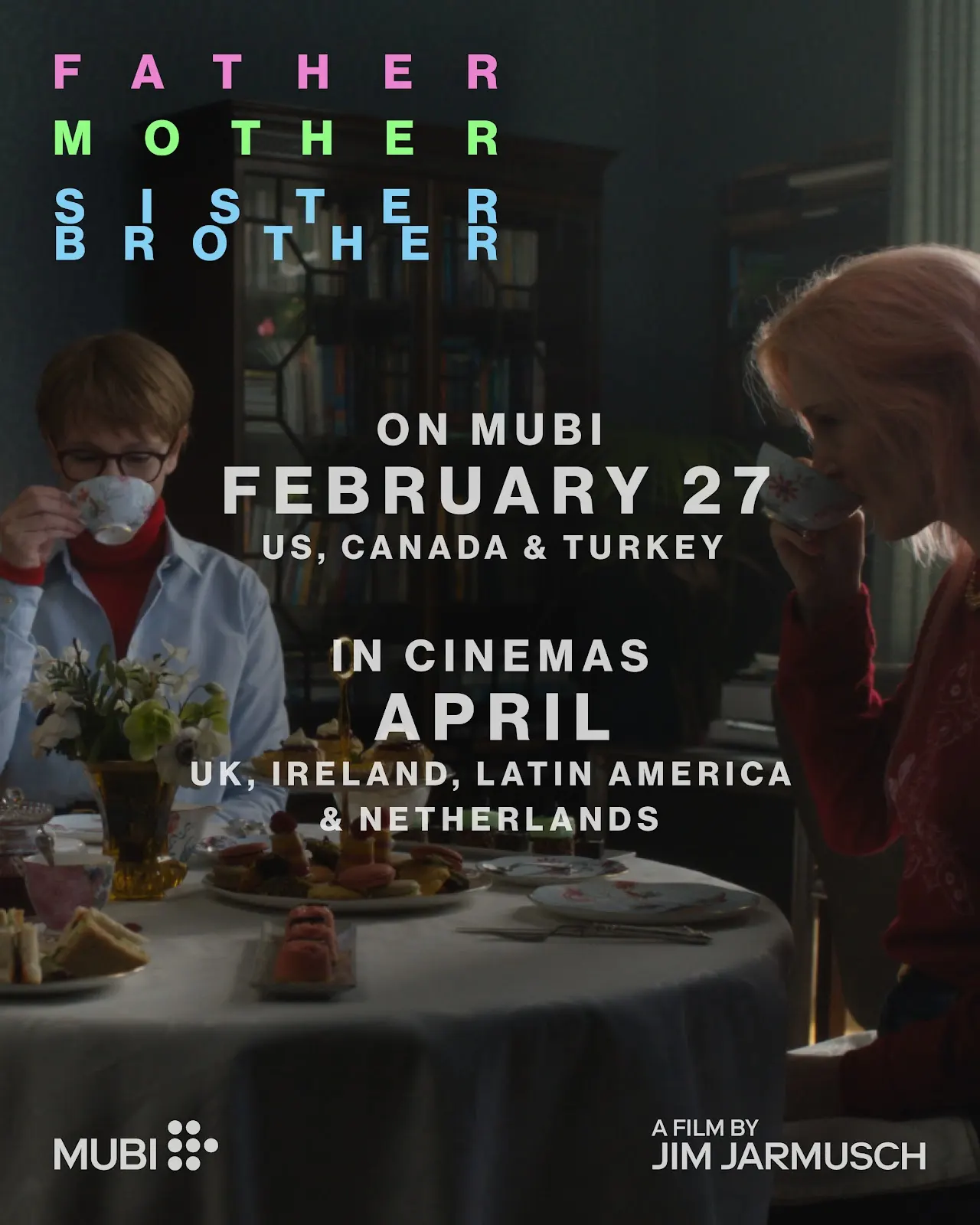
I caught up with Father Mother Sister Brother at Lincoln Center. The showing was preceded by Mr. Jarmusch's delightful, albeit brief, introduction.
He mentioned that they strived to build the episodes in such a way as to create a cumulative effect toward the film's end. He also joked that he's been to the Walter Reade Theater so many times, but never figured out who Mr. Reade actually was. It was an absolute delight to experience him in person.
My impression of the film after this first viewing is rather mixed. I enjoyed parts of it (especially the opening story), the interplay between Bialik and Driver characters, and Tom Waits and Charlotte Rampling's nuanced performances, but as the film progressed, the stories resonated less and less with me. It seemed to be exactly the opposite of what the director intended. In the end, of all the Jarmusch films, this felt the thinnest. Still, I am looking forward to revisiting this film in the future and hope it will click for me eventually. It could be the same case as with The Dead Don't Die, which I appreciated and enjoyed much more on my second viewing.
Here is a photo of Mr. Jarmusch from the event, and my doodle of him.


He mentioned that they strived to build the episodes in such a way as to create a cumulative effect toward the film's end. He also joked that he's been to the Walter Reade Theater so many times, but never figured out who Mr. Reade actually was. It was an absolute delight to experience him in person.
My impression of the film after this first viewing is rather mixed. I enjoyed parts of it (especially the opening story), the interplay between Bialik and Driver characters, and Tom Waits and Charlotte Rampling's nuanced performances, but as the film progressed, the stories resonated less and less with me. It seemed to be exactly the opposite of what the director intended. In the end, of all the Jarmusch films, this felt the thinnest. Still, I am looking forward to revisiting this film in the future and hope it will click for me eventually. It could be the same case as with The Dead Don't Die, which I appreciated and enjoyed much more on my second viewing.
Here is a photo of Mr. Jarmusch from the event, and my doodle of him.
-
hearthesilence
- Joined: Fri Mar 04, 2005 8:22 am
- Location: NYC
Re: Jim Jarmusch
It seems to be doing on par with his recent features once you take inflation into account (in mid-2010's U.S. dollars, about $7 million in overall grosses with about $1 million coming from the U.S. - it's currently over $7 million with those April openings still on the horizon). I imagine this means he'll likely get to make another film for about the same budget, etc.
-
cantinflas
- Joined: Sat Dec 08, 2007 5:48 am
- Location: sydney
Re: Jim Jarmusch
Glad to hear. Waiting until April is hard.
-
hearthesilence
- Joined: Fri Mar 04, 2005 8:22 am
- Location: NYC
-
beamish14
- Joined: Fri May 18, 2018 7:07 pm
Re: Father Mother Sister Brother (Jim Jarmusch, 2025)
That timeline with Cassavetes’ script seems a bit off, unless she truly was showing signs of Alzheimer’s during the 90’s. She worked quite a bit that decade and into the next
-
cantinflas
- Joined: Sat Dec 08, 2007 5:48 am
- Location: sydney
Re: Father Mother Sister Brother (Jim Jarmusch, 2025)
Apparently the producer said his new film is a road movie that will pass through four French cities.
Guess it'll be too soon for Venice this year so will be a long wait until next year.
-
hearthesilence
- Joined: Fri Mar 04, 2005 8:22 am
- Location: NYC
Re: Father Mother Sister Brother (Jim Jarmusch, 2025)
That’s the frustrating part about indie films of this scale. They are low budget, but not microbudget, meaning they still need millions of dollars to make, so there is a sizable amount of money that needs to be recouped, which means you can’t just put it out, you need to have this slow post-creation process of putting it through the marketplace (ideally through a high-profile festival) and finding a buyer/distributor who then has to plan out a marketing campaign and a release schedule that will recoup THEIR costs. It ends up burning through a whole year or two after the film is pretty much done.