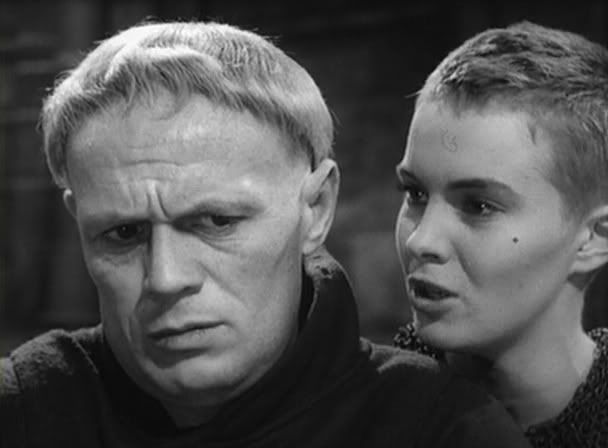
First off I was surprised of the quality of the VHS-- I had seen some other screen grabs of the film which must have been severely generational, for they looked terribly duped and soaked thru & thru with analog halos. This VHS transfer reveals a satisfactory amount of detail, albeit via a composite of different materials of a variety of gauges: 35, 17.5, and 9.5mm (for the ancient home video market, where families with 9.5 mm projectors could watch a condensed version of the film entitled "Joan The Maid"). Even the 9.5mm material looks decent-- some of the best looking 9.5 I've seen, far better than Weine's Raskolnikow, Oswalds Cagliostro, Epstein's Lion des Mogols, etc.
A cursory look reveals a vibrant and affecting film-- so far everything that I've seen is excellent. If there's a single negative one can lodge against Dreyer's masterpiece (was for quite a time my #1 favorite film) is that it overshadowed and relegated this film to the sidelines. Naturalistically acted, wonderfully photographed, rendered with an ethereal, haunting quality punctuated by a lilting and moody orchestral score which fits the images like a glove, the film's obscurity is officially and heretofore baffling. Moreso considering the subject matter-- is it possible for there to be too many silent masterpieces from France about Joan of Arc? It's a sin thatCecil B. DeMille's Joan The Woman still occupies it's spot on the melodramatic mantle of silent historical dramas, yet this most sincere, and sprawling, and impressive, and affecting, and moody piece needs to be tweezed out from the must and the dust of the floorboard cracks.
As the intertitles are entirely original French, and I haven't run through the narrative in one consecutive sitting yet (I've only consumed it in intermittent pieces since getting it day before yest.) I don't want to go any deeper than very general assessments of the overall look and feel of the work in sum.
Some interesting tidbits about the film's history, published on the event of the death of Simone Genevois, Jeanne D'Arc in this film, from the UK Independent:
Some screen caps-- I don't feel it neccessary to worry about spoilers since we all know Joan was put on trial and burned at the stake... enjoy these magnificently ethereal images!Simone Genevois, actress: born Paris 13 February 1912; married 1931 Jacques Pathe (marriage dissolved), secondly Andre Conti (one son); died Ascona, Switzerland 16 December 1995.In 1927, a film about Joan of Arc went into production in France which, under the direction of Carl Dreyer, was financed by the same company that had made Napoleon. They hoped for a similar epic about France's national heroine. Dreyer spent their money on huge sets which he never showed; he produced an avant-garde film largely photographed in bold close-ups. It was not a commercial success, but its critical reputation, increasing over the years, obliterated another film on Joan of Arc, made at roughly the same time, La Merveilleuse vie de Jeanne d'Arc, directed by Marco de Gastyne.
Dreyer's actress, Falconetti, gave a mesmerizing performance of sanctity and suffering, but could that same woman have led the forces of France against the English? Simone Genevois, in the film by de Gastyne, had just that heroic quality, and her performance was one of the wonders of the silent cinema.
Alas, the film was lost for many years, and when it was restored it was shown only once in England at the National Film Theatre (in a season organised by John Gillett). Those who saw it were astonished by the scale of the production, particularly the battle scenes, where Simone Genevois led 8,000 extras from the French army against the ramparts of Carcassonne (standing in with Aigues-Mortes for Orleans).
"In the beginning," said Genevois, "I was 15 years old and they made me a very light suit of armour, but I ended up with real armour. At the Battle of Orleans I had to wear a 22-kilo suit of chain mail. As soon as I finished a scene, they would lay me down and I would sleep on the ground because I couldn't take the weight."
The trial scenes were filmed almost as starkly as the Dreyer film (which neither Genevois nor her director had yet seen) in the medieval Abbey of Mont St Michel. The execution, the only scene to be shot at the Joinville studio, was equally realistic - perhaps too much so.
"The moment the wood caught fire I yelled 'It burns!' Marco was so sure that I was afraid that he did nothing at all. All of a sudden the cameraman, Gaston Brun, shouted 'She's burning!' and everyone ran towards me, because I was tied up and couldn't budge. I was very frightened."
(...)
By the time she was cast as one of Bonaparte's sisters in Abel Gance's Napoleon - in 1925 - Simone Genevois was a veteran with eight years' acting behind her. To her regret, however, a scene in which she wept at the feet of Salicetti (Philippe Heriat) was cut by Gance from the final film. However, it was Heriat (a Goncourt prize- winning novelist as well as actor) who secured for her the role she will be remembered by.
She did not correspond to the requirements demanded in the national casting compeititon for Joan of Arc: "I did not have a sturdy peasant build, nor dark hair - I was as blonde as a wheatfield - nor did I know how to ride a horse." But Heriat told de Gastyne of this girl who had worked in the business for years yet was the right age. It took nearly two years to make the film, so vast was the scale, and it was rewarded - like Napoleon - with a premiere at the Opera. But by the time the film was released, in 1929, sound was the rage and, like so many great films of the late silent era, it was overwhelmed by all the exciting new talkies.
Simone made a few sound films - including a couple for de Gastyne - but they failed to make an impression and she left the movies after Quand les feuilles tombent in 1935. She had worked 18 years in the film business. She was still only 23.
La Merveilleuse vie de Jeanne d'Arc was reissued in the 1930s on 17.5mm, a gauge which quickly became obsolete. Owners of 9.5mm home movie projectors could see some of the spectacular scenes in a two-reel condensation called St Joan - the Maid. It was not until 1982 when Simone Genevois and her husband Andre Conti personally underwrote the restoration of the 35mm version - achieved by Renee Lichtig, doyenne of film restorers - that audiences could see the film in its entirety.
Ironically, Genevois first met Conti at the premiere of her version of Joan of Arc. He turned out to have been an investor in the Dreyer version.

Joan, at home in the country with the flock, pre-warrior days:

Listening to woeful tales from wounded & beaten soldiers about the destruction of France at the hands of the English:


9.5mm shot:

Joan's first visions:

A heavenly visitation & calling:


Misc scenes:


Joan, captured, places her hand on the bible before the tribunal:


Forcing her to sign the confession:

Joan condemned:


Joan's robe catching fire:


The End...