
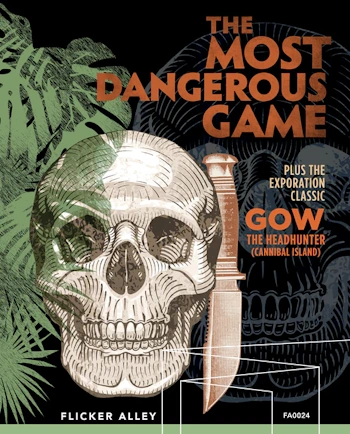


The Most Dangerous Game is a superb, pre-Code action-adventure film. Based upon a famous short story by Richard Connell, it follows big game hunter, Bob Rainsford, (Joel McCrea), as he becomes quarry for another, the opulently deranged Count Zaroff, (floridly played by Leslie Banks). Utilizing some of the amazing sets made for King Kong, the film is sometimes thought of as a place-holder to keep key cast and crew available during Kong's lengthy animation schedule. This included actors Fay Wray, Robert Armstrong, Noble Johnson and Steve Clemento, as well as editor Archie Marshek, composer Max Steiner, sound effects expert Murray Spivak, illustrators Mario Larrinaga and Byron Crabbe, and optical effects wizards Vernon Walker and Linwood Dunn.
Gow is not only a true curiosity but also in many ways a key influence of later Cooper and Schoedsack productions including King Kong. The footage in Gow was produced by Edward A. Salisbury, a wealthy British adventurer, who in 1920 set sail in an 80-ton yacht equipped with a motion picture laboratory to, in his words, catch and hold for history a photo record of the fast–disappearing races of the South Seas Islands”. Cooper and Schoedsack were among the cameramen on this two-year expedition that documented genuine head-hunters and cannibals along its route. The material was originally released as four separate films in the silent era and was consolidated as the film Gow, The Headhunter for an illustrated lecture by expedition member William Peck. Peck recorded his own cringe-inducing commentary in 1931.
Details by Film
The Most Dangerous Game
Streaming Options
































Gow the Head Hunter
Streaming Options
Release Information:
Technical Specifications
Supplements
- Audio Commentary for The Most Dangerous Game by Rick Jewell
- Audio Commentary for Gow the Head Hunter by Matthew Spriggs
- Excerpts from a 1971 audio interview with Merian C. Cooper conducted by film historian Kevin Brownlow
- A booklet containing notes on each film - by Merian C. Cooper as quoted in David O. Selznick's Hollywood by Ronald Haver and by Emerson College professor, Eric Schaefer