

Buy Physical Copy At:


Licensor Information
Atlantic-Film
Directed by: Fritz Lang
Featuring: Rudolf Klein-Rogge, Otto Wernicke, Oskar Beregi, Sr., Gustav Diessl, Wera Liessem, Karl Meixner
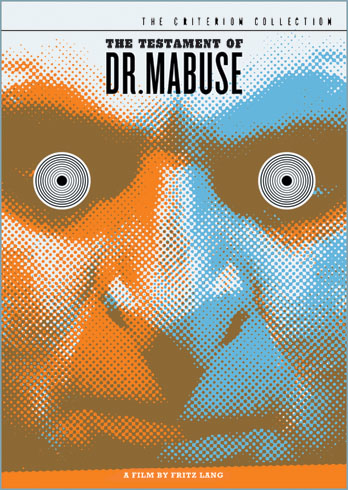
Locked away in an asylum for a decade and teetering between life and death, the criminal mastermind Doctor Mabuse (Rudolf Klein-Rogge) has scribbled his last will and testament: a manifesto establishing a future empire of crime. When the document’s nefarious writings start leading to terrifying parallels in reality, it’s up to Berlin’s star detective, Inspector Lohmann (Otto Wernicke, reprising his role from M) to connect the most fragmented, maddening clues in a case unlike any other. A sequel to his enormously successful silent film Dr. Mabuse: The Gambler, Fritz Lang’s The Testament of Dr. Mabuse reunites the director with the character that had effectively launched his career. Lang put slogans and ideas expounded by the Nazis into the mouth of a madman, warning his audience of an imminent menace, which was soon to become a reality. Nazi Minister of Information Joseph Goebbels saw the film as an instruction manual for terrorist action against the government and banned it for “endangering public order and security.” A landmark of mystery and suspense for countless espionage and noir thrillers to come, this is the complete, uncut original director’s version in a stunning new transfer.
Streaming Options
3032.
-10



Release Information:
Technical Specifications
Format:
DVD
Discs:
DVD-9 (2 Discs)
Total: 2 Discs
Regions:
1/2/3/4/5/6 (DVD)
Aspect Ratio:
1.19:1
Audio Options:
German Dolby Digital Mono 1.0
Resolution:
480p/29.97
Subtitles:
English
Supplements
Types of Supplements Included: Audio Commentary, Feature Film, Documentary Excerpt, Documentary, Video Essay, Interview, Gallery, Insert
- Audio commentary by David Kalat, author of The Strange Case of Dr. Mabuse
- Complete French-language version of the film, Le testament du Dr. Mabuse, filmed simultaneously by Lang with French actors
- Excerpts from For Example Fritz Lang (Zum Beispiel: Fritz Lang), 1964 interview with Fritz Lang, directed by famed German documentarian Erwin Leiser (Mein Kampf)
- Mabuse in Mind (Mabuse Im Gedächtnis), 1984 film by Thomas Honickel featuring an interview with actor Rudolf Schündler (Hardy in The Testament of Dr. Mabuse)
- Comparison between the 1933 German version, the French version, and The Crimes of Dr. Mabuse, the edited and dubbed American version of the film
- Interview with German Mabuse expert MIchael Farin about the literary inventor of the series, Norbert Jacques
- Rare production design drawings by art director Emil Hasler (M, The Blue Angel)
- Collection of memorabilia, press books, stills, and posters
- Liner notes by Tom Gunning, author of The Films of Fritz Lang: Allegories of Vision and Modernity
Forum Member Statistics
Sign-in with your forum account to rate this release
Film
Picture
Audio
Supplements
Artwork
Release Credits
Producer: Susan Arosteguy
Release Notes on Restoration
The Testament of Dr. Mabuse
The Testament of Dr. Mabuse premiered on April 21, 1933, in Budapest, Hungary. Originally 124-minutes long, the film was banned in Germany. It wasn’t until August 24, 1961, that the movie was first shown in Germany, in a shortened, 111- minute version. The original negative survived at the German Film Institute but was severely damaged. Therefore, a 1951 intermediate positive from the film institute’s collection served as a template for the restoration. Whenever possible, missing scenes available from the Federal Film Archive and the Munich Film Museum were inserted.
In its present form, the film runs 121 minutes. The film was restored under the direction of Martin Koerber and by the German Film Institute in collaboration with the Federal Film Archive, the Munich Film Museum, KirchMedia, and ZDF/ARTE.
The Testament of Dr. Mabuse is presented in its original aspect ratio of 1.19:1, a European process that is much narrower than the 4:3 monitor. The black bars along the side of the screen, called “pillarboxing,” are normal for this format, and will be even more pronounced on Widescreen televisions. The narrowness of this format is due to the variable density soundtrack, which was positioned to the left of the picture area. Various prints made in later years were zoomed in to fill out the frame. This new high-definition digital transfer was created on a Spirit Datacine from the restored 35mm duplicate negative. Thousands of instances of dirt, debris, and scratches were removed using the MTI Digital Restoration System. The soundtrack was mastered at 24-bit from the new digital restoration master, and audio restoration tools were used to reduce clicks, pops, hiss, and crackle. The Dolby Digital 1.0 signal will be directed to the center channel on 5.1-channel sound systems, but some viewers may prefer to switch to two-channel playback for a wider dispersal of the mono sound.
In its present form, the film runs 121 minutes. The film was restored under the direction of Martin Koerber and by the German Film Institute in collaboration with the Federal Film Archive, the Munich Film Museum, KirchMedia, and ZDF/ARTE.
The Testament of Dr. Mabuse is presented in its original aspect ratio of 1.19:1, a European process that is much narrower than the 4:3 monitor. The black bars along the side of the screen, called “pillarboxing,” are normal for this format, and will be even more pronounced on Widescreen televisions. The narrowness of this format is due to the variable density soundtrack, which was positioned to the left of the picture area. Various prints made in later years were zoomed in to fill out the frame. This new high-definition digital transfer was created on a Spirit Datacine from the restored 35mm duplicate negative. Thousands of instances of dirt, debris, and scratches were removed using the MTI Digital Restoration System. The soundtrack was mastered at 24-bit from the new digital restoration master, and audio restoration tools were used to reduce clicks, pops, hiss, and crackle. The Dolby Digital 1.0 signal will be directed to the center channel on 5.1-channel sound systems, but some viewers may prefer to switch to two-channel playback for a wider dispersal of the mono sound.