
The Criterion Collection
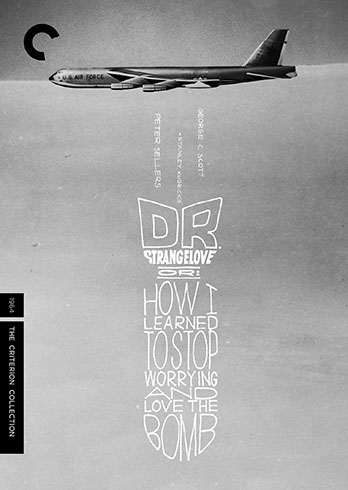
Dr. Strangelove, or: How I Learned to Stop Worrying and Love the Bomb
Edition no. 821

Buy Physical Copy At:


Licensor Information
Sony Pictures Home Entertainment
Directed by: Stanley Kubrick
Featuring: Peter Sellers, George C. Scott, Sterling Hayden, Keenan Wynn, Slim Pickens, Peter Bull, James Earl Jones, Tracy Reed
Stanley Kubrick’s painfully funny take on Cold War anxiety is without a doubt one of the fiercest satires of human folly ever to come out of Hollywood. The matchless shape-shifter Peter Sellers plays three wildly different roles: Air Force Captain Lionel Mandrake, timidly trying to stop a nuclear attack on the USSR ordered by an unbalanced general (Sterling Hayden); the ineffectual and perpetually dumbfounded President Merkin Muffley, who must deliver the very bad news to the Soviet premier; and the titular Strangelove himself, a wheelchair-bound presidential adviser with a Nazi past. Finding improbable hilarity in nearly every unimaginable scenario, Dr. Strangelove, or: How I Learned to Stop Worrying and Love the Bomb is a genuinely subversive masterpiece that officially announced Kubrick as an unparalleled stylist and pitch-black ironist.
Streaming Options
344.
+45
Stream

Rent







Release Information:
Technical Specifications
Format:
DVD
Discs:
DVD-9 (2 Discs)
Total: 2 Discs
Regions:
1 (DVD)
Aspect Ratio:
1.66:1
Audio Options:
English Dolby Digital Mono 1.0
English Dolby Digital Surround 5.1
Resolution:
480p/29.97
Supplements
Types of Supplements Included: Audio Interview, Interview, Theatrical Trailer, Booklet, Featurette, Documentary
- Excerpts from a 1965 audio interview with Stanley Kubrick, conducted by Jeremy Bernstein
- New interview with film scholar Mick Broderick
- 2000 Featurette The Art of Stanley Kubrick
- Interviews with cinematographer and camera innovator Joe Dunton and camera operator Kevin Pike
- 2000 Featurette Inside Dr. Strangelove
- New interview with David George, son of Peter George, on whose novel Red Alert the film is based
- 2006 documentary No Fighting in the Warroom
- Best Sellers, a 2006 Featurette about the career of actor Peter Sellers
- New interview with Kubrick scholar Rodney Hill
- Interviews from 1963 with Peter Sellers and actor George C. Scott
- Excerpt from a 1980 interview with Peter Sellers from NBC
- Trailer
- Exhibitor's trailer
- A booklet featuring an essay by scholar David Bromwich and a 1962 article by screenwriter Terry Southern on the making of the film
Forum Member Statistics
Sign-in with your forum account to rate this release
Film
Picture
Audio
Supplements
Artwork
Release Credits
Producer: Curtis Tsui
Artwork: Eric Skillman
Release Notes on Restoration
Dr. Strangelove, or: How I Learned to Stop Worrying and Love the Bomb
Dr. Strangelove, or: How I Learned to Stop Worrying and Love the Bomb is presented in its original aspect ratio of 1.66:1. On standard 4:3 televisions, the image will appear letterboxed. On standard and widescreen televisions, black bars may also be visible on the left and right to maintain the proper screen format. Because of overprinting and damage created at the time of its theatrical release, the original camera negative of Dr. Strangelove was destroyed at the laboratory fifty years ago. As a result, a combination of elements, including 35mm fine-grain master positives, duplicate negatives, and prints, were used for this digital transfer, which was created in 4K resolution on an Oxberry wet-gate film scanner at Cineric in New York in 2004. Given the condition of the many elements;the fact that they represented different manufacturing generations from the original camera negative, resulting in wide variations in density and contrast; and the need to maintain the filmmakers’ aesthetic intentions, it was determined that the only way to restore the film properly was in a full 4K digital space. Daniel DeVincent, Cineric’s director of digital restoration, created lookup tables designed to optimize the scanner for each element and achieve the dynamic range of 35mm film. Under the supervision of Grover Crisp, initial color correction was carried out by DeVincent, with additional color correction done by Scout Ostrowsky at Technicolor and Colorworks in Los Angeles. Thousands of instances of dirt, debris, splices, warps, jitter, and flicker were manually removed by Cineric using DaVinci’s Revival.
The original monaural soundtrack and the alternate 5.1 surround mix were remastered from the best surviving optical tracks at Chace Audio by Deluxe, under Crisp’s supervision. Addition restoration was undertaken by the Criterion Collection using Pro Tools and iZotope Rx4.
The original monaural soundtrack and the alternate 5.1 surround mix were remastered from the best surviving optical tracks at Chace Audio by Deluxe, under Crisp’s supervision. Addition restoration was undertaken by the Criterion Collection using Pro Tools and iZotope Rx4.