

Buy Physical Copy At:


Licensor Information
Les Films du Jeudi
Directed by: Max Ophuls
Featuring: Martine Carol, Peter Ustinov, Anton Walbrook, Will Quadflieg, Oskar Werner, Ivan Desny, Henry Guisol
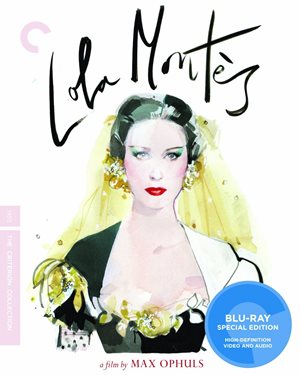
Lola Montès is a visually ravishing, narratively daring dramatization of the life of the notorious courtesan and showgirl, played by Martine Carol. With his customary cinematographic flourish and, for the first time, vibrant color, Max Ophuls charts the course of Montès’s scandalous past through the invocations of the bombastic ringmaster (Peter Ustinov) of the American circus where she has ended up performing. Ophuls’s final film, Lola Montès is at once a magnificent romantic melodrama, a meditation on the lurid fascination with celebrity, and a one-of-a-kind movie spectacle.
Streaming Options
27839.
+4



Release Information:
Technical Specifications
Format:
Blu-ray
Disc:
BD-50 (1 Disc)
Total: 1 Disc
Regions:
A (Blu-ray)
Aspect Ratio:
2.55:1
Audio Options:
French DTS-HD MA Stereo 3.0
Resolution:
1080p/24
Subtitles:
English
Supplements
Types of Supplements Included: Audio Commentary, Television Program, Documentary, Screen Tests, Theatrical Trailer, Booklet
- Audio commentary featuring Max Ophuls scholar Susan White
- “Max Ophuls ou le plaisir de tourner,” a 1965 episode of the French television program Cinéastes de notre temps, featuring interviews with many of Ophuls’s collaborators
- Max by Marcel, a new documentary by Marcel Ophuls about his father and the making of Lola Montès
- Silent footage of actress Martine Carol briefly demonstrating the various glamorous hairstyles in Lola Montès
- Theatrical rerelease trailer from Rialto Pictures
- A booklet featuring a new essay by film critic Gary Giddins
Forum Member Statistics
Sign-in with your forum account to rate this release
Film
Picture
Audio
Supplements
Artwork
Release Credits
Artwork: Eric Skillman
Producer: Johanna Schiller
Artwork: David Downton
Release Notes on Restoration
Lola Montes
Lola Montès is presented in its original CinemaScope aspect ratio of 2.55:1. Black bars at the top and bottom of the screen are normal for this format. (Later prints were made in the narrower ratio of 2.35:1, cropping the image on the left and right.)
Lola Montès premiered in Paris on December 22, 1955. A hugely anticipated, expensive production shot in three versions-French, German, and English-the film was as an instant critical, popular, and financial disaster. In vain, Max Ophuls fought to prevent the reediting of his film and its three original negatives. The French version alone would ultimately have three incarnations: (1) the original premiere version from December 1955, which ran 114 minutes and contained multilingual passages; (2) a February 1956 version, down to 110 minutes after the deletion of four sequences, with all the multilingual passages now dubbed in French; and (3) a 1957 cut that ran 91 minutes and told the story in chronological order, with voice-over commentary and shortened circus sequences.
Producer Pierre Braunberger obtained the rights to Lola Montès in 1966, for his company Les Films de la Pléiade, and proceeded to buy up all of its extant elements. In 1967 and 1968, he began to reconstruct the film from its existing 90-minute version, combing European laboratories for cuts made from the original camera negative and eventually printing up an internegative from positive separations, with advice from the film’s cinematographer, Christian Matras. Though the results were not perfect, because of the general state of film restoration at the time, Braunberger premiered his 110-minute version in France and the U.S. (at the sixth New York Film Festival) in 1969. A commercial release across the U.S. followed later that year—the first distributed U.S. version to approximate the director’s cut. But even with this loving reconstruction, Lola Montés had not recovered its original colors, format, or soundtrack, or its complete running time.
Braunberger died in 1990, but in 2006, his daughter Laurence, with aid from the Thomson Foundation for Film and Television Heritage, the Franco-American Cultural Fund, and the Cinématheque française, set out on a new Lola Montés restoration quest.
Technicolor technicians, working under the supervision of Tom Burton, digitized the incomplete original negative, a rough cut, original YCM black-and-white color separations, and a very fragile, faded, incomplete exhibition print. The film could then be digitally repaired, and restored to its 1955 premiere length, without additional wear to the original elements. Thousands of instances of scratches, tears dirt, debris, poor splicing, warps, jitter, and flicker were digitally removed, frame by frame, using a variety of restoration platforms, including MTI Correct, Digital Vision DVO Phoenix, and DaVinci’s Revival. Other severely damaged, torn, or missing frames and image reconstructions
Lola Montès premiered in Paris on December 22, 1955. A hugely anticipated, expensive production shot in three versions-French, German, and English-the film was as an instant critical, popular, and financial disaster. In vain, Max Ophuls fought to prevent the reediting of his film and its three original negatives. The French version alone would ultimately have three incarnations: (1) the original premiere version from December 1955, which ran 114 minutes and contained multilingual passages; (2) a February 1956 version, down to 110 minutes after the deletion of four sequences, with all the multilingual passages now dubbed in French; and (3) a 1957 cut that ran 91 minutes and told the story in chronological order, with voice-over commentary and shortened circus sequences.
Producer Pierre Braunberger obtained the rights to Lola Montès in 1966, for his company Les Films de la Pléiade, and proceeded to buy up all of its extant elements. In 1967 and 1968, he began to reconstruct the film from its existing 90-minute version, combing European laboratories for cuts made from the original camera negative and eventually printing up an internegative from positive separations, with advice from the film’s cinematographer, Christian Matras. Though the results were not perfect, because of the general state of film restoration at the time, Braunberger premiered his 110-minute version in France and the U.S. (at the sixth New York Film Festival) in 1969. A commercial release across the U.S. followed later that year—the first distributed U.S. version to approximate the director’s cut. But even with this loving reconstruction, Lola Montés had not recovered its original colors, format, or soundtrack, or its complete running time.
Braunberger died in 1990, but in 2006, his daughter Laurence, with aid from the Thomson Foundation for Film and Television Heritage, the Franco-American Cultural Fund, and the Cinématheque française, set out on a new Lola Montés restoration quest.
Technicolor technicians, working under the supervision of Tom Burton, digitized the incomplete original negative, a rough cut, original YCM black-and-white color separations, and a very fragile, faded, incomplete exhibition print. The film could then be digitally repaired, and restored to its 1955 premiere length, without additional wear to the original elements. Thousands of instances of scratches, tears dirt, debris, poor splicing, warps, jitter, and flicker were digitally removed, frame by frame, using a variety of restoration platforms, including MTI Correct, Digital Vision DVO Phoenix, and DaVinci’s Revival. Other severely damaged, torn, or missing frames and image reconstructions