
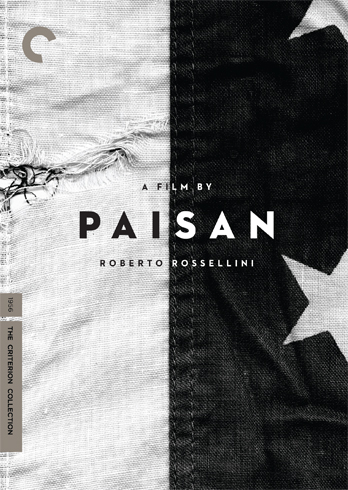

This release can only be found in the following box set: Roberto Rossellini’s War Trilogy
Buy Physical Copy At:


Licensor Information
Cinecitta
Directed by: Roberto Rossellini
Featuring: Carmela Sazio, Robert Van Loon, Dots M. Johnson, Maria Michi, Gar Moore, Harriet White, Renzo Avanzo, William Tubbs
Roberto Rossellini’s follow-up to his breakout Rome Open City was the ambitious, enormously moving Paisan (Paisa), which consists of six episodes set during the liberation of Italy at the end of World War II, and taking place across the country, from Sicily to the northern Po Valley. With its documentary-like visuals and its intermingled cast of actors and nonprofessionals, Italians and their American liberators, this look at the struggles of different cultures to communicate and of people to live their everyday lives in extreme circumstances is equal parts charming sentiment and vivid reality. A long-missing treasure of Italian cinema, Paisan is available here for the first time in its full original release version.
Streaming Options
34730.
-1



Release Information:
Technical Specifications
Format:
DVD
Disc:
DVD-9 (1 Disc)
Total: 1 Disc
Regions:
1 (DVD)
Aspect Ratio:
1.33:1
Audio Options:
Italian Dolby Digital Mono 1.0
Resolution:
480p/29.97
Subtitles:
English
Supplements
Types of Supplements Included: Introduction, Interview, Video Presentation, Video Essay
- Video introduction by Roberto Rossellini from 1963
- New video interview with Rossellini scholar Adriano Aprà
- Excerpts from rarely seen videotaped discussions Roberto Rossellini had in 1970 with faculty and students at Rice University about his craft
- Into the Future, a new visual essay about the War Trilogy by film scholar Tag Gallagher
Forum Member Statistics
Sign-in with your forum account to rate this release
Film
Picture
Audio
Supplements
Artwork
Release Credits
Producer: Johanna Schiller
Artwork: Jason Hardy
Release Notes on Restoration
Paisan
Rome Open City, Paisan, and Germany Year Zero are presented in their original aspect ratio of1.33:1. On widescreen televisions, black bars will appear on the left and right of the image to maintain the proper screen format. The pictures have been slightly windowboxed to ensure that the maximum image is visible on all monitors.
For decades, the available versions of these three films have been based on later-generation elements exhibiting both physical wear and tear and printed-in dirt and damage. These defects have often been attributed to the circumstances under which the films were made, especially Rome Open City, for which Rossellini resorted to using scavenged and mismatched film stocks. This new high-definition digital transfer of Rome Open City, created on a Spirit 2K Datacine from a 35 mm fine-grain master positive, displays remarkable detail, sharpness, and image clarity.
The disastrous condition of Paisan’s materials has rendered the film virtually unavailable for decades, while Germany Year Zero has never been seen in the United States in this original version, with German opening titles and its complete and correct original-language soundtrack. These new high-definition digital transfers of both films were created on a Spirit 2K Datacine from 35 mm fine-grain master positives.
All three films required extensive digital restoration, using MTI’s DRS system and Pixel Farm’s PFClean system, to remove, by hand, dirt, debris, stains, scratches, splices, warps, jitter, and flicker. Paisan alone required more than five hundred hours of MTI machine time for more than 265,000 individual manual fixes. Digital Vision’s DVNR system was also used for fine dirt, grain, and noise reduction.
The monaural soundtracks for all three films were mastered at 24-bit from the corresponding 35mm optical tracks. Clicks, thumps, hiss, and hum were manually removed using Pro Tools HD. Crackle was attenuated using AudioCube’s integrated audio workstation.
For decades, the available versions of these three films have been based on later-generation elements exhibiting both physical wear and tear and printed-in dirt and damage. These defects have often been attributed to the circumstances under which the films were made, especially Rome Open City, for which Rossellini resorted to using scavenged and mismatched film stocks. This new high-definition digital transfer of Rome Open City, created on a Spirit 2K Datacine from a 35 mm fine-grain master positive, displays remarkable detail, sharpness, and image clarity.
The disastrous condition of Paisan’s materials has rendered the film virtually unavailable for decades, while Germany Year Zero has never been seen in the United States in this original version, with German opening titles and its complete and correct original-language soundtrack. These new high-definition digital transfers of both films were created on a Spirit 2K Datacine from 35 mm fine-grain master positives.
All three films required extensive digital restoration, using MTI’s DRS system and Pixel Farm’s PFClean system, to remove, by hand, dirt, debris, stains, scratches, splices, warps, jitter, and flicker. Paisan alone required more than five hundred hours of MTI machine time for more than 265,000 individual manual fixes. Digital Vision’s DVNR system was also used for fine dirt, grain, and noise reduction.
The monaural soundtracks for all three films were mastered at 24-bit from the corresponding 35mm optical tracks. Clicks, thumps, hiss, and hum were manually removed using Pro Tools HD. Crackle was attenuated using AudioCube’s integrated audio workstation.