
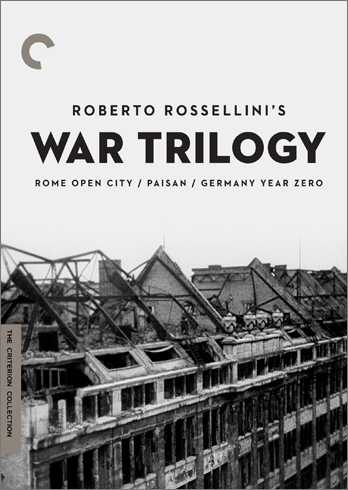



Details by Film
Rome Open City
Streaming Options









Paisan
Streaming Options
Germany Year Zero
Streaming Options
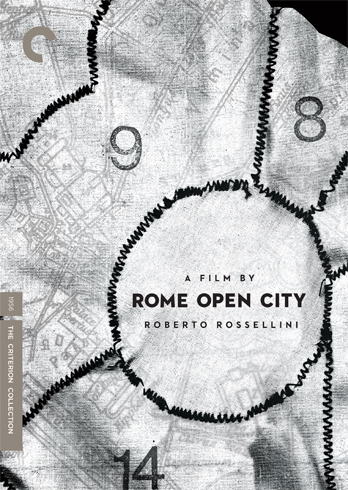
Rome Open City
This was Roberto Rossellini’s revelation, a harrowing drama about the Nazi occupation of Rome and the brave few who struggled against it. Though told with more melodramatic flair than the other films that would form this trilogy and starring some well-known actors—Aldo Fabrizi as a priest helping the partisan cause and Anna Magnani in her breakthrough role as the fiancée of a resistance member—Rome Open City (Roma città aperta) is a shockingly authentic experience, conceived and directed amid the ruin of World War II, with immediacy in every frame. Marking a watershed moment in Italian cinema, this galvanic work garnered awards around the globe and left the beginnings of a new film movement in its wake.
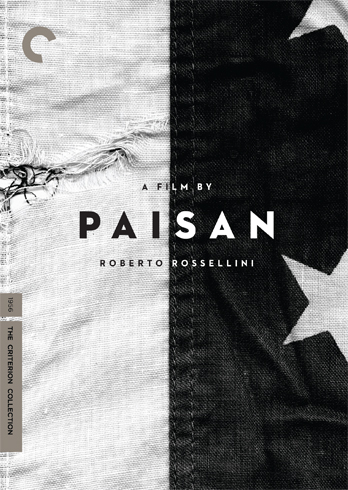
Paisan
Roberto Rossellini’s follow-up to his breakout Rome Open City was the ambitious, enormously moving Paisan (Paisa), which consists of six episodes set during the liberation of Italy at the end of World War II, and taking place across the country, from Sicily to the northern Po Valley. With its documentary-like visuals and its intermingled cast of actors and nonprofessionals, Italians and their American liberators, this look at the struggles of different cultures to communicate and of people to live their everyday lives in extreme circumstances is equal parts charming sentiment and vivid reality. A long-missing treasure of Italian cinema, Paisan is available here for the first time in its full original release version.
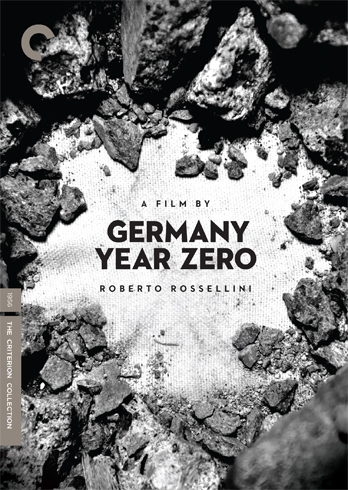
Germany Year Zero
The concluding chapter of Roberto Rossellini’s War Trilogy is the most devastating, a portrait of an obliterated Berlin, seen through the eyes of a twelve-year-old boy. Living in a bombed-out apartment building with his sick father and two older siblings, young Edmund is mostly left to wander unsupervised, getting ensnared in the black-market schemes of a group of teenagers and coming under the nefarious influence of a Nazi-sympathizing ex-teacher. Germany Year Zero (Deutschland im Jahre Null) is a daring, gut-wrenching look at the consequences of fascism, for society and the individual.
Release Information:
Technical Specifications
Supplements
- Video introduction by Roberto Rossellini from 1963
- Video introduction by Roberto Rossellini from 1963
- Video introduction by Roberto Rossellini from 1963
- Audio commentary featuring film scholar Peter Bondanella
- New video interview with Rossellini scholar Adriano Aprà
- The Italian release opening credits and voice-over prologue
- Once Upon a Time . . . “Rome Open City,” a 2006 documentary on the making of this historic film, featuring rare archival material and footage of Anna Magnani, Federico Fellini, Ingrid Bergman, and many others
- Excerpts from rarely seen videotaped discussions Roberto Rossellini had in 1970 with faculty and students at Rice University about his craft
- Roberto Rossellini, a 2001 documentary by Carlos Lizzani, assistant director on Germany Year Zero, tracing Rossellini’s career through archival footage and interviews with family members and collaborators, with tributes by filmmakers François Truffaut and Martin Scorsese
- New video interviews with Rossellini scholar Adriano Aprà
- Into the Future, a new visual essay about the War Trilogy by film scholar Tag Gallagher
- Letters from the Front: Carlos Lizzani on “Germany Year Zero,” a podium discussion with Lizzani from the 1987 Tutto Rossellini conference
- Rossellini and the City, a new visual essay by film scholar Mark Shiel (Italian Neorealism: Rebuilding the Cinematic City) on Rossellini’s use of the urban landscape in the war trilogy
- New video interview with Rossellini scholar Adriano Aprà
- New video interview with film critic and Rossellini friend Father Virgilio Fantuzzi, who discusses the filmmaker and the role of religion in Rome Open City
- Italian directors Paolo Taviani and Vittorio Taviani (Padre padrone) discussing the profound influence Rossellini’s films have had on them
- Roberto and Roswitha, a new illustrated essay by film scholar Thomas Meder on Rossellini’s relationship with his mistress Roswitha Schmidt
- A booklet featuring essays by James Quandt, Irene Bignardi, Colin MacCabe, and Jonathan Rosenbaum
Forum Member Statistics
Release Notes on Restoration
For decades, the available versions of these three films have been based on later-generation elements exhibiting both physical wear and tear and printed-in dirt and damage. These defects have often been attributed to the circumstances under which the films were made, especially Rome Open City, for which Rossellini resorted to using scavenged and mismatched film stocks. This new high-definition digital transfer of Rome Open City, created on a Spirit 2K Datacine from a 35 mm fine-grain master positive, displays remarkable detail, sharpness, and image clarity.
The disastrous condition of Paisan’s materials has rendered the film virtually unavailable for decades, while Germany Year Zero has never been seen in the United States in this original version, with German opening titles and its complete and correct original-language soundtrack. These new high-definition digital transfers of both films were created on a Spirit 2K Datacine from 35 mm fine-grain master positives.
All three films required extensive digital restoration, using MTI’s DRS system and Pixel Farm’s PFClean system, to remove, by hand, dirt, debris, stains, scratches, splices, warps, jitter, and flicker. Paisan alone required more than five hundred hours of MTI machine time for more than 265,000 individual manual fixes. Digital Vision’s DVNR system was also used for fine dirt, grain, and noise reduction.
The monaural soundtracks for all three films were mastered at 24-bit from the corresponding 35mm optical tracks. Clicks, thumps, hiss, and hum were manually removed using Pro Tools HD. Crackle was attenuated using AudioCube’s integrated audio workstation.
For decades, the available versions of these three films have been based on later-generation elements exhibiting both physical wear and tear and printed-in dirt and damage. These defects have often been attributed to the circumstances under which the films were made, especially Rome Open City, for which Rossellini resorted to using scavenged and mismatched film stocks. This new high-definition digital transfer of Rome Open City, created on a Spirit 2K Datacine from a 35 mm fine-grain master positive, displays remarkable detail, sharpness, and image clarity.
The disastrous condition of Paisan’s materials has rendered the film virtually unavailable for decades, while Germany Year Zero has never been seen in the United States in this original version, with German opening titles and its complete and correct original-language soundtrack. These new high-definition digital transfers of both films were created on a Spirit 2K Datacine from 35 mm fine-grain master positives.
All three films required extensive digital restoration, using MTI’s DRS system and Pixel Farm’s PFClean system, to remove, by hand, dirt, debris, stains, scratches, splices, warps, jitter, and flicker. Paisan alone required more than five hundred hours of MTI machine time for more than 265,000 individual manual fixes. Digital Vision’s DVNR system was also used for fine dirt, grain, and noise reduction.
The monaural soundtracks for all three films were mastered at 24-bit from the corresponding 35mm optical tracks. Clicks, thumps, hiss, and hum were manually removed using Pro Tools HD. Crackle was attenuated using AudioCube’s integrated audio workstation.
For decades, the available versions of these three films have been based on later-generation elements exhibiting both physical wear and tear and printed-in dirt and damage. These defects have often been attributed to the circumstances under which the films were made, especially Rome Open City, for which Rossellini resorted to using scavenged and mismatched film stocks. This new high-definition digital transfer of Rome Open City, created on a Spirit 2K Datacine from a 35 mm fine-grain master positive, displays remarkable detail, sharpness, and image clarity.
The disastrous condition of Paisan’s materials has rendered the film virtually unavailable for decades, while Germany Year Zero has never been seen in the United States in this original version, with German opening titles and its complete and correct original-language soundtrack. These new high-definition digital transfers of both films were created on a Spirit 2K Datacine from 35 mm fine-grain master positives.
All three films required extensive digital restoration, using MTI’s DRS system and Pixel Farm’s PFClean system, to remove, by hand, dirt, debris, stains, scratches, splices, warps, jitter, and flicker. Paisan alone required more than five hundred hours of MTI machine time for more than 265,000 individual manual fixes. Digital Vision’s DVNR system was also used for fine dirt, grain, and noise reduction.
The monaural soundtracks for all three films were mastered at 24-bit from the corresponding 35mm optical tracks. Clicks, thumps, hiss, and hum were manually removed using Pro Tools HD. Crackle was attenuated using AudioCube’s integrated audio workstation.