
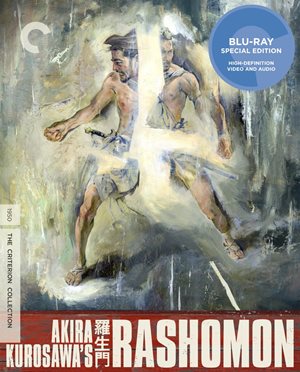

Buy Physical Copy At:


Licensor Information
Kadokawa Herald Pictures
Directed by: Akira Kurosawa
Featuring: Toshiro Mifune, Machiko Kyo, Masayuki Mori, Takashi Shimura, Minoru Chiaki, Kichijiro Ueda, Fumiko Honma, Daisuke Kato
A riveting psychological thriller that investigates the nature of truth and the meaning of justice, Rashomon is widely considered one of the greatest films ever made. Four people give different accounts of a man’s murder and the rape of his wife, which director Akira Kurosawa presents with striking imagery and an ingenious use of flashbacks. This eloquent masterwork and international sensation revolutionized film language and introduced Japanese cinema—and a commanding new star by the name of Toshiro Mifune—to the Western world.
Streaming Options
3331.
+2


Rent



Buy


Free with Ads




Release Information:
Technical Specifications
Format:
Blu-ray
Disc:
BD-50 (1 Disc)
Total: 1 Disc
Regions:
A (Blu-ray)
Aspect Ratio:
1.37:1
Audio Options:
Japanese PCM Mono 1.0
Resolution:
1080p/24
Subtitles:
English
Supplements
Types of Supplements Included: Audio Commentary, Interview, Documentary Excerpt, Documentary, Audio Interview, Theatrical Trailer, Booklet
- Audio commentary by Japanese-film historian Donald Richie
- Interview with director Robert Altman about Rashomon
- Excerpts from The World of Kazuo Miyagawa, a documentary on Rashomon
- A Testimony as an Image, a sixty-eight-minute documentary featuring interviews with cast and crew
- Archival audio interview with actor Takashi Shimura
- Original and rerelease trailers
- A booklet featuring a new essay by film historian Stephen Prince; an excerpt from director Akira Kurosawa
Forum Member Statistics
Sign-in with your forum account to rate this release
Film
Picture
Audio
Supplements
Artwork
Release Credits
Producer: Kim Hendrickson
Artwork: Kent Williams
Release Notes on Restoration
Rashomon
Rashomon is presented in its original aspect ratio of 1.37:1. 0n widescreen teievisions, biack bars will appear on the left and right of the image to maintain the proper screen format.
This restoration of Rashomon was produced in 2008 by the Academy Film Archive, in association with the Kadokawa Culture Promotion Foundation and the Film Foondation. The basis for the restoration was a 35 mm black-and-white print held in the collection of the National Film Center in Tokyo. Made in 1962 from the original camera negative, the print itself was in good physical condition, but the negative from which it had been made was extremely battered due to extensive printing and handling over the years; many shots had started to shrink and warp, and there were numerous scratches and abrasions. Moreover, dust, dirt, and other artifacts from the damaged negative had been photographed into the print.
The print was scanned at 4K resolution at Lowry Digital in Burbank, California. The original scans were then converted to 2K files for extensive image processing and cleanup. Certain damage could be repaired using Lowry’s automated software, but many frames had to be cleaned by hand. The warping in some shots and the blurring of every second frame of the film were addressed with customized visual effects tools. Once the image restoration was complete, two 4K digital intermediate 35 mm negatives were produced, as well as a complete digital archive of both the raw scan and the restored image files.
The film’s audio was restored from the 1962 print and a fine-grain master positive in the Kadokawa Foundation's collection. The elements were transferred at DJ Audio in Los Angeles, and Audio Mechanics in Burbank identified the best source element for each shot, in order to create a seamless soundtrack.
This restoration of Rashomon was produced in 2008 by the Academy Film Archive, in association with the Kadokawa Culture Promotion Foundation and the Film Foondation. The basis for the restoration was a 35 mm black-and-white print held in the collection of the National Film Center in Tokyo. Made in 1962 from the original camera negative, the print itself was in good physical condition, but the negative from which it had been made was extremely battered due to extensive printing and handling over the years; many shots had started to shrink and warp, and there were numerous scratches and abrasions. Moreover, dust, dirt, and other artifacts from the damaged negative had been photographed into the print.
The print was scanned at 4K resolution at Lowry Digital in Burbank, California. The original scans were then converted to 2K files for extensive image processing and cleanup. Certain damage could be repaired using Lowry’s automated software, but many frames had to be cleaned by hand. The warping in some shots and the blurring of every second frame of the film were addressed with customized visual effects tools. Once the image restoration was complete, two 4K digital intermediate 35 mm negatives were produced, as well as a complete digital archive of both the raw scan and the restored image files.
The film’s audio was restored from the 1962 print and a fine-grain master positive in the Kadokawa Foundation's collection. The elements were transferred at DJ Audio in Los Angeles, and Audio Mechanics in Burbank identified the best source element for each shot, in order to create a seamless soundtrack.