

Buy Physical Copy At:


Marty | Patterns | No Time for Sergeants | A Wind from the South | Bang the Drum Slowly | Requiem for a Heavyweight | The Comedian | Days of Wine and Roses
Licensor Information
Sonny Fox Productions
Directed by: Delbert Mann, Fielder Cook, Alex Segal, Daniel Petrie, Ralph Nelson, John Frankenheimer
Featuring: Rod Steiger, Joanna Ross, Andy Griffith, Julie Harris, Paul Newman, Jack Palance, Mickey Rooney, Cliff Robertson, Nancy Marchand, Jack Arthur, Donald Woods, Clu Gulager, Keenan Wynn, Kim Hunter, Piper Laurie, Esther Minciotti, Joy Lafleur, George Peppard, Edmond O'Brien, Charles Bickford, Joe Mantell, Elizabeth Montgomery, Ed Wynn, Mel Tormé, Malcolm Atterbury, Augusta Ciolli, Ed Begley, Sterling Hayden, Betsy Palmer, Lee Philips
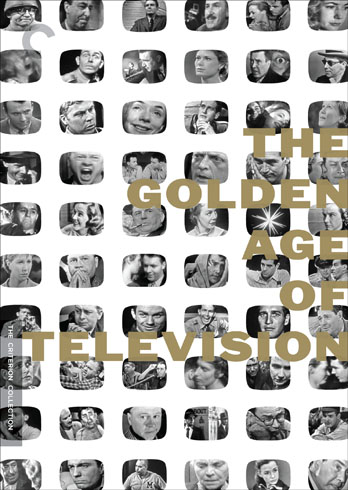
The hugely popular live American television plays of the 1950s have become the stuff of legend. Combining elements of theater, radio, and filmmaking, they were produced at a moment when TV technology was growing more mobile and art was being made accessible to a newly suburban postwar demographic. These astonishingly choreographed, brilliantly acted, and socially progressive “teleplays” constituted an artistic high for the medium, bringing Broadway-quality drama to all of America. The award-winning programs included in this box set—originally curated for PBS in the early 1980s as the series The Golden Age of Television, featuring recollections from key cast and crew members—were conceived by such up-and-comers as Rod Serling and John Frankenheimer and star the likes of Paul Newman, Mickey Rooney, Rod Steiger, Julie Harris, and Piper Laurie.
Details by Film
Marty
Year: 1953
Time: 51
Aspect Ratios
1.33:1
Audio
English Dolby Digital Mono 1.0


Patterns
Year: 1955
Time: 60
Aspect Ratios
1.33:1
Audio
English Dolby Digital Mono 1.0
Streaming Options
No streaming options currently available for this title in your region.
No Time for Sergeants
Year: 1955
Time: 60
Aspect Ratios
1.33:1
Audio
English Dolby Digital Mono 1.0
Streaming Options
No streaming options currently available for this title in your region.
A Wind from the South
Year: 1955
Time: 60
Aspect Ratios
1.33:1
Audio
English Dolby Digital Mono 1.0
Streaming Options
No streaming options currently available for this title in your region.
Bang the Drum Slowly
Year: 1956
Time: 60
Aspect Ratios
1.33:1
Audio
English Dolby Digital Mono 1.0
Streaming Options
No streaming options currently available for this title in your region.
Requiem for a Heavyweight
Year: 1956
Time: 90
Aspect Ratios
1.33:1
Audio
English Dolby Digital Mono 1.0
Streaming Options
Rent

Buy
Free


The Comedian
Year: 1957
Time: 90
Aspect Ratios
1.33:1
Audio
English Dolby Digital Mono 1.0
Streaming information not available for this title.
Days of Wine and Roses
Year: 1958
Time: 90
Aspect Ratios
1.33:1
Audio
English Dolby Digital Mono 1.0
Streaming information not available for this title.
Release Information:
Technical Specifications
Format:
DVD
Discs:
DVD-9 (3 Discs)
Total: 3 Discs
Regions:
1 (DVD)
Aspect Ratio:
1.33:1
Audio Options:
English Dolby Digital Mono 1.0
Resolution:
480p/29.97
480i/59.94
Subtitles:
English
Supplements
Types of Supplements Included: Audio Commentary, Interview, Booklet
- Audio commentaries by directors John Frankenheimer, Delbert Mann, Ralph Nelson, and Daniel Petrie
- Interviews with Paul Frankeur; actors Andy Griffith, Julie Harris, Kim Hunter, Richard Kiley, Piper Laurie, Nancy Marchand, Jack Palance, Cliff Robertson, Mickey Rooney, Rod Steiger, and Mel Tormé; and Carol Serling, Rod Serling’s widow
- A booklet featuring an essay by curator Ron Simon and his extensive liner notes on each program
Forum Member Statistics
Sign-in with your forum account to rate this release
Marty
Patterns
No Time for Sergeants
A Wind from the South
Bang the Drum Slowly
Requiem for a Heavyweight
The Comedian
Days of Wine and Roses
Picture
Audio
Supplements
Artwork
Release Credits
Producer: Susan Arosteguy
Artwork: F. Ron Miller
Release Notes on Restoration
Marty
Patterns
No Time for Sergeants
A Wind from the South
Bang the Drum Slowly
Requiem for a Heavyweight
The Comedian
Days of Wine and Roses
Although there are several video to film technologies available, the most widely used method has been kinescope process. The performances contained in this set were shot live, and the video feed, displayed on a monitor, was photographed with a film camera using positive or reversal stock. Although this may seem like a simple and straightforward process, a number of problems had to be overcome to obtain acceptable results. First, in 525/60 NTSC video systems, theme must be compensation for the difference in frame rates between the film, recording at 24 fps, and the video, at 30 fps. This was accomplished by systematically eliminating 12 video fields each second. Second, the camera's shutter had to be synchronized between the video fields to avoid the appearance of a thick black bar at the top of the frame. Third, the inherent loss of resolution in the video monitoring display had to be compensated for by the use of video image enhancement circuits, which add sharpness. Finally, the difference in gamma characteristics between the film and video system had to be reduced before it reached the kinescope. This provided a light-transfer characteristic that was appropriate to the film's gamma curve. Once the camera's film stock was exposed, it was sent to the lab for ultrafast developing and printing to facilitate quick transmission of the program to other time zones.