
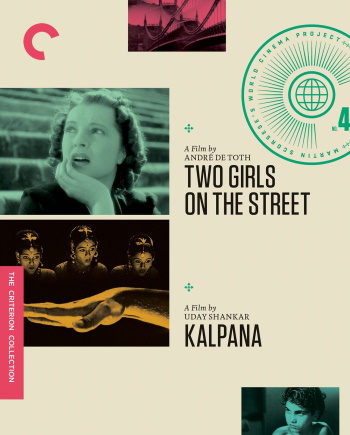



Two Girls on the Street
The maverick Hollywood stylist André de Toth sharpened his craft in his native Hungary, where he directed five films, including this chic, dynamically paced melodrama studded with deco decor and jazzy musical interludes. Mária Tasnádi Fekete and Bella Bordy sparkle as upwardly mobile working women—one a musician in an all-girl band, the other a bricklayer—who join forces as they both try to make it in Budapest, supporting each other through changing economic fortunes, the advances of lecherous men, and the highs and heartbreaks of love. Kinetic camera work, brisk editing, and avant-garde imagery abound in Two Girls on the Street, an often strikingly modern ode to the power of working-class female solidarity.
Kalpana
A riot of ecstatic imagery, performance, and set design, the only film by the visionary dancer and choreographer Uday Shankar is a revolutionary celebration of Indian dance in its myriad varieties and a utopian vision of cultural renewal. Unfolding as an epic film within a film, Kalpana tells the story of an ambitious dancer (Shankar) determined to open a cultural center devoted to breathing new life into India’s traditional artistic forms; meanwhile, the obvious adoration between him and his lead dancer (Shankar’s wife and collaborator, Amala Uday Shankar) arouses the jealousy of his enterprising companion (Lakshmi Kanta). Swirling surrealist dance spectacles—featuring dance masters and young performers, many of whom would become stars in their own right—are interwoven with anticolonial, anticapitalist commentary for a radical, proto-Bollywood milestone that is one of the most influential works in Indian cinema.
Details by Film
Two Girls on the Street
Streaming Options
Kalpana
Streaming Options
Release Information:
Technical Specifications
Supplements
- Introduction to Two Girls on the Street by World Cinema Project founder Martin Scorsese
- Interview with Two Girls on the Street director André de Toth
- Introduction to Kalpana by World Cinema Project founder Martin Scorsese
- Interview featuring Indian film historian Suresh Chabria and filmmaker Kumar Shahani (on Kalpana)